In the automotive aftermarket, most people worry about:
- production defects
- material issues
- logistics delays
But there is another silent, expensive risk that many underestimate:
One wrong vehicle application.
A single incorrect OE reference in a catalog or order list can trigger:
- returns from retailers
- inventory chaos
- mechanic complaints
- brand damage
- double handling and wasted freight
This is not just a “small mistake.”
It is a system risk.
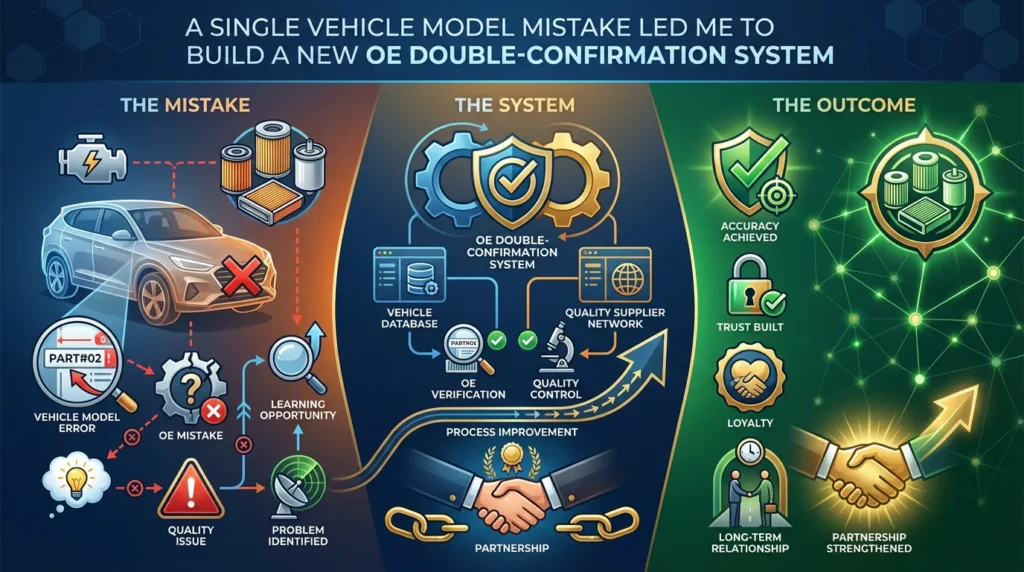
One day, a customer message made this painfully clear — and pushed me to rebuild how we handle OE and vehicle model matching.
“Bruce, This Filter Does Not Fit the Vehicle”
1.1 The Email No Supplier Wants to Receive
A customer once contacted me with a problem none of us want to hear:
“Bruce, this filter does not fit the vehicle.
We need to return the entire batch.”
The moment I saw the message, I knew what probably happened.
It was not:
- a quality issue
- a production issue
- an installation mistake
It was something simpler and more dangerous:
A vehicle model mismatch — one wrong reference in a long list of OE numbers.
1.2 The Hidden Cost of One Wrong Reference
In the automotive aftermarket, one incorrect OE mapping or model reference can create:
- ❌ Inventory chaos
- Wrong parts in stock
- Correct SKUs missing
- ❌ Returns from retailers
- Boxes sent back
- Administrative workload
- ❌ Unhappy mechanics
- Time wasted trying to fit a wrong part
- Lost confidence in the brand
- ❌ Lost sales
- Mechanics switch to another brand that “just fits”
- ❌ Negative brand perception
- “This brand is not reliable”
- “Their catalog is wrong”
- ❌ Wasted shipping cost
- Freight out
- Freight back
- Reshipment
- ❌ Double warehouse handling
- Receiving the wrong items
- Handling returns
- Re‑sorting corrected stock
All from one incorrect line in a vehicle / OE list.
The worst part?
It wasn’t even the customer’s fault.
It was a result of both sides relying on fast communication and not enough structured confirmation.
That day I decided:
👉 We must build an OE double‑confirmation process.
Speed without accuracy is a trap.
We needed a system that protects both our customer’s brand and ours.
Why Vehicle Model and OE Mis‑Mapping Is So Dangerous
2.1 Catalog and Database Errors: The Silent Profit Killer
In the aftermarket, catalogs and databases are the backbone of the business.
But they are also a major source of error:
- Multiple catalog sources (OEM, aftermarket, regional)
- OE numbers that change or supersede
- Same engine with different equipment depending on region
- Old or incomplete digital catalogs
If the catalog is wrong, everything built on top of it is fragile:
- Stock planning
- SKUs per vehicle
- Mechanic trust
- Retailer confidence
You can have:
- a perfect production line
- top‑class filter media
- excellent packaging
and still lose money and customers because:
The part doesn’t fit the intended vehicle.
2.2 The Long Tail of “Just One Mistake”
Some people think:
- “It’s just one wrong application, no big deal.”
But in reality, the impact can stretch over weeks:
- Customer ships the parts to retailers
- Mechanics try to install → discover mismatch
- Retailers complain → returns start
- Warehouse must process and re‑check everything
- Sales team deals with angry calls
- Customer questions the entire catalog, not just one item
By the time everything is resolved:
- Trust is damaged
- Cost has multiplied
- Energy that should go into growing sales is now used to fix mistakes
That is why:
In the automotive aftermarket, prevention is always cheaper than correction.
The Decision: Build an OE Double‑Confirmation System
The only way to avoid repeating this type of problem was to:
- slow down at the catalog and OE mapping stage
- build a structured confirmation workflow
- share clear responsibility with the customer
So I created a new OE double‑confirmation system.
The OE Double‑Confirmation Workflow We Implemented
4.1 Step 1 – Customer Provides OE Numbers + Vehicle List
Previously, some orders were placed simply by:
- “Send me filters for this model”
- Or by our side recommending a part without full documentation
Now, we require:
1️⃣ The customer must provide a list of OE numbers and vehicle information.
This includes:
- OE number(s)
- Vehicle make and model
- Engine type / displacement
- Year range or production period
- Any regional notes (e.g., EU version vs. Middle East version)
And we set a simple rule:
No SKU order is accepted without OE mapping and vehicle data.
This forces both sides to be precise from the beginning.
4.2 Step 2 – Cross‑Checking With Our Internal Database
Once we receive the OE and vehicle list, we:
2️⃣ Cross‑check each OE number with our internal database and cross references.
This includes alignment with well‑known references such as:
- Ahlstrom technical data
- MANN cross reference
- Hengst cross reference
- Other credible catalog sources
We also check:
- If the OE corresponds to multiple filters (e.g., different engines)
- If there are superseded OE numbers
- If there are known regional variations
This step is where technical catalog work replaces guesswork.
4.3 Step 3 – Sending a Confirmation Sheet Back
After cross‑checking, we prepare a structured confirmation sheet and send it to the customer.
The confirmation sheet includes, for each line:
- ✔ OE number
- ✔ Vehicle brand and model
- ✔ Engine type / fuel type
- ✔ Year range (e.g., 2015–2020)
- ✔ Beling part number
- ✔ Basic description (air / oil / cabin / fuel)
- ✔ Image confirmation, if needed
In some cases, we also attach:
- Product photos
- Dimensional sketches
- Comparison notes
So the customer sees clearly:
- How we matched each OE
- Which Beling part number corresponds to which vehicle
4.4 Step 4 – Customer Sign‑Off Before Mass Production
Next, we require:
4️⃣ Customer sign‑off on the confirmation sheet before mass production.
This sign‑off can be:
- Signed PDF
- Email confirmation referencing the document
- Official PO linked to that confirmation list
Only after receiving confirmation do we:
- Start mass production
- Print labels and packaging
- Generate the final packing list
This means:
- Both sides explicitly agree:
“Yes, these are the correct parts for these vehicles / OE numbers.”
4.5 Step 5 – Sales + QC Receive the Same Copy
To ensure full traceability and consistency:
5️⃣ Sales and QC both receive and keep the same confirmation copy.
- Sales uses it to check:
- that the PO matches the agreed application
- that labeling and catalog text are aligned
- QC uses it to:
- verify part numbers during pre‑shipment inspection
- double‑check that the right SKUs are packed under the correct labels
This creates an internal “safety net”:
- If someone tries to change a part or label, it will be caught against the confirmation sheet.
4.6 The Result: Mismatches Dropped to Zero
After we implemented this OE double‑confirmation system:
- Application mismatches dropped to zero across confirmed projects.
- Customers had more confidence to:
- expand their range
- develop new references with us
- trust our catalog input
We moved from:
to:
- proactive error prevention.
The Core Lesson: Prevention vs. Correction
In the automotive aftermarket:
👉 Prevention is always cheaper than correction.
One incorrect model means:
- weeks of trouble
- unnecessary logistics
- warehouse rework
- mechanic frustration
- brand damage
- trust erosion
But one clear confirmation process means:
- stable supply chain
- predictable operations
- fewer returns
- happier retailers and mechanics
- stronger brand perception
Customers often say:
- “We need fast response.”
- “We want quick catalog support.”
But what they actually want even more is:
Accuracy.
Because speed is only useful when it is right.
Why Overseas Buyers Appreciate OE Double‑Confirmation
6.1 The Daily Reality of Distributors
European, Middle Eastern, and American distributors constantly struggle with:
- Multiple OE catalogs and sources
- Regional vehicle variations (same name, different engine or filter)
- SKU confusion between different suppliers
- Database discrepancies between OEM, aftermarket, and local tools
- Returns and complaints from mechanics who receive wrong parts
Many of them:
- spend a lot of time cleaning catalog data
- handle frequent “wrong part” complaints
- lose money correcting errors that were easily avoidable
They lose far more money:
than they would:
- investing in cooperation with a supplier who double‑checks for them.
6.2 Why Top‑Tier Procurement Prefers Methodical Suppliers
This is why professional procurement managers and product managers often prefer:
- methodical, process‑driven suppliers
over:
- very fast, but disorganized suppliers
They know:
- Every returned batch damages the brand and the P&L
- One serious series of mismatches can kill confidence in an entire product line
A supplier who says:
- “Let’s double‑confirm before production”
is actually saying:
- “We care about your downstream cost and your brand’s reputation.”
That is what smart buyers value.
How Beling Filters Manages Accuracy in Application Matching
At Beling Filters, we see OE matching and vehicle application accuracy as part of our core quality, not just catalog work.
7.1 Strict OE‑Matching Process
We use a strict OE‑matching process that:
- Cross‑checks multiple sources
- Avoids assumptions when data is unclear
- Flags any questionable mappings for joint review
This process covers:
for passenger cars and light commercial vehicles.
7.2 Double‑Confirmation Workflow
We have embedded the double‑confirmation workflow into our daily operations:
- No mass production without customer sign‑off on confirmed OE / model mapping
- Confirmed documents shared internally with sales and QC
- Consistent reference for future reorders and catalog updates
This protects:
- Your warehouse
- Your retailers
- Your brand reputation
7.3 Image‑Based Verification
Where necessary or requested, we provide image‑based verification:
- Product photos from different angles
- Comparison to existing parts
- Key dimension highlights
This visual layer of confirmation gives extra confidence, especially when:
- multiple similar filters exist for close vehicle variants
- customers are transitioning from another brand
7.4 IATF 16949 Traceability
Behind this application accuracy, we rely on an IATF 16949 quality and traceability system:
- Clear part number control
- Batch traceability
- Documented change management
So if any issue ever does arise, we can:
- trace back quickly
- analyze the cause
- correct the root, not just the surface
7.5 30+ Country Market Knowledge & 95%+ Model Coverage
With experience in 30+ country markets and 95%+ global model coverage for key ranges, we understand:
- Regional vehicle differences
- Specific applications used in Europe, the Middle East, Latin America, etc.
- Common catalog pitfalls in each region
This helps us advise customers:
- when one OE mapping is risky
- when a vehicle model name hides multiple technical variants
- when extra confirmation is needed for certain markets
We don’t only check filters.
We also check the correctness of your catalog.
Beling – Save Your Time & Cost
One incorrect vehicle model mapping led to a painful return — and to a better system.
We learned:
- A single line error can damage weeks of work
- Customers don’t just need fast answers; they need accurate answers
- OE double‑confirmation is not optional for serious aftermarket business
At Beling Filters, we manufacture OE‑level Air / Cabin / Oil / Fuel filters with:
- ✔ Strict OE‑matching process
- ✔ Double‑confirmation workflow
- ✔ Image‑based verification where needed
- ✔ IATF 16949 traceability
- ✔ 30+ country market experience
- ✔ 95%+ global model coverage in our catalog ranges
If you value accuracy more than speed, and want a supplier who actively protects your brand and your supply chain:
Let’s connect and build a zero‑error program together.
📩 bruce.gong@belingparts.com
🌐 www.belingparts.com
Your valuable automotive filter partner since 2008.