
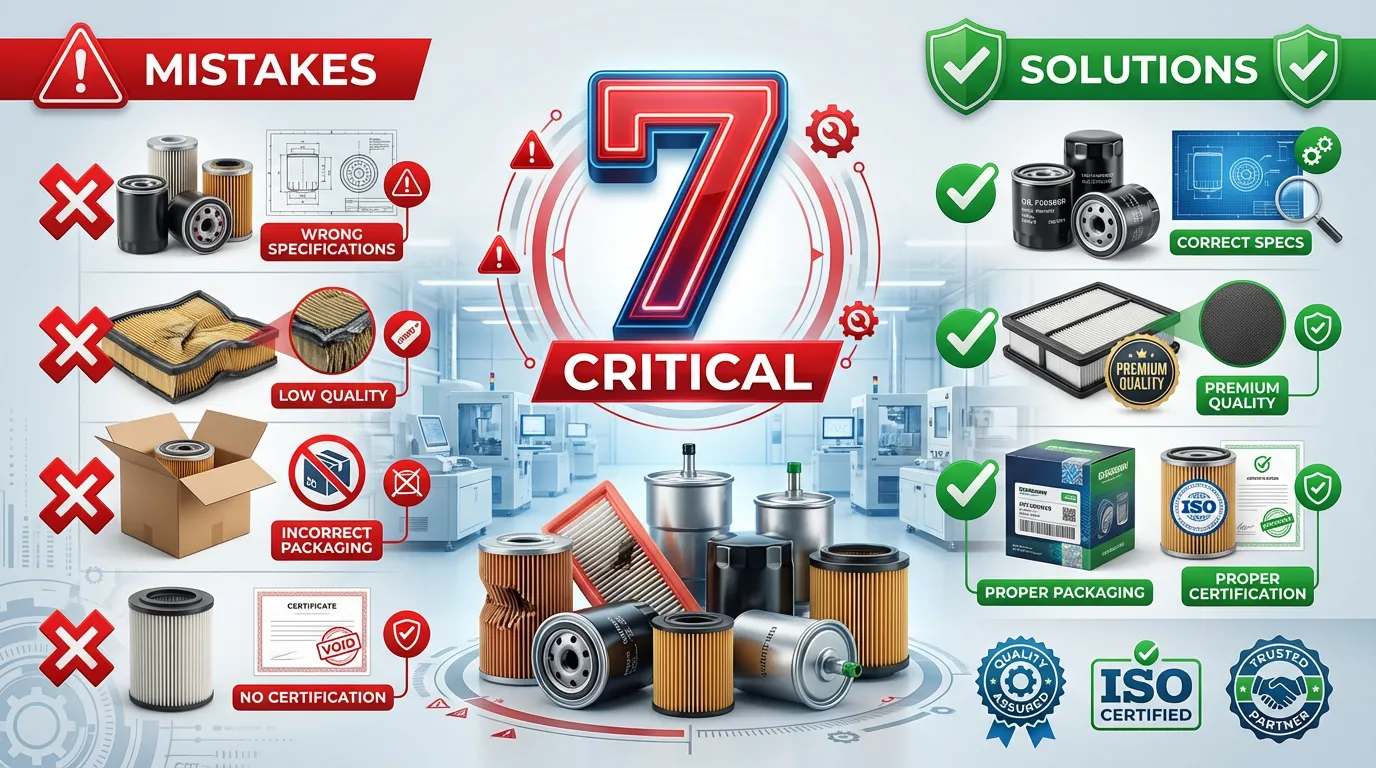
In the global aftermarket industry, automotive filters are often treated as commodity items. However, procurement teams know the truth: choosing the wrong supplier can lead to high-impact consequences—customer complaints, high return rates, and damage to your brand reputation.
Through years of working with importers across Europe, the Middle East, and Southeast Asia, we’ve seen many companies unknowingly repeat the same errors.
This guide reveals the 7 most critical mistakes when Sourcing Automotive Filters and provides risk-reducing strategies you can apply immediately.
The Risk: A lower unit price often signals downgraded materials. If a filter saves you $0.10 but fails 30% faster, the cost of returns and lost customers will far exceed the savings.
How to Avoid:
The Risk: In the filter industry, having a high SKU count makes inventory management difficult. If a supplier lacks Supplier Delivery Stability, a 2-week delay can force you into expensive emergency air freight or cause stock-outs at your distributors.
How to Avoid:
The Risk: Poor fitment is the #1 cause of mechanic complaints. An air filter with poor dimensions causes leakage; a cabin filter that doesn’t fit frustrates installers.
How to Avoid:
The Risk: Many factories claim to have quality control, but without a certified system, quality fluctuates between batches. If you cannot trace a defect back to the root cause, you cannot fix it.
How to Avoid:
The Risk: Filters are fragile. High humidity in Southeast Asia or heat in the Middle East can crush generic boxes. Damaged packaging lowers your brand’s perceived value before the customer even opens the box.
How to Avoid:
The Risk: Problems will happen. The mistake is assuming the supplier will fix them without a prior agreement. When a quality issue arises, a bad supplier disappears; a good supplier responds.
How to Avoid:
The Risk: Some suppliers attract orders with an ultra-low introductory price, only to raise prices sharply once you have switched over. This disrupts your annual budget and erodes margins.
How to Avoid:
Avoiding these seven mistakes is the key to building a profitable, headache-free filter supply chain. A reliable partner offers more than just a product; they offer consistency, brand protection, and peace of mind.
At Beling Filters, we support our partners with OE-level quality, IATF 16949 standards, and 95% global vehicle coverage.
Need a Supplier Scorecard or a Quote? If you want to evaluate your current risk or need a tailored proposal for your market, let’s connect.
Contact Bruce Gong (Key Account Manager)
Email: bruce.gong@belingparts.com
WhatsApp: +86 15057764729
LinkedIn: www.linkedin.com/in/brucegong-beling
Privacy Policy Powered by 2uncle