
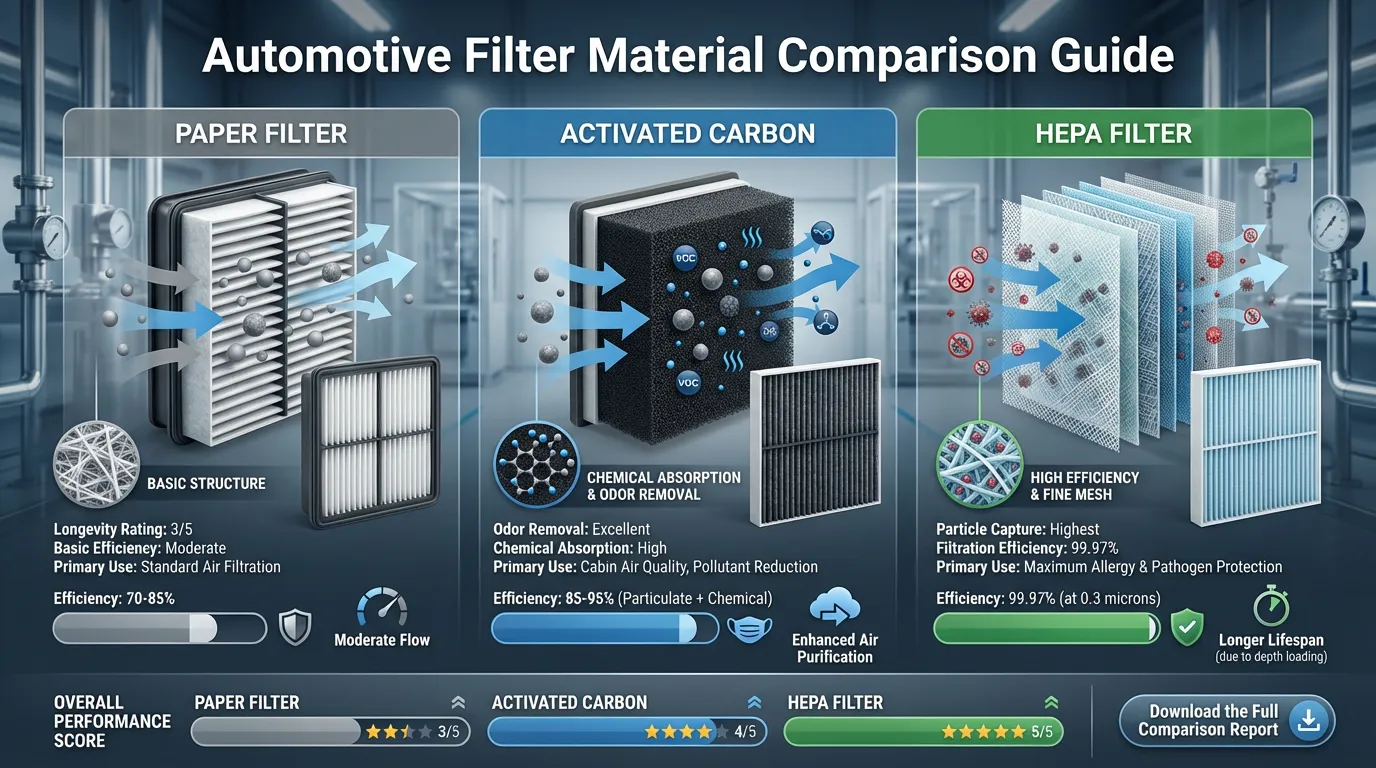
For automotive brand owners and engineers, selecting the right filter media is the most critical decision in product development. The material dictates the filtration efficiency, airflow restriction, and ultimately, the market positioning of your product.
Should you prioritize cost (Paper), odor removal (Carbon), or maximum protection (HEPA)?
This Automotive Filter Material Comparison guide breaks down the technical differences to help you choose the best solution for your private label line.
Best For: Engine Air Filters, Standard Cabin Filters, Oil Filters.
Overview: Standard air filter paper (cellulose or synthetic blend) remains the industry workhorse. It operates via mechanical filtration, creating a porous barrier that traps dust and debris physically.
Manufacturer’s Note: At Beling, we use cured cellulose paper to ensure pleat stability even in humid conditions.
Best For: Premium Cabin Air Filters (Anti-Odor / Anti-Allergen).
Overview: Activated carbon filters add a chemical adsorption layer to the physical filtration media. Using processed coconut shell or coal, this material creates a massive surface area to trap volatile organic compounds (VOCs).
Best For: Luxury Vehicles, Electric Vehicles (EVs), Medical Transport.
Overview: HEPA (High-Efficiency Particulate Air) media is composed of a dense matrix of fiberglass or fine synthetic fibers. It is designed to intercept ultrafine particles via diffusion and impaction.
| Feature | Air Filter Paper | Activated Carbon | HEPA |
| Primary Target | Dust & Dirt | Gases & Odors | Fine Particulates (PM2.5) |
| Efficiency | 98% @ 5 microns | Adsorption (Chemical) | 99.97% @ 0.3 microns |
| Cost Level | Low | Medium | High |
| Best Application | Engine Intake | City Commuting | Health/EV Focus |
There is no “perfect” material—only the right material for your target market.
Beling Filters can manufacture all three types according to your technical drawings.
Contact Our Team
Let’s discuss which material fits your budget and performance goals.
Bruce Gong (Key Account Manager)
Email: bruce.gong@belingparts.com
WhatsApp: +86 15057764729
LinkedIn: www.linkedin.com/in/brucegong-beling
Privacy Policy Powered by 2uncle