
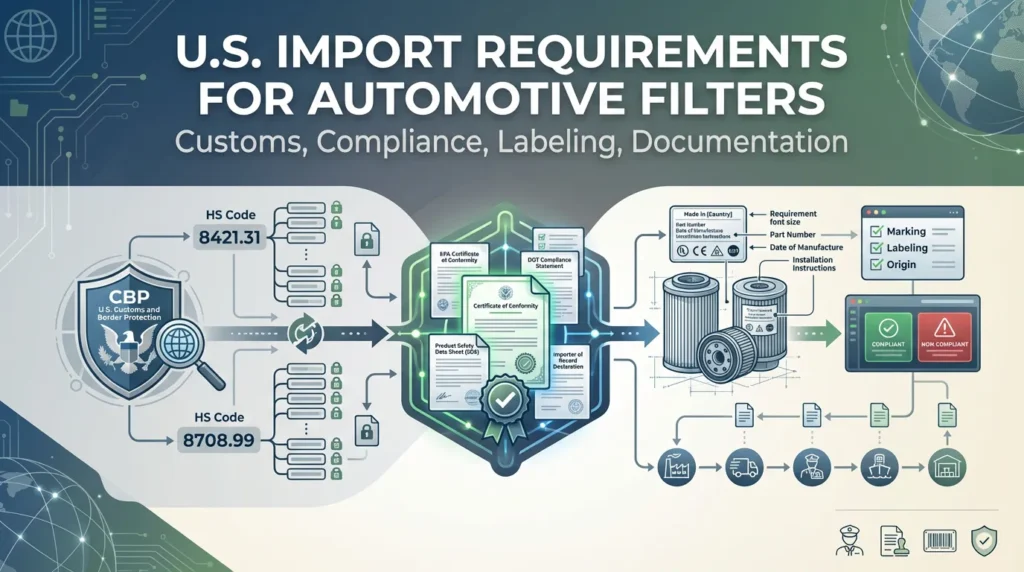
Importing Automotive Filters to the USA: A Guide to HTS Codes, Compliance & Customs

Importing Automotive Filters to the USA: A Guide to HTS Codes, Compliance & Customs

The United States is one of the largest automotive aftermarket sectors in the world, but for importers, it also represents one of the most strictly regulated customs environments.

Unlike other regions, U.S. Customs and Border Protection (CBP) is extremely detail-oriented. A single error in a Harmonized Tariff Schedule (HTS) code or a missing “Made in China” mark on a unit box can lead to shipment detentions, heavy fines, or forced re-export.

At Beling Parts, we understand that winning in the U.S. market isn’t just about product quality—it’s about supply chain security. This guide outlines the critical compliance steps we take to ensure our U.S. partners experience smooth, penalty-free importing.

  1. Mastering U.S. HTS Codes & Duty Classification

The foundation of U.S. import compliance is the Harmonized Tariff Schedule (HTS). Using a generic code is a red flag for customs auditors.

We ensure precise classification to prevent overpayment of duties or allegations of duty evasion.

  • Oil & Fuel Filters: Typically fall under HTS heading 8421.23 (Filtering or purifying machinery and apparatus for internal combustion engines: Oil or fuel filters).
  • Intake Air Filters: Typically fall under 8421.31.
  • Cabin Air Filters: Often fall under 8421.39.

The Beling Advantage: We monitor U.S. trade policy updates (including Section 301 tariff exclusions where applicable) to ensure your commercial invoices reflect the most current and accurate codes.

  1. Country of Origin (COO) Marking: The “Non-Negotiable” Rule

U.S. law (19 CFR 134) requires that every article of foreign origin be marked legibly, indelibly, and permanently with the English name of the country of origin.

Common Mistakes Suppliers Make:

  • Printing “Made in China” on the master carton but forgetting the individual unit box.
  • Hiding the origin marking in small fonts that CBP officers consider “illegible.”

Our Standard: We guarantee strict COO compliance. The phrase “Made in China” will appear clearly on:

  1. The filter housing (where technically feasible).
  2. The immediate retail box/polybag.
  3. The master shipping carton.
  4. All commercial documentation.
  1. Material Safety & California Prop 65

For U.S. distributors—especially those selling nationwide or specifically in California—regulatory safety is a major concern.

  • MSDS (Material Safety Data Sheets): We provide full material traceability for adhesives, media, and sealants used in our filters to satisfy any customs safety inquiries.
  • California Proposition 65: If your distribution network reaches California, we can support you with compliant Prop 65 warning labels on packaging to protect your business from legal liability regarding chemical exposure regulations.
  1. Warehouse-Ready Packaging & UPC Labeling

U.S. warehousing operations are highly automated. A shipment that cannot be scanned is a shipment that costs you money.

We customize packaging to fit American logistics standards:

  • UPC/Barcodes: High-contrast printing to ensure 100% scan rates at receiving docks.
  • Clear Part Numbering: Large, legible fonts for easy visual identification.
  • Interchange Numbers: We can print competitor cross-reference numbers on the box to help your customers confirm fitment.
  • Durable Cartons: We use reinforced corrugated boxes to withstand the long trans-Pacific journey and U.S. domestic trucking.
  1. Zero-Error Documentation Strategy

In the U.S., the paperwork is the product. Mismatches between the Packing List and the actual cargo count can trigger an intensive (and expensive) Customs Exam Station (CES) inspection.

Our Pre-Shipment Document Audit Includes:

  • Commercial Invoice: Verified HTS codes, correct values, and clear product descriptions.
  • Packing List: Accurate net/gross weights and cubic measurement (CBM).
  • ISF (Importer Security Filing) Data: We provide the necessary data points to your broker at least 72 hours before loading, ensuring you file your ISF 10+2 on time to avoid the standard $5,000 late filing penalty.
  1. Logistics: Visibility from Factory to Port

U.S. importers demand predictability. We act as an extension of your logistics team.

  • No Rolled Shipments: We book space early during peak seasons (like pre-CNY or pre-Christmas).
  • Loading Evidence: You receive a full photo report of the container loading process, proving that goods were stacked correctly to prevent crushing.
  • Draft Review: You approve all draft documents before the vessel departs, ensuring no amendments are needed later.

Summary: A Partner Who Protects Your Supply Chain

Importing automotive filters into the U.S. doesn’t have to be a gamble. When you work with a manufacturer who understands the specific demands of U.S. Customs and Border Protection, you reduce risk and focus on what matters: growing your market share.

Choose a supplier who values compliance as much as quality.

Ready to Upgrade Your U.S. Supply Chain?

If you need a reliable partner for high-quality automotive filters with 100% U.S. import compliance, contact the Beling Parts team today.

Contact Us: https://belingparts.com/contact/

Email: info@belingparts.com

WhatsApp: +86 150 5776 4729

More to read

10 Red Flags: Your Automotive Filter Supplier Might Be Dragging Down Your Profits

2026 Global Automotive Filter Market Trends: OEM vs Aftermarket Outlook

7 Brutal Questions to Ask Automotive Filter Suppliers Before You Trust Them

Privacy Policy Powered by  2uncle