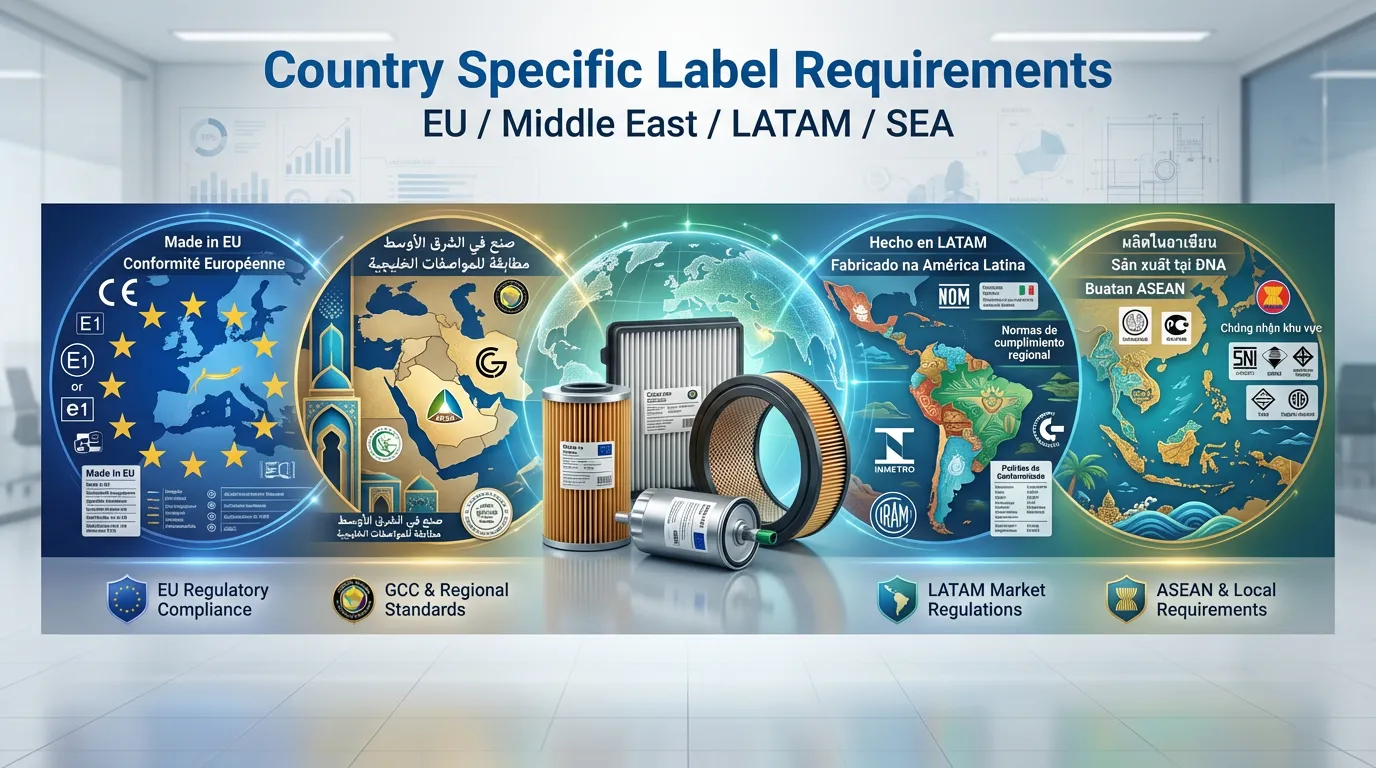
Same filter.
Same carton.
But the label rules change depending on where it goes. 🌍
Many importers only discover this after:
- Customs stops the shipment
- A distributor complains about missing information
- A retailer flags that the label doesn’t meet local requirements
By that time, it’s already:
- Costly
- Slow to fix
- Damaging for customer confidence
At Beling Filters, we try to solve this before production starts, not at the port.
This article explains how we handle country specific label requirements for automotive filters, focusing on:
- EU filter label requirements – clarity & traceability
- Middle East filter label rules – origin & language sensitivities
- LATAM filter labeling for customs and retail
- Southeast Asia filter label compliance – mixed import & local rules
- Our overall approach to compliant label design for global filter exports
-
EU Filter Label Requirements: Clarity & Traceability 🇪🇺
(What EU Distributors and Customs Expect to See)
For automotive filters in the European Union, labels are not just decoration.
They support:
- Traceability
- Consumer information
- Customs and market surveillance
In many EU markets, buyers and their customers expect:
- Clear product name and part number
- Country of origin clearly shown
- “Made in China”, “Made in …” or similar, visible and not hidden in a corner.
- Supplier or manufacturer details
- Brand owner, manufacturer, or responsible company contact details.
- Barcodes (EAN) where possible
- For warehouse scanning, retail systems, and e-commerce listings.
In addition, some EU countries are strict about:
- Multiple languages on the label
- Especially for safety notes or basic usage information.
- Safety and installation icons
- For example, icons indicating correct installation direction, recycling, or disposal instructions.
1.1 How We Support EU Filter Label Requirements
Our approach for EU customers:
- Align label language and layout with the local distributor
- We ask for their existing label examples or market preferences.
- Add EAN / barcode formats where their system needs it
- We can print or leave space for EAN/UPC, depending on who manages the code.
- Keep product and outer carton information consistent
- Product label, carton label and documents (invoice, packing list) reflect the same part number, brand and origin.
This helps:
- Reduce customs questions
- Improve warehouse and retail handling
- Support market surveillance and aftersales traceability
-
Middle East Filter Label Rules: Origin & Language Sensitivities 🌙
(Made In, Arabic Text and Carton Marks)
Many Middle East markets have particular sensitivities in labeling, especially for automotive parts like filters.
Common expectations include:
- “Made in …” must be visible 🏷️
- Country of origin on the product or carton label, not only hidden in documents.
- Arabic on label or carton in some markets
- Certain countries expect Arabic language on outer packing, especially for consumer-facing products.
- Carton marks must match documents
- Brand, product name, and origin shown on cartons should align with invoice, packing list and Certificate of Origin.
If these are not respected, you can face:
- Customs delays
- Requirements to re-label cargo at the port
- Distributors unhappy with non-compliant packaging
2.1 How We Adapt Labels for Middle East Filter Imports
Our typical process:
- Confirm with partners if Arabic text or stickers are required
- Some buyers prefer direct printing, others use local stickers.
- Check if any “country of origin” positioning is sensitive
- Some markets have preferences or sensitivities around where and how “Made in …” appears.
- Avoid putting information on the box that contradicts CO or documents
- We make sure brand, origin and company details on labels do not conflict with official documentation.
This helps importers:
- Avoid misunderstandings with customs
- Build trust with local customers
- Reduce “surprises” when containers arrive
-
LATAM Filter Labeling for Customs and Retail 🎯
(Spanish / Portuguese, Application Info and Document Matching)
In Latin America (LATAM), label requirements are often driven by:
- Customs practice
- Local language expectations
- Retail and workshop needs
Typical points we see in many LATAM markets:
- Customs checks label vs invoice carefully
- Product description, part number, and sometimes origin on labels are compared with invoice text.
- Spanish or Portuguese is often required
- For consumer-facing packaging, local language is frequently expected or required.
- End users like to see application info on the box
- Mechanics and distributors want to quickly know:
- Which model or engine this filter fits
- What type of filter it is
3.1 How We Support LATAM Filter Label Requirements
We help LATAM importers by:
- Preparing Spanish / Portuguese label templates
- We can provide base wording that buyers can adjust to their market.
- Matching label text with invoice descriptions
- So customs sees the same wording in both places, reducing questions.
- Adding model / vehicle application where customers request it
- For example: “Para Toyota Corolla 1.8L (2015–2019)” or similar, if the customer wants application printed.
This makes it easier for:
- Customs to clear the shipment
- Warehouses to identify items
- Mechanics and end users to trust the product and choose the right part
-
Southeast Asia Filter Label Compliance: Mixed Import & Local Rules 🌏
(Different Countries, Different Focus)
Southeast Asia (SEA) is very diverse.
Different countries have different label expectations for automotive filters.
In general, we see a mix of:
- Focus on origin and HS clarity
- Customs and local authorities pay attention to country of origin and correct classification.
- Local language on labels in some markets
- For example, requirements or expectations for Vietnamese, Thai, Bahasa Indonesia, etc.
- Extra safety or usage information for certain retail channels
- Especially when filters are sold in consumer retail stores or online platforms.
4.1 How We Handle Filter Label Requirements in Southeast Asia
Our practice for SEA markets:
- Ask buyers what their broker or authority requested before
- We want to learn from their past clearance experience.
- Keep flexibility for local language stickers
- We can provide a standard English label and leave space for local-language stickers to be applied by the importer if preferred.
- Standardise core elements
- Brand
- Part number
- Country of origin
- QR code or barcode (where useful)
This combination allows:
- A global base label that is always consistent
- Local adaptation via stickers or additional printing according to each country’s rule
-
Compliant Label Design for Global Filter Exports 🎫
(Our General Rule: “Label = Small, Impact = Big”)
We treat labels as part of compliance and market access, not just part of design.
A label is a small piece of paper or print – but it can:
- Trigger customs delays
- Cause re-labeling costs
- Confuse warehouses and mechanics
- Damage the end user’s trust
5.1 Our Questions Before Confirming Packing and Labels
Before we finalise packing details and print labels, we ask:
- Which market is this shipment for?
- EU, Middle East, LATAM, SEA, or elsewhere.
- Any label template or photo from your side?
- If the buyer already sells filters, we want to match or complement their existing style and requirements.
- Any language or origin sensitivity?
- For example:
- Markets that require local language
- Markets that are strict about “Made in …” position and wording
Based on the answers, we adjust:
- Product labels
- Carton marks
- Core information (brand, part number, origin, barcode/QR)
with the goal to reduce customs questions and end user confusion.
5.2 Same Filters, Different Labels, One Goal
Even when we ship the same filter model, we often use different label layouts depending on the region.
- Same internal code
- Same physical product
- Same quality control
But:
- EU label might have multiple languages and EAN barcode
- Middle East label might emphasize “Made in …” and Arabic text
- LATAM label might show Spanish description and vehicle application
- SEA label might keep English core info with space for local stickers
Different markets.
Different labels.
Same goal:
Smooth customs + clear information for the people who actually use and sell the filters.
-
Need Help With Label Expectations in Your Market?
If you’re importing filters into:
- EU
- Middle East
- LATAM
- Southeast Asia
and you’re not fully sure about local label expectations, we can:
- Review your current label designs or photos
- Compare them with what we’ve seen work well in similar markets
- Suggest a practical label layout that balances:
- Compliance
- Warehouse and retail needs
- Your branding
We can also share real label samples (with sensitive data removed) that we use for different regions, so you can see how we adapt the same filter to multiple markets.
Contact Our Team
Bruce Gong – Key Account Manager, Beling Filters
Email: bruce.gong@belingparts.com
WhatsApp: +86 150 5776 4729
LinkedIn: www.linkedin.com/in/brucegong-beling
Country specific label requirements don’t have to be a mystery.
Handled correctly, they become part of your competitive advantage in each market.