
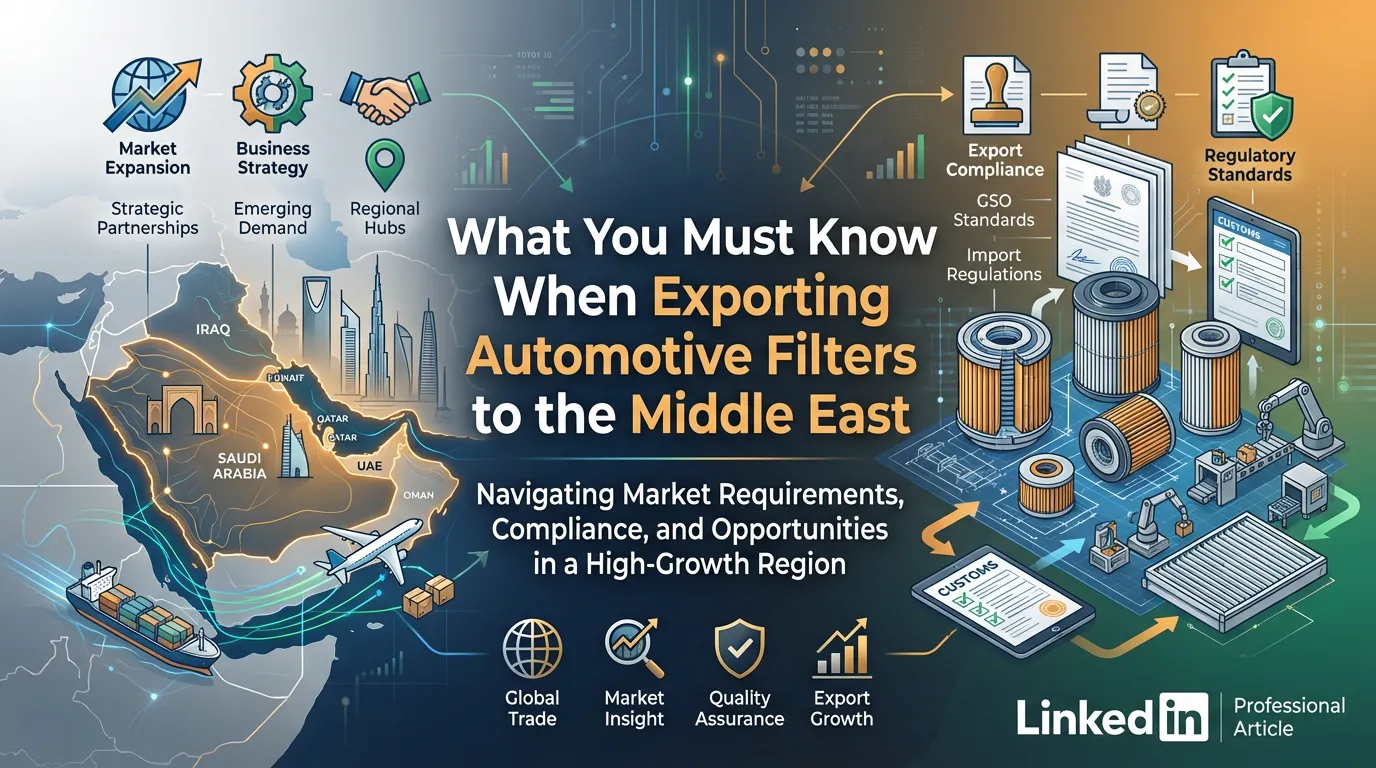
The Middle East (GCC) is one of the fastest-growing markets for automotive aftermarket parts. However, for importers in Saudi Arabia (KSA) and the United Arab Emirates (UAE), it is also one of the most challenging regions regarding customs compliance.
Unlike other markets where a simple invoice might suffice, GCC customs authorities enforce strict standards on safety, labeling, and documentation. A single error—like a missing Arabic translation or an incorrect HS code—can cause your container to be held at Jebel Ali or Jeddah for weeks, incurring massive demurrage charges.
At Beling Parts, we don’t just manufacture filters; we navigate the bureaucracy for you. Here is our guide to smooth importing into the GCC.
For clients in Saudi Arabia, SABER is the single biggest hurdle. If your supplier does not understand the SABER electronic platform, your shipment cannot enter the country.
We support our Saudi partners through the entire conformity process:
We ensure all our filters meet SASO technical standards, preventing rejection during physical inspection.
In the UAE and Saudi Arabia, English-only packaging is no longer widely accepted. GCC standardization organizations (GSO) strictly require bilingual information.
We provide compliant packaging solutions that include:
By printing correct Arabic text directly on the packaging (or using high-quality compliant labels), we save you the cost and delay of re-labeling goods at the port.
Middle East customs officers frequently open boxes to verify the Country of Origin.
We implement strict Quality Control (QC) to ensure every filter housing and box carries the correct origin marking, eliminating the risk of “seizure and destruction” orders due to mislabeling.
Incorrect HS classification is a primary reason for penalties and VAT disputes.
We ensure our Commercial Invoices align with GCC Common Customs Law and Saudi ZATCA invoicing requirements. This includes accurate descriptions, proper HS codes, and breakdown of values to facilitate smooth VAT calculation and payment.
Time is money. We understand that Middle East distributors operate on tight schedules to supply local retailers and workshops.
Don’t let compliance issues slow down your growth in the Middle East aftermarket. You need a manufacturing partner who understands the difference between a SASO certificate and a SABER request.
At Beling Parts, we deliver high-quality filters with the paperwork to match.
Ready to secure your supply chain? If you are importing into Saudi Arabia, UAE, or the wider GCC, let’s discuss how we can support your compliance needs.
Contact Us: https://belingparts.com/contact/
Email: info@belingparts.com
WhatsApp: +86 150 5776 4729
Privacy Policy Powered by 2uncle