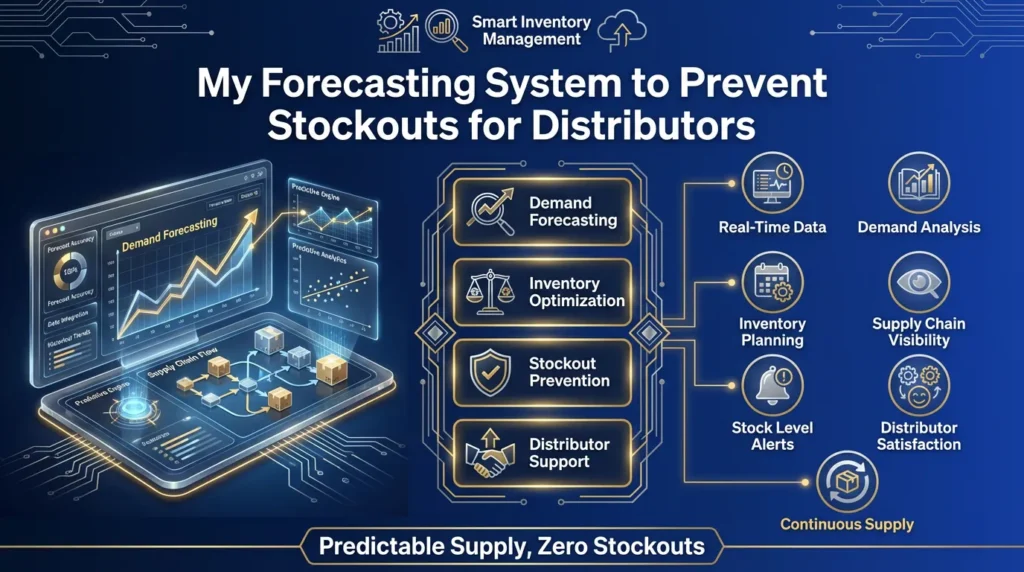
Most stockouts in private label automotive filters don’t happen because demand is impossible to predict.
They happen because no one turned what they already know into a simple, repeatable system that:
- Focuses on the right SKUs
- Uses history intelligently
- Translates forecasts into clear reorder decisions
This article explains the practical forecasting framework I use with distributors to keep private label filters available, without drowning them in slowmoving stock.
It’s designed for real aftermarket businesses: simple enough to maintain, strong eno
Start With the Right Segmentation – Not 3,000 SKUs at Once
1.1 Why You Can’t Forecast Every SKU the Same Way
Trying to forecast 2,000–3,000 SKUs at the same level of detail is a waste of time.
In a typical automotive filter range, a relatively small group of SKUs generates most of the volume and customer sensitivity. The rest are “long tail” products.
If you treat everything equally:
- You spend hours debating minor reference movements
- You still miss the big stockouts in your top sellers
1.2 A/B/C Segmentation for Filters
We always start by segmenting the range:
- A items
- Top sellers
- High frequency
- Critical for customer satisfaction and daily availability
- B items
- Medium rotation
- Important but less sensitive to occasional delays
- C items
- Low rotation
- Niche or special applications
1.3 Different Forecasting Rules per Segment
Forecasting rules are not the same for each group:
- A items →more detail, tighter control, higher service level
- B items →simpler, periodbased checks with moderate service levels
- C items →mostly reorder point or projectdriven logic
This segmentation prevents you from:
- Wasting time modelling “tail” items in detail
- While missing the real drivers of your business (A items)
With a good A/B/C split, you can focus 80% of your time on the 20% of SKUs that matter most.
Use 12–18 Months of History (But Don’t Be a Slave to It)
2.1 Why History Is Useful – and Dangerous
Historical data is a valuable foundation, but it must be cleaned and interpreted, not followed blindly.
When available, we pull 12–18 months of sales data per SKU:
- Monthly or weekly sales quantities
- Big tenders and oneoff projects flagged
- Promotions clearly marked
2.2 Cleaning the Base Demand
We then clean the data to create a realistic baseline:
- Remove nonrepeatable spikes:
- Special tenders
- Onetime fleet deals
- Clearance campaigns
- Analyze and isolate promotions:
- Don’t let promo peaks define normal demand
- Look for seasonality:
- Winter vs summer patterns
- Preholiday peaks
- Yearend effects
The objective is a clean base demand per SKU that reflects normal, repeatable business.
2.3 When Not Enough History Exists
For newer SKUs or brands with weaker history:
- Use analogous SKUs(similar applications or vehicle parc) as a proxy
- Combine:
- Partial history
- Market knowledge from sales
- Supplier experience in similar markets
The point is not perfect mathematical precision, but a sensible starting point you can refine over time.
Simple Forecast Models That People Actually Use
3.1 The Problem With OverComplex Models
I avoid complex forecasting formulas that only one person understands and that live in a single Excel file or BI system.
If the system is too complicated:
- No one updates it regularly
- Sales and logistics don’t trust the numbers
- It becomes “nice theory” with no impact on ordering
3.2 Practical Forecast Models for A/B SKUs
For most SKUs, we use simple, transparent methods such as:
- Moving average (last 3–6 months)
- Good for stable products
- Smooths out small random variations
- Weighted average
- Recent months have higher weight
- Useful when:
- Demand is gradually growing
- The range is still ramping up
- Seasonality index
- Applied where history clearly shows seasonal patterns
- Example: multiply base demand by a monthly factor
3.3 Design Principle: Easy to Update
The focus is always:
A system your team can update in 1–2 hours per month, not a PhD project.
Key rules:
- Use formulas that can be explained in 2–3 sentences
- Make sure at least two people can maintain the file or system
- Display results in a clear, actionoriented format(e.g. suggested order quantities, risk flags)
Translate Forecast Into Safety Stock and Reorder Points
4.1 Forecast Without Action = Useless
Forecasting is useless if it doesn’t translate into clear numbers to act on.
Per A/B SKU, we calculate:
- Average demand per month (or week)
- Supplier lead time:
- Real, measured lead time
- Not the “marketing lead time”
- Desired service level:
- 95–98% for A items (very low tolerance for stockouts)
- 90–95% for B items (more flexibility)
4.2 From Demand to Safety Stock and Reorder Points
From these inputs, we define:
- Safety stock, which protects against:
- Variability in demand
- Variability in lead time
- Reorder point, typically:
Reorder point = expected demand during lead time + safety stock
In practical terms:
- When stock falls to the reorder point, you trigger an order
- Safety stock absorbs the “real life noise” while you wait for replenishment
4.3 Different Logic for C Items
For C items with low and sporadic demand, we often switch to:
- Simple “min–max” rules:
- Fixed minimum stock
- Fixed maximum stock level after replenishment
- Or make/ordertoproject:
- Only order when there is a specific customer project
- Accept longer lead time if communicated clearly
This avoids locking too much capital in slowmoving stock while still covering key needs.
Align Forecast Horizon With Production and Shipping Reality
5.1 Why Lead Time Reality Must Drive Forecast Horizon
For imported private label filters, forecasting must reflect real world supply timing, including:
- Production lead time (e.g. 40 workdaysin our case)
- Internal documentation and booking
- Ocean transit time
- Customs clearance
- Local transport to your warehouse
5.2 Building a Realistic Planning Horizon
We usually work with:
- 3–6 months outlook on key A items, depending on:
- Your sales pattern
- Frequency of container shipments
- Clear order windows to consolidate containers efficiently:
- Avoid many halfempty containers
- Align with your warehousing capacity
- Extra buffer around holiday periods:
- Chinese New Year
- Local public holidays
- Factory maintenance shutdowns
5.3 Forecast as a Timing Tool, Not a Crystal Ball
The purpose of forecasting here is not to perfectly guess demand.
The purpose is to:
- Place orders early enough
- So stock arrives before you run out
- Even with production and transit lead times fully included
This alone drastically reduces emergency shipments and lastminute negotiations.
Joint Forecasting With Your Supplier – Not in Isolation
6.1 Why Joint Planning Beats Solo Forecasting
Distributors get the best results when they connect their forecasting system with their supplier’s planning.
When you forecast in isolation:
- Your supplier is surprised by your peaks
- They can’t preposition materials or capacity
- Lead times become unstable
6.2 Our Joint Forecasting Process
With serious partners, our process is:
- You share a rolling forecast (nonbinding)for top SKUs
- Monthly or quarterly update
- Focused on A/B items
- We translate it into internal plans:
- Raw material and media plans
- Packaging and component stock
- Reserved production slots for your business
- You place actual orderswithin this “corridor”, with reasonable flexibility
6.3 Benefits for Both Sides
This joint forecasting means:
- We can preproduce or preallocate componentsfor your A items
- Lead times stay more stable, even when demand grows
- You avoid:
- Lastminute stockouts
- Emergency air freight
- Constant firefighting
It connects your forecasting system directly to our 40workday lead time and capacity planning.
Early Warning Dashboard – A Simple “Risk of Stockout” List
7.1 The Need for a Practical Control Tool
To keep forecasting practical, I always push for one simple output:
A monthly “Risk of Stockout” report for the next 2–3 months.
This turns spreadsheets and models into clear, concrete actions.
7.2 What the Dashboard Shows
For each A/B SKU, we check:
- Current physical stock
- Open purchase orders and their ETA
- Forecast demand for the coming months
- Calculated runout date
We then highlight:
- SKUs that will hit zero before the next shipment arrives
- SKUs where we still have time to bundle into the next container / order
7.3 Why This Works
This simple dashboard gives your team:
- A focused action list, not just historical reports
- Early warning to:
- Advance orders for key SKUs
- Split shipments if needed
- Adjust promotions if risk is high
Instead of reacting to empty shelves, you act weeks or months earlier.
Feedback Loop: Forecast vs Reality
8.1 Accepting That Forecasts Are Never Perfect
Forecasts are always wrong – the question is:
- By how much?
- In which direction?
- What do you do with that information?
A static system quickly becomes outdated.
8.2 Regular Review of Forecast Accuracy
After each period (monthly or quarterly), we:
- Compare forecast vs actual sales per key SKU
- Identify patterns such as:
- Always underforecastingcertain references
- Regularly overstockingolder applications
- Analyze lead time performance:
- Is the supplier actually delivering in the assumed time?
- Are customs or transport delays common?
8.3 Adjusting the System
Based on these findings, we adjust:
- Safety stock levels:
- Increase for volatile SKUs
- Decrease where demand is more stable
- Seasonality factors:
- Refine monthly multipliers
- Adjust for new patterns
- Lead time assumptions:
- Based on real performance
- Not on outdated or optimistic figures
This keeps the system alive and learning, instead of becoming just a onetime exercise.
Special Handling for New SKUs and PhaseOut Models
9.1 Two HighRisk Moments
Two particularly dangerous situations for stock and availability:
- New SKU introductions
- No history
- High uncertainty
- Big marketing expectations
- Phaseout models
- Demand declining but not zero yet
- Risk of both stockouts and dead stock
9.2 Forecasting for New SKUs
For new references, we:
- Start with a conservative initial batch
- Link demand expectations to similar referencesas a proxy
- Monitor very closely in the first 6–12 months:
- Monthly review
- Adjust orders quickly based on real sales
This avoids large dead stock while still supporting a solid launch.
9.3 Managing PhaseOut SKUs
For phaseout models, we decide early whether you will:
- Run down and stop
- Keep minimal emergency stockonly
- Transfer demand to a replacement SKU
Based on that strategy, we:
- Reduce order volumes in advance
- Avoid large lasttimebuy mistakes
- Communicate clearly with sales and key customers
This protects both working capital and customer satisfaction.
Turn Forecasting Into a Process, Not a OneTime Exercise
10.1 The Most Important Element: Discipline
The most important part of my system is not the formula – it’s the routine.
We set a fixed cycle (monthly or quarterly) with clear owners:
- Sales
- Market intelligence
- Tenders and projects
- Planned promotions
- Supply/Logistics
- Current stock and open POs
- ETA and constraints
- Warehouse and container space
- Finance/Management
- Service level targets
- Capital and stock investment limits
10.2 Standard Forecast Review Agenda
The agenda always includes:
- Review the last period
- Stockouts on key SKUs
- Excess stock situations
- Forecast accuracy review
- Update assumptions
- Lead times (real vs planned)
- Demand trends (growth, decline, new segments)
- Confirm next orders and priorities
- Which SKUs go in the next container
- Where to raise or lower safety stocks
- Which promotions need stock reinforcement
10.3 From Excel File to Real “Shield” Against Stockouts
Handled this way, forecasting becomes:
- A practical shieldagainst stockouts
- A way to reduce emergency freight and lastminute stress
- A tool that connects:
- Your sales plans
- Your stock levels
- Our 40day production and shipping reality
How I Support Distributors in Practice
With our customers, I don’t just send a template and disappear. I work with you to build a light but disciplined system that fits your business.
Typically, we:
- Clean and structure sales historyfor filters
- Build a simple A/B/Cbased forecasting template
- Set safety stock and reorder rulesSKU by SKU for the top of your range
- Connect those rules to our 40 workday lead time and shipping plans
- Run a regular forecast review and “risk of stockout” checkbefore each order
The result:
- Significantly fewer stockouts on key SKUs
- More stable availability for dealers and workshops
- Far less lastminute panic and emergency transport
If your current approach is basically “order when the shelf looks empty”, even this kind of simple, structured system will already make a major difference.
Beling – Save Your Time & Cost
Your valuable automotive filter partner since 2008.
Contact Our Team
Bruce Gong – Key Account Manager, Beling Filters
Email: bruce.gong@belingparts.com
WhatsApp: +86 150 5776 4729
LinkedIn: www.linkedin.com/in/brucegong-beling
We’re happy to share how we usually adjust pallets for EU vs Middle East vs Latin America markets, and help you fine tune palletization to your warehouse system.