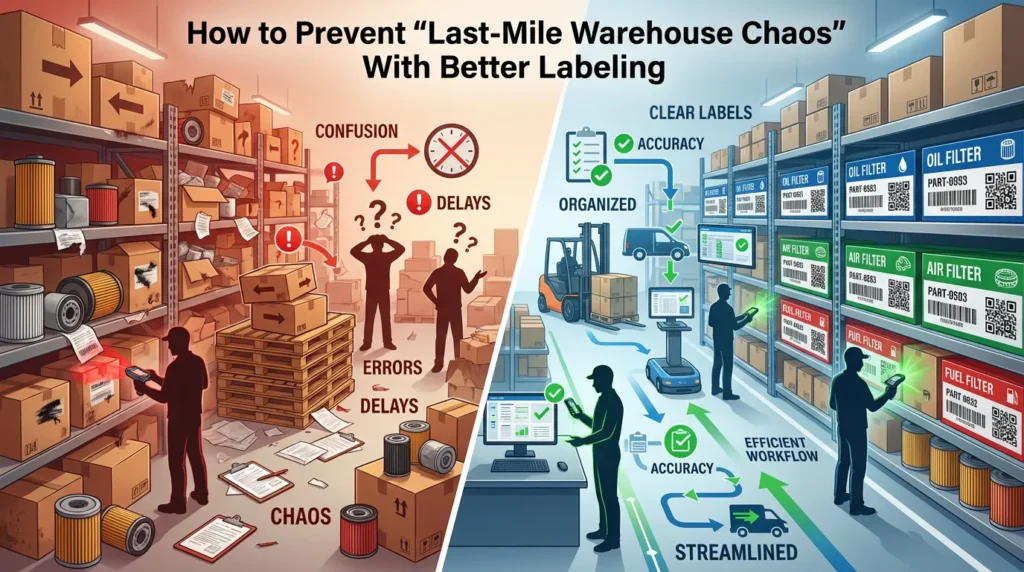
In many auto parts and filter supply chains, the container arrives on time, with no visible damage. The shipment matches the purchase order. Every item is technically “correct.”
Yet the receiving warehouse is still in chaos.
- Staff are confused about what’s on each pallet.
- Operators walk back and forth to find the right SKUs.
- Pickers make mis picks, especially on similar part numbers.
- Warehouse teams apply extra stickers by hand just to make sense of the cartons.
- Customers downstream receive wrong items or experience delays.
In these cases, the problem is often not the container, the freight forwarder, or even the transport.
The problem is the labeling.
For auto parts and filters, where there can be thousands of SKUs and similar-looking boxes, poor labeling creates:
- Mis picks
- Slow receiving
- Wrong shelf location
- Inventory discrepancies
- Angry customers downstream
At Beling Filters, we’ve seen how good labeling can completely change the “last mile” experience in the warehouse. This article explains how we use carton labels, pallet labels, color coding, and ERP/WMS alignment to reduce last mile chaos for our distribution partners.
Why Labeling Is Critical in Auto Parts & Filter Warehouses
In auto parts logistics, warehouses often handle:
- High SKU counts
- Many similar items with small differences
- Frequent replenishment shipments
- Mixed pallets with multiple references
Filters are a good example: oil filters, air filters, cabin filters, fuel filters — often in boxes of similar size with only small text differences.
If labels are:
- Hard to read
- Only on one side
- Not aligned with your ERP or WMS codes
- Missing key information
…then every step in the warehouse becomes slower and more error‑prone:
- Receiving takes longer because staff must open cartons or search for information.
- Put-away is inconsistent because operators are not sure which zone or shelf is correct.
- Picking becomes risky because SKUs are hard to distinguish, especially when part numbers are long.
- Stock counting requires extra effort because labels are not visible or not standardized.
Good labeling is one of the most cost‑effective ways to improve warehouse efficiency and accuracy — especially in auto parts and filter distribution.
Think Like the Receiving Team, Not the Factory
Many label designs are created from the perspective of the factory: what the production line needs to identify items internally. But what the warehouse receiving team needs can be very different.
We start by thinking like warehouse operators, not like a factory.
Understanding the Warehouse Use Case
Before we finalize any label format with a new customer, we ask practical questions:
- “What do you need to see on each carton to receive it quickly?”
- “Which information matters most for your forklift drivers and receivers?”
- “How do your pickers identify SKUs on the shelf?”
- “Do you scan barcodes or QR codes? Which standard do you use?”
- “Do you want customer part numbers, our part numbers, or both?”
The goal is to design labels that support your process, not just our internal production.
Designing for Speed
Warehouse staff typically have seconds, not minutes, to understand a box:
- They scan, glance, and move.
- They don’t have time to interpret complex layouts or tiny fonts.
So we make sure labels are:
- Clean and uncluttered
- Prioritizing the most important information visually
- Easy to read from a reasonable distance
By starting from the receiving team’s needs, we can immediately reduce friction in the last mile of your supply chain.
Clear, Consistent Carton Labels for Auto Parts & Filters
For auto parts and filters, carton labels are the core of warehouse visibility. We build a standard format that can then be customized per customer.
What We Include on Standard Carton Labels
For filter shipments, a typical label can include:
- Customer part number – so your team can work with familiar codes.
- Our part number – for cross‑reference and after‑sales support.
- Description – often in the local language if needed.
- Model / application – brief, not a full catalog, but enough to distinguish.
- Quantity per carton – to speed up receiving and counting.
- Barcode or QR code – aligned with your ERP/WMS if you use scanning.
- Country of origin – often needed for customs, compliance, and traceability.
We keep the layout:
- Structured and consistent across SKUs
- Not overloaded with unnecessary text
- Using fonts large enough for real warehouse environments
Benefits of Clear, Consistent Carton Labels
Clear and consistent carton labels help your warehouse to:
- Receive faster with fewer questions
- Put away to the correct zone and shelf on the first attempt
- Reduce mis picks when items look similar
- Simplify stock counting and cycle counts
Over time, this consistency reduces the “hidden costs” in your warehouse operations.
Multi‑Side Carton Labeling for Faster Handling
One of the most common practical problems in warehouses is label orientation.
Cartons arrive on pallets, are stacked in racking, moved by forklift… and suddenly:
- The label is facing the wall.
- The label is at the bottom of the stack.
- The label is covered by another box.
Operators then have to:
- Rotate cartons
- Climb or stretch to read labels
- Walk around pallets just to find the right face
Our Multi‑Side Labeling Approach
To avoid this, we typically:
- Apply labels on at least 2–3 sides of each carton.
- Ensure that labels are placed in consistent positions on each box.
For example:
- Front and right side, or
- Front, right, and back
This way, no matter how pallets are stored, there is a high chance that at least one label is visible.
Time Saved in Key Operations
Multi‑side carton labels save time during:
- Receiving – operators don’t need to rotate pallets to find labels.
- Put-away – forklift drivers can confirm the SKU without dismounting.
- Picking – pickers can quickly verify the correct reference.
- Stock counting – counters see the information without moving every box.
It’s a simple adjustment that has a big cumulative impact on warehouse productivity.
Pallet Labels Linked to the Packing List
For larger shipments, especially mixed loads with many different filters, pallet labels become crucial.
Instead of every carton being treated individually, pallets are often handled as functional units:
- One pallet may contain multiple SKUs.
- One pallet may be dedicated to a single SKU or product family.
How We Label Pallets
We work with customers to set up a pallet ID system:
- Each pallet receives a unique ID (e.g., Pallet 01, Pallet 02, etc.).
- This pallet ID appears on both the pallet label and the packing list.
On the pallet label, we can show:
- Pallet ID
- Main SKUs included on the pallet
- Total quantity per SKU
- Total carton count on that pallet
For example:
Pallet 12
– SKU A1234: 600 pcs (30 cartons)
– SKU B5678: 600 pcs (30 cartons)
Total: 60 cartons / 1200 pcs
Matching Pallet Labels With the Packing List
The packing list is structured to match these pallet IDs:
- Section “Pallet 12” in the packing list shows the same SKUs and quantities as the pallet label.
- Warehouse staff can verify pallet contents without opening cartons.
This helps during:
- Receiving – quick check that pallet matches documentation.
- Put-away – pallets can be directed to the right zone based on dominant SKU.
- Internal transfers – pallets can be moved between locations with full visibility.
For big shipments, pallet‑level labeling significantly reduces confusion and speeds up warehouse processes.
Color Coding by Product Family or Warehouse Zone
Text is useful, but in a busy warehouse, color is faster.
Color coding helps operators instantly identify:
- Product families
- Urgent orders
- Special handling requirements
- Warehouse zones or aisles
Examples of Color Coding for Filters
For filters, we may implement:
Or we can align colors with your warehouse zoning:
- Orange band for Zone A
- Purple band for Zone B
- Green band for high‑turnover area
We can apply color logic through:
- Color bands on labels
- Color stickers on cartons
- Color headers on pallet labels
Benefits of Color Coding
Color coding is especially helpful when:
- You have a large assortment with many part numbers.
- Operators are under time pressure.
- Many SKUs share similar packaging formats.
The visual cues reduce cognitive load and speed up:
- Put-away by product family
- Picking by route or order type
- Error detection (a red “urgent” box in the wrong area stands out)
Labeling Aligned With Your ERP / WMS
Nice labels alone are not enough. To really eliminate last mile chaos, labels must match your systems.
If labels and your ERP/WMS are not aligned, warehouse teams end up:
- Scanning codes that are not recognized.
- Manually entering data.
- Creating their own stickers to match internal references.
This adds both labor cost and risk of error.
How We Align With Your Systems
Before we finalize labeling, we ask for:
- Samples of your current labels.
- Your SKU code format.
- Your barcode standard (e.g., EAN, Code 128, QR).
- Any internal location codes you want printed (e.g., Aisle B3, Rack C, Level 2).
We then:
- Mirror the key elements from your existing labels.
- Make sure barcodes or QR codes follow your standard.
- Confirm that the printed data will be recognized by your ERP/WMS.
Operational Impact at Receiving
When goods arrive:
- Scan → recognized (no error messages).
- Code → matches ERP, so no manual data correction.
- Labels support your existing processes, instead of creating a new workflow.
This alignment makes it much easier to integrate new suppliers into your warehouse operations without disruption.
8.Our Labeling Approach at Beling Filters
At Beling Filters, we see labeling as part of our service, not just a printing detail.
To reduce “last mile warehouse chaos” for auto parts and filter distributors, we:
- Discuss labeling requirements before the first order.
- Share standard label templates for your feedback (carton and pallet).
- Customize per customer (language, code structure, layout).
- Print multi‑side carton labels so boxes are readable from more angles.
- Add pallet labels linked to the packing list for large or mixed shipments.
- Align packing list structure with labeling logic, so documentation and labels tell the same story.
The results for our partners:
- Faster, more accurate receiving
- Fewer picking errors and mis picks
- More efficient put-away and stock control
- Less manual relabeling in the warehouse
- Lower “hidden cost” in downstream operations
Last Mile Chaos Is Not Destiny – It’s a Design Issue
Many distributors accept last mile chaos as “normal”:
- Teams writing extra stickers by hand for each shipment
- Warehouse staff re-boxing or re-labeling goods
- Repeated errors on similar SKUs
- Extra time spent explaining shipments internally
But in most cases, this chaos is not a destiny. It’s a labeling design issue that can be solved before production even starts.
By redesigning labels around:
- The receiving process
- The pickers’ workflow
- Your ERP/WMS requirements
- Multi‑side readability
- Pallet‑level visibility
- Color logic for product families or zones
…you can transform the last mile from a permanent headache into a controlled, predictable operation.
If your team is still handwriting stickers after each shipment, that’s a clear signal that your suppliers’ labeling is not aligned with your real needs.
Want to See a Real-World Labeling Example?
If you’re reviewing your current labeling setup for auto parts and filters, it often helps to see concrete examples.
At Beling Filters, we can share:
- A standard carton label format used with distributors
- A sample pallet label linked to a packing list
- Examples of color coding for product families
- A checklist of key data points for ERP/WMS alignment
You can compare these with your current labels and identify quick wins:
- What’s missing?
- What’s duplicated?
- What slows down your warehouse team?
From there, we can adjust our export labels so that your receiving, put-away, and picking all become smoother from the first shipment onward.
If you’d like to explore this, we’re happy to walk through real formats and adapt them to your operation.