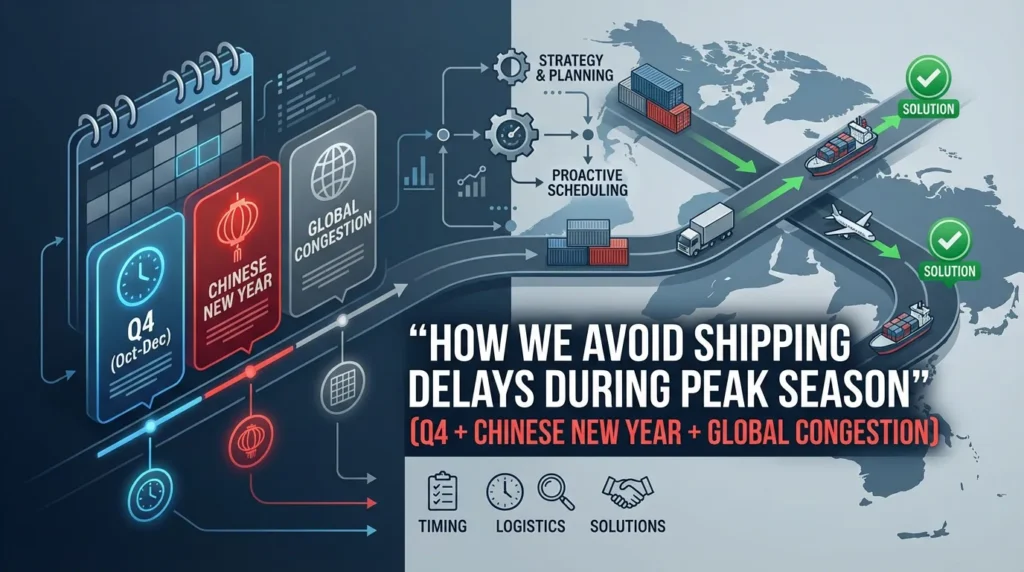
In international trade, many people treat shipping delays as “bad luck” – something you can’t control.
At Beling Filters, we completely disagree.
Delays are rarely random. They are usually the result of predictable patterns and known bottlenecks:
- Q4 holiday demand spikes in Europe, North America, and many global markets
- Chinese New Year (CNY) shutdowns that pause manufacturing and trucking for weeks
- Port congestion and container shortages as everyone rushes to ship at the same time
- Overbooked vessels and rolled containers
- Local customs and terminal slowdowns caused by volume overload
The result for importers is often a perfect storm:
- Containers stuck at origin or destination ports for weeks
- Stockouts and emergency backorders in local warehouses
- Urgent air freight costs that destroy your margins
- Unhappy workshops, retailers, and end customers
- Lost sales that you can never recover
To protect our partners in 30+ countries, we have built a Peak-Season Risk Control System specifically for automotive filters. Our goal is to keep your supply chain stable when the rest of the market is struggling.
Below is exactly how we do it.
Peak Season Forecasting & Planning (60–90 Days Ahead)
Forecasting is the first line of defense against delays.
We don’t wait passively for your purchase order to arrive – we prepare for it months in advance.
1.1 Data-Driven Demand Planning
Before every major peak period – especially:
- Q4 (October–December)
- Pre‑Chinese New Year (typically 4–6 weeks before CNY)
we collaborate closely with our distributors to analyze:
- Expected Q4 demand curves
- Sales history by month
- Seasonal peaks (Black Friday, Christmas, local holidays)
- High‑runner SKU velocity
- Which references move the fastest in your market
- Which SKUs generate 70–80% of your revenue
- New vehicle model introductions
- New OEM applications entering your market
- Filters needed for fresh vehicle parc growth
- Upcoming promotional plans
- Planned campaigns, catalog launches, or price promotions
- Anticipated sales spikes from marketing activities
The more data you share, the better we can support you.
1.2 Securing Capacity Before Everyone Rushes In
Once we receive this data 60–90 days in advance, we can:
- Lock in raw material supplies
- Filter paper, synthetic media, PU, steel, plastics, packaging materials
- Avoid shortages or rising prices from upstream suppliers
- Reserve production slots
- Your critical SKUs are scheduled in our production plan before the peak rush
- We avoid being “fully booked” when you need urgent replenishment
- Pre‑arrange packaging and labeling materials
- Private label boxes and labels
- Region‑specific packaging (EU, Middle East, LATAM, etc.)
This proactive approach keeps your orders ahead of the queue, while more reactive competitors fight for whatever capacity is left.
Priority Production for High‑Demand SKUs
With an annual production capacity of 32 million filters, we have the scale to handle strong demand.
But in peak season, intelligent scheduling becomes more important than raw capacity.
2.1 Focusing on “A-Class” Items
During peak months, we shift our production logic from “first come, first served” to “Critical Inventory First”.
We prioritize:
- High‑volume spin‑on oil filters
- Core aftermarket references used on popular passenger and light commercial vehicles
- Fast‑moving activated carbon cabin filters
- Critical for customer satisfaction and often sold as premium replacements
- Popular air filter references
- Especially those for regional best‑sellers (e.g., Hilux / Fortuner in Asia, popular VW/Hyundai/Toyota models in Europe and LATAM)
This doesn’t mean other items are ignored, but your revenue drivers get top priority.
2.2 Aligning Production with Your Sales Mix
We often work with partners to classify their catalog:
- A-Class: High volume, high margin, must‑have stock
- B-Class: Regular movers, moderate volume
- C-Class: Slow movers or niche SKUs
During peak season, we:
- Make sure A-Class items are produced first and in sufficient quantity
- Time B-Class production according to available capacity and your forecast
- Manage C-Class via more flexible scheduling or advanced planning
The result: your most important references are ready to ship early, significantly reducing the risk of stockouts on the SKUs that matter most.
Container Space Booking Strategy
In Q4 and pre‑CNY, ocean freight becomes a critical bottleneck:
- Freight rates typically spike
- Steamship lines often overbook
- Bookings can be rolled (delayed to a later vessel) if space is tight
If you or your supplier book late, your container is at risk of getting pushed back again and again.
3.1 Treating Shipping Space as a Strategic Resource
To mitigate this, we:
- Pre‑book Space
- We secure container slots weeks before cargo is fully ready, based on your forecast and planned ETD.
- This ensures your shipment has a reserved place when vessels are full.
- Work with Multiple Forwarders and Carriers
- We cooperate with a network of freight forwarders and shipping lines.
- If one carrier is overloaded or facing issues, we can switch to alternatives instead of being stuck with a single option.
- Early ETD/ETA Sharing
- As soon as bookings are confirmed, we share:
- ETD (Estimated Time of Departure)
- ETA (Estimated Time of Arrival)
- This allows your local logistics team and customs broker to prepare in advance.
3.2 Reducing the Risk of Rolled Containers
By booking early and diversifying carriers, we:
- Lower the risk that your containers will be rolled to later sailings
- Avoid last‑minute “no space” surprises
- Give you more predictable transit times, even in peak season
When others are still trying to find a container, your shipment is already on the water.
Flexible Shipping Routes and Ports
Peak‑season congestion doesn’t impact all ports and routes equally.
The ability to change paths is a powerful way to avoid delays.
4.1 Multi‑Port Flexibility in China
Depending on real‑time port conditions, available sailings, and your destination, we can route shipments through:
- Ningbo or Shanghai
- Ideal for most major global routes (EU, North America, Middle East, Africa).
- Large volume ports with frequent sailings.
- Shenzhen / Guangzhou (South China)
- Often more efficient for Southeast Asia connections (e.g., Malaysia, Indonesia, Thailand, Philippines)
- Strong routes to the Middle East and some Oceania markets.
- Qingdao and other North China ports
- Useful alternatives for specific North American or Russian/CIS lanes.
- Can be leveraged when East China ports are heavily congested.
4.2 Route Optimization by Region
Whether you are importing into:
- The European Union
- The USA or Canada
- LATAM (Brazil, Chile, Peru, Colombia, Mexico, etc.)
- Southeast Asia or the Middle East
we work with forwarders to:
- Identify the least congested routes and ports
- Avoid known bottlenecks when possible
- Balance transit time, cost, and reliability
This route flexibility can make the difference between a shipment arriving on time or being stuck for weeks at an overloaded gateway.
Protective Packaging for Longer Transit Times
Peak season doesn’t just increase delay risk – it also increases the chance of rough handling:
- Longer dwell times at ports and terminals
- More stacking and re‑stacking of containers
- Higher humidity exposure on certain routes
- Greater mechanical stress due to increased throughput
A delay is bad.
Receiving damaged goods after a delay is even worse.
5.1 Enhanced Protection During High-Risk Periods
To counter this, during high‑risk shipping windows (Q4, pre‑CNY, known congestion periods), we upgrade our packaging and loading protocols:
- Moisture‑Proofing
- Extra desiccants inside cartons or containers
- Additional plastic wrapping or liners where necessary
- Especially important for long sea journeys and humid climates
- Reinforced Cartons
- Sturdier box materials for bulk and retail packaging
- Better resistance to compression when stacked deep in containers or warehouses
- Secure Palletizing
- Tightly wrapped and strapped pallets
- Corner protection if required
- Balanced loading to prevent shifting during transit
- Optimized Loading Patterns
- Smart loading plans to minimize movement inside the container
- Avoiding void spaces that can cause cargo collapse
5.2 Full Loading Documentation
We also provide visual proof and documentation:
- Container loading photos
- Pallet and carton arrangement images
- Seal numbers and container IDs
This helps you:
- Verify loading quality
- Support insurance claims if anything happens
- Show your customers the professional handling of their products
Transparency: The “No‑Surprise” Policy
In peak season, delays can still happen in the global logistics chain – even with good planning.
What makes the difference is how quickly and clearly you are informed.
The worst thing a supplier can do is stay silent when something goes wrong.
6.1 Real-Time Communication
We maintain a transparent, proactive communication system for our partners:
- Weekly production updates during high‑risk periods
- What has been produced
- What is in process
- What is scheduled next
- Pre‑shipment alerts and confirmations
- Container booking details
- ETD / ETA
- Any changes from carriers
- Immediate delay alerts (if any occur)
- If a vessel is delayed
- If a container is rolled
- If there are unexpected port issues
You don’t have to “chase for updates” – we keep you informed.
6.2 Complete Document Pack Before Departure
Before the vessel departs China, we send you a full document pack to avoid last‑minute surprises:
- Draft/final Commercial Invoice and Packing List
- Draft/final Certificate of Origin
- MSDS or compliance documents (if required)
- Container Loading Plan
- Labeling and packaging photos
This supports:
- Pre‑clearance or document checks by your customs broker
- Early planning for your warehouse receiving team
- Faster reaction if any correction is needed
We don’t just react to peak season – we prepare for it together with you.
Secure Your Supply Chain for the Next Peak Season
Q4 and Chinese New Year do not have to be chaotic.
With the right partner, peak season becomes a managed risk, not a disaster.
By working with Beling Filters, you gain:
- Early planning and demand forecasting support
- Priority production for your high‑value SKUs
- Stronger control over container space and routes
- Better packaging for longer, rougher transit
- Transparent communication with no unpleasant surprises
Don’t wait until the next crisis to fix your supply chain.
Plan Your Next Order With Us
If you want to:
- Avoid last‑minute panic before Q4 and CNY
- Keep your warehouses stocked when others are out
- Protect your margins from emergency air freight
- Offer your customers a reliable, stable supply of filters
we are ready to help you build a Peak‑Season Risk Control Plan tailored to your market.
Bruce Gong – Key Account Manager, Beling Filters
Email: bruce.gong@belingparts.com
WhatsApp: +86 150 5776 4729
LinkedIn: www.linkedin.com/in/brucegong-beling
Secure your supply chain before the next peak hits.
Let’s turn “bad luck” into controlled, predictable logistics.