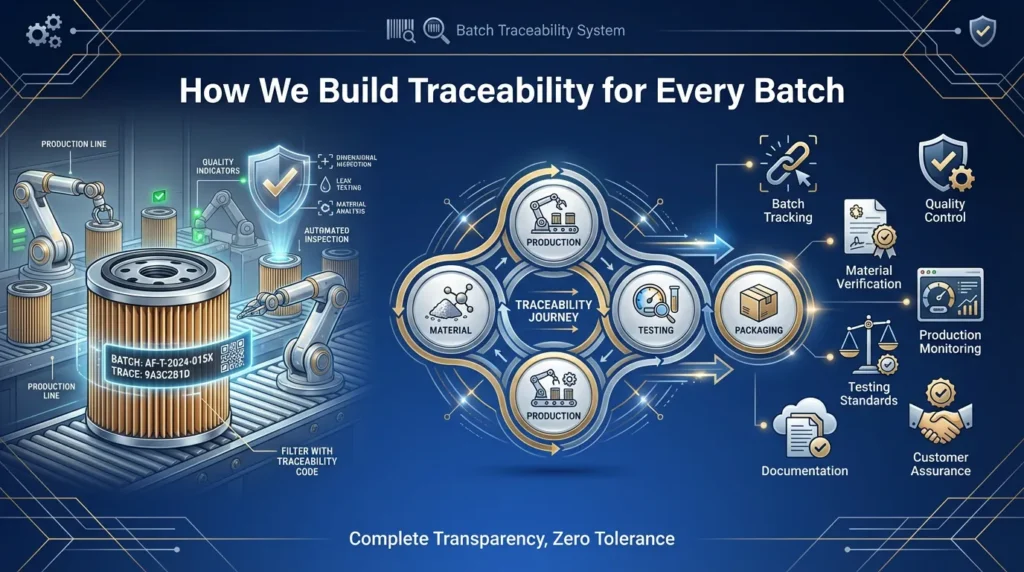
How a filter looks in your hand is only half the story.
The other half is what you cannot see:
- Which media batch was used
- Which operator assembled it
- Which line produced it
- Which quality checks that batch passed
This hidden “story” behind each filter is what separates “we guess” from “we know.”
That is where traceability becomes a strategic advantage for importers, distributors, and private label brand owners.
At Beling, supplying 30+ countries since 2008 with IATF 16949 certification, we’ve learned that real traceability is not just a label or a printed code – it is a system.
Below is how we build batch-level traceability for every filter, and what this means for your risk control, claims handling, and brand reputation.
Why Traceability Matters to Overseas Buyers
If you are sourcing automotive filters for your market, traceability directly affects your business risk.
1.1 Risk Control and Issue Containment
With proper traceability, whenever a problem appears in the market, you can:
- Identify the affected batch
- Check production and test records
- Decide clearly whether the issue is:
- A single case (installation, local conditions, misuse)
- Or a real batch-related deviation
This allows you to isolate the problem and act precisely.
Without traceability, you face:
- Uncertainty about how many pieces are affected
- Fear of hidden variables in your supply chain
- Pressure to replace more product than necessary “just in case”
With traceability, a complaint becomes a controlled quality event, not a crisis.
1.2 Claims Handling and Customer Communication
Filter complaints will happen at some point with any brand – because:
- Vehicles are used in different environments
- Workshops install parts differently
- Drivers use different fuels and oils
The question is not “will I have claims?” but how professionally can I handle them?
Without traceability:
- You can only respond with “we will check” or “this is rare”
- Discussions become emotional and based on opinion
- Workshops and fleet customers lose confidence if you cannot explain what happened
With traceability:
- You can request:
- Part number
- Batch/lot number
- Photos of label and product
- Your supplier can pull:
- Production date and shift
- Material lot used
- QC results for that batch
Now you can communicate with data:
- “This batch used media lot X, tested at Y g/m², passed dimensional and functional checks on date Z.”
- “We found no deviation in production; we recommend checking installation and operating conditions.”
- Or: “We did find a deviation, these are the corrective actions and the affected batches.”
This level of response builds trust with workshops and key accounts.
1.3 Brand Reputation and Professional Image
For serious importers and distributors, traceability is also a positioning tool:
- You can differentiate your brand from low-end, untraceable suppliers
- You can show fleet customers and big wholesalers that:
- Your brand sits on top of a controlled factory system
- Quality events are traceable and manageable
Without traceability, your brand can be perceived as “generic.”
With traceability, your brand starts to look structured, reliable, and long-term.
What “Batch Traceability” Means in Beling’s System
When we say “batch traceability,” we mean that each production lot of filters is linked, inside our system, to a complete chain of information.
2.1 Key Elements Linked to Each Batch
For every batch, Beling records:
- Raw material batches, including:
- Filter media
- Rubber (gaskets, O-rings, seals)
- Plastics
- Steel parts (cans, center tubes, end caps)
- Adhesives and potting compounds
- Production information:
- Production line
- Date and shift
- Operators or teams
- In-process quality control (IPQC) data:
- Machine settings
- Sample checks
- Any non-conformities and actions
- Final QC results:
- Dimensions
- Visual inspection
- Functional tests (e.g. bypass valve, anti-drainback valve)
- Packing and shipment data:
- Which customer
- Which packing date
- Container / shipment identification
This is managed through our ERP/MRP system integrated with QC records, not via scattered Excel sheets or handwritten notes.
How We Build Traceability Step by Step
Traceability starts the moment raw material reaches our factory and continues until the finished filters are loaded into your container.
3.1 Step 1 – Incoming Material: Starting the Batch “Story”The traceability story begins at goods receiving.
What we do:
- Every raw material batch receives a unique internal code
- Our material inspection team performs checks such as:
- For media: basis weight, thickness, appearance, supplier COA (Certificate of Analysis)
- For rubber: hardness, appearance, dimensions
- For steel and plastics: dimensions, coating, appearance
- Only after passing these inspections is the material:
- Approved in the system
- Released into production
From this point, we know exactly which media batch and component lots can be used in future production orders.
If any deviation is discovered later in the supply chain, we can trace back to the original supplier batch.
3.2 Step 2 – Production Order: Linking Materials to Customer Parts
Each customer order is turned into a production order in our MRP system.
The system defines:
- Product code and revision/version
- Planned production line and date
- Required quantities
- Which material batches are assigned to that order
During production:
- Operators scan or record the material batch codes they use
- The production order is updated with actual material usage
Result:
The finished batch of filters is directly linked to specific raw material lots (media, rubber, steel, etc.).
This link is fundamental for later tracing.
3.3 Step 3 – In-Process Control: Recording What Happens on the Line
Traceability is not only about which materials were used, but also how they were processed.
For each batch on the line, we record:
- Machine settings, such as:
- Pleat depth and pitch
- Glue/potting temperature
- Press force for end-cap forming or crimping
- Sample inspections during production:
- Key dimensions (height, outer diameter, inner diameter, gasket position)
- Weight (to verify media and component consistency)
- Visual inspection (glue overflow, damaged pleats, printing quality)
- Functional checks for valves or seals on a sample basis
- Any adjustments made:
- Parameter changes
- Minor stoppages and corrections
If something is found out of specification, that sub-batch:
- Can be isolated
- Checked again
- Reworked or rejected
All these checks and actions are logged against the production order and batch number.
This ensures you do not get a batch where a mid-shift issue went completely unnoticed.
3.4 Step 4 – Final Inspection: The Last Gate Before Packing
Before a batch can move to packing and warehouse, it must pass final QC.
At this stage, we check:
- Dimensions and fitment-critical points:
- Overall height
- Diameters
- Gasket position and thickness
- Appearance and marking:
- Cleanliness
- Correct logo and print
- No visible defects
- Functional tests (sampling for key references):
- Bypass valve opening pressure on oil filters
- Anti-drainback valve performance
- In some cases, sealing tests
The results are recorded along with:
- Batch/lot code
- Date
- Inspector name or ID
Only batches that meet the criteria are given “released” status and moved into warehouse in our ERP system.
3.5 Step 5 – Packing & Shipment: Linking Batch to Your Brand and Label
Traceability is only useful if you can identify the batch from the outside once the product is in your warehouse.
That is why we include:
- Batch or lot information on:
- Carton labels
- Inner documentation
- Sometimes on product markings (depending on customer requirements)
So when you send us:
- A photo of the label
- Production date code or lot number
- Part number
We can immediately pull from our system:
- Material batches used
- Production line, date, and shift
- IPQC and final QC records
- Which other shipments (if any) share the same batch
This makes real root cause analysis and corrective action possible.
What You Can Expect as a Beling Customer
With this traceability system, when something happens in your market, you can expect a different level of support than “just send replacement.”
4.1 Fast, Structured Response
When you report a case:
- You send part number + batch/lot info + photos.
- We trace it in our system and quickly identify:
- Production date and line
- Material lot
- QC results
We can then tell you whether this is:
- A single isolated case
- Or something that may be related to a specific batch or material lot
This saves time and avoids unnecessary arguments.
4.2 Data-Based Analysis, Not Guessing
Instead of “we will check and get back,” we focus on data-driven responses.
We provide, where relevant:
- Material batch details (e.g., which media supplier, which COA)
- Process parameters used for that batch
- IPQC and final QC results
- Our internal analysis and proposed corrective actions
You can then share clear, technical explanations with your customers, making your brand look professional and supported by a real factory.
4.3 Limited Impact if a Deviation Is Confirmed
No factory is perfect. At some point, a deviation will occur – in media, component, or process.
The real difference is what happens after it is found.
With traceability:
- We can identify exactly:
- Which batches are affected
- Which containers they were loaded into
- Which customers received them
This means:
- You don’t need to panic and recall everything
- You can limit any action to the actual affected batches
This protects:
- Your costs
- Your reputation (by acting quickly and precisely)
- Your long-term relationship with your customers
How Traceability Protects Your Brand and Business
For importers, distributors, and private label owners, Beling’s traceability system translates into practical benefits.
5.1 More Confidence to Grow Your Range
When you know your supplier has batch-level control, you can:
- Expand your vehicle coverage with less fear of unknown risk
- Introduce new references and media strategies (economy vs premium) with confidence
- Engage larger customers who demand data and traceability
And if an issue appears, you know it can be identified and contained, rather than “we are not sure where the problem is.”
5.2 Stronger Position with Workshops and Key Accounts
Workshops and fleets are becoming more professional and demanding.
They ask:
- “Who produces these filters?”
- “Can you trace problems back to the factory?”
- “What happens if something goes wrong?”
When you can show:
- Batch-coded products
- Example batch reports
- A clear process for complaint handling
You stand out from competitors who can only say “made in China / made in X country” without any deeper explanation.
Traceability is not just a technical point – it’s a sales and trust tool.
5.3 A More Stable, Respect-Based Partnership
Our philosophy is simple:
- Problems are not the end of a relationship.
- Lack of traceability and transparency is.
With traceability:
- We can face issues together
- We have data instead of opinions
- We can continuously improve products and processes
This leads to:
- Fewer surprises
- Lower long-term cost of quality
- A partnership where both sides can grow business with confidence
If you need a filter supplier who supports not only products, but also process and traceability, we are ready to share more detail – including example batch reports – so you can see how this works in practice.
Beling – Save Your Time & Cost
Your valuable automotive filter partner since 2008.
Contact Our Team
Bruce Gong – Key Account Manager, Beling Filters
Email: bruce.gong@belingparts.com
WhatsApp: +86 150 5776 4729
LinkedIn: www.linkedin.com/in/brucegong-beling
We can’t remove all variability from global logistics.
But we can make it visible, manageable and much less painful for your distribution business.