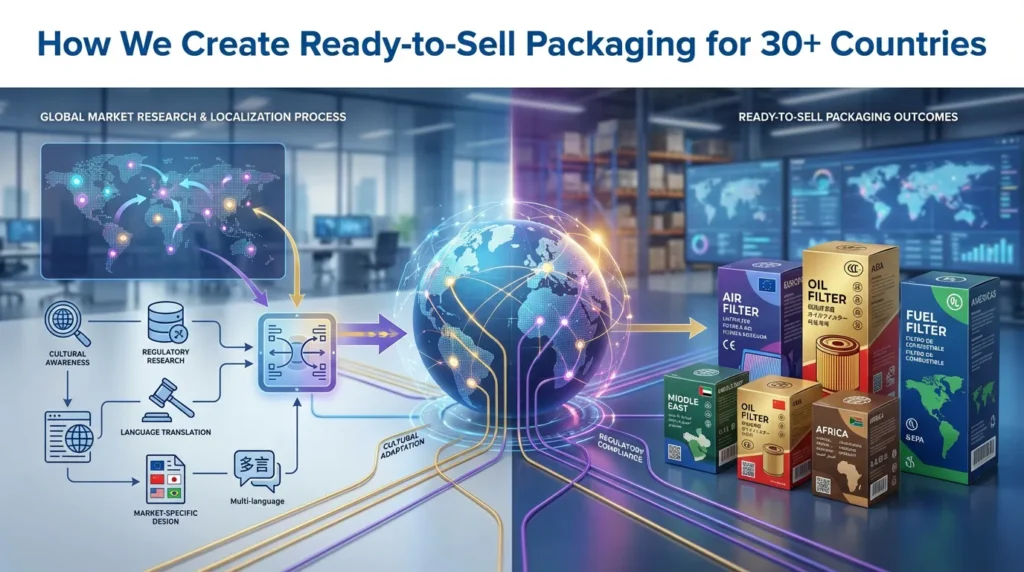
When you sell automotive filters into multiple markets, one of the biggest headaches is packaging:
- Different languages
- Different legal requirements
- Different logistics habits
- But you still want one consistent brand
If packaging is not planned correctly from the start, you end up with:
- Constant relabeling
- Local corrections with stickers and stamps
- Complaints from customs, warehouses, or workshops
- A brand that looks different in every country
At Beling, our filters are shipped with customer brands into 30+ countries across Europe, the Middle East, Latin America, and Africa. Over time we’ve built a structured workflow so that your packaging is ready to sell when it arrives – not “one more thing for you to fix locally”.
This article explains how we design and manage multicountry packaging for private label automotive filters.
Start With a Core Global Packaging Concept
We never design from zero for each country. That would be slow, expensive, and almost impossible to manage as you grow.
Instead, we start with a “core global” packaging concept that can work across regions.
1.1 What a Core Global Packaging Concept Looks Like
The core concept is built around:
- Clean, modern design
- Clear brand blocks:
- Your logo
- Your main brand color(s)
- Enough neutral space for:
- Labels and barcodes
- Extra languages
- Local markings and stickers
This core box:
- Matches your brand positioning(economy / mid / premium)
- Is neutral and flexibleenough to be adapted for different regions without redesigning from scratch each time
1.2 Why This Matters for MultiCountry Brands
Starting from a core concept gives you:
- A coherent brand identityeverywhere: your boxes still look like one brand in all markets
- Faster time to market: you don’t lose months designing new boxes for every new country
- Easier future updates: when you make changes, you update the core and apply them smartly across regions
At Beling, this core global concept becomes the foundation for all further regional adaptations.
Modular Packaging Layout: Fixed Areas vs Flexible Areas
To keep packaging manageable across 30+ markets, we use a modular layout. That means we split the design into areas that are:
- Fixed(always the same)
- Flexible(can change by region or customer requirement)
2.1 Fixed Areas: Your Brand’s NonNegotiables
Fixed areas define your visual identity:
- Logo placement
- Main brand colors and key visuals
- Overall design structure and hierarchy
These are the elements that make your brand look:
- Recognizable from a distance
- Consistent whether it’s on a shelf in Germany, Saudi Arabia, or Chile
We keep these fixed so your brand looks like one brand everywhere.
2.2 Flexible Areas: Regional and Customer Customization
Flexible areas are designed for adaptation:
- Language blocks
- Technical text or claims
- Regulatory and recycling icons
- Space for countryspecific stickers or labels
- Importer or distributor address fields
This modular approach lets us:
- Maintain a strong, consistent look
- Customize only where necessary for each region or customer
- Avoid spinning out dozens of totally different designs
For private label customers active in multiple regions, this modular structure is what keeps the project manageable long term.
MultiLanguage Packaging Strategy by Region
Language is one of the biggest challenges in multicountry packaging. Trying to make a separate box for every language is neither efficient nor costeffective.
Instead, we use a regional language cluster strategy.
3.1 Language Clusters We Commonly Use
We typically group countries into language clusters such as:
- Europe
- English + 2–4 European languages
- For example: EN + DE + FR + ES / PL / IT (depending on your key markets)
- Middle East / North Africa (MENA)
- EN + AR
- Sometimes plus FR for North African or francophone markets
- Latin America
- ES / PT + EN (Spanish / Portuguese + English)
This way, instead of 20 different box versions, we design a few smart combinations that still cover many countries.
3.2 How We Build the MultiLanguage Concept
In practice, we:
- Agree with you which markets are priority now and in the next 1–3 years
- Decide how many languages per box are practical:
- Too few: you need extra stickers everywhere
- Too many: the box becomes crowded and hard to read
- Use short, iconsupported text so:
- Translation is easier
- There is enough space for all languages
- The design stays clean
3.3 Result: Fewer Versions, Less Complexity
With this approach, you get:
- Boxes that can be sold in several countries at once
- Lower printing and stock management costs
- Less risk of “wrong language boxes” being sent to the wrong country
For brands active in multiple regions, this multilanguage clustering is a key lever to keep complexity under control.
BuiltIn Space for Labels & Local Requirements
Even with good multilanguage packaging, many distributors still need to add their own:
- Price stickers
- Warehouse location labels
- Local language stickers for specific regulations or tenders
If the packaging doesn’t anticipate this, labels end up:
- Covering logos or key information
- Making the overall box look messy or unprofessional
- Causing confusion in warehouses and workshops
4.1 How We Plan for Local Label Needs
We plan for this from day one by:
- Reserving clean, lightcolored areaswhere labels can be placed without destroying the design
- Making sure key elements (logo, part number, product type) remain visibleeven after extra labels are applied
- Keeping a standard label layoutthat:
- Works globally
- Can be slightly adapted per region or customer without changing the box design
4.2 Benefits for Warehouses and Retailers
This approach makes your packaging:
- Warehouse friendly:
- Staff know exactly where to put internal labels
- No important information gets covered
- Retail friendly:
- Price or promo stickers can be added cleanly
- The brand is still clearly visible to the end customer
Across 30+ countries, this simple planning step avoids a lot of daily frustration and visual damage.
Compliance & Packaging Marking Checklist
Different regions have different expectations and rules for packaging markings. Missing or misplaced information can cause:
- Customs delays
- Fines or rework
- Goods being rejected by retailers or inspection bodies
To avoid this, we use a practical compliance & markings checklist at the design stage.
5.1 Typical Packaging Requirements We Cover
Our checklist covers common needs such as:
- “Made in …” / country of origin
- Basic safety or usage icons (where relevant)
- Recycling symbols and cardboard identification
- Space for importer / distributor addressor imprint
- Any specific local markings that you tell us are required in your market
5.2 Defining What Goes Where
Together with you, we clarify:
- Which information is mandatory on the boxitself
- Which can be placed on the label only
- Which can be handled via a local stickeradded by your team (for example, specific legal wording in one certain market)
This balance is important to keep boxes:
- Legally compliant
- Visually clean
- Flexible enough to adapt to special country cases
5.3 Locking Compliance into the Artwork
Once the rules are clear, we:
- Integrate the mandatory elements into the box artworks
- Assign dedicated areas for optional/importer information
- Save the final layout in our system as your standard compliant design
The result: boxes arrive ready to go on shelf, not needing lastminute local corrections.
Data & Barcodes Standardized From the Start
If every region or local office starts “doing its own thing” with barcodes, part numbers, and label content, your brand quickly becomes fragmented and hard to manage.
To prevent this, we standardize data and barcodes from the beginning of the project.
6.1 Standard Barcode Strategy
We work with you to:
- Define a standard barcode type:
- Typically EAN/GTIN for retail and wholesale
- Optionally internal code formats if you have special needs
- Fix the barcode position on the label so:
- It is always in the same place
- Warehouse scanners can easily find and read it
6.2 Clear Information Structure on Labels
We keep a clear structure for key data, such as:
- Your part number(the primary code mechanics and buyers use)
- Short description (if needed and space allows, e.g. “Oil filter” / “Cabin filter”)
- OE / application references (depending on label sizeand your strategy)
- Batch and traceability codes
By standardizing this structure globally you avoid:
- Confusion when sharing stock between countries
- The need to relabelwhen sending products from one region to another
6.3 Benefits for 30+ Countries
For multicountry distribution, consistent data and barcode rules:
- Help central purchasingteams coordinate and compare across markets
- Make inventory control and stock transfers easier
- Reduce errors during receiving, picking, and reordering
At Beling, we build this consistency into the packaging and label concept from day one.
Sample Round Before Mass RollOut
Before we print tens of thousands of boxes for all your target countries, we always go through a sample and validation round.
7.1 What We Do Before Mass Printing
We prepare:
- Physical box samples (or highquality printed mockups)
- Labels with your:
- Logo
- Brand colors
- Language combinations
- Barcodes and codes
7.2 What You Check and Approve
You and your team can then check:
- Languages: spelling, grammar, priority order
- Logo colors: do they match your brand palette?
- Readability of part numbers and barcodes at real size
- Available space for your local stickers or price labels
- Overall visual impact and positioning of elements
If needed, we run one or more revision rounds to:
- Correct translation details
- Adjust color tones for your brand
- Finetune icon or text size and line spacing
- Slightly reorganize language blocks or label areas
7.3 Locking the Final Version
Only after your final approval do we:
- Lock the artwork version
- Register it with a clear ID in our internal system
- Start mass printing for your orders
This avoids unpleasant surprises when your first big shipment arrives.
Version Control for LongTerm Packaging Stability
For brands active in many countries, one of the worst scenarios is:
- Different box versions appearing in different shipments
- Old and new designs getting mixed in the same warehouse
- Customers thinking “this looks different – is it original?”
To prevent this, we apply strict version control to your packaging.
8.1 How Our Packaging Version Control Works
We:
- Give each customer’s packaging concept a version code
- Update it only when:
- You request a change, or
- There is a necessary regulatory or strategic update
- Clearly track which version is used for each production order and shipment
8.2 Why This Matters for MultiCountry Brands
This gives you:
- A stable, longterm packaging identity across all markets
- Clear documentation of:
- When design or text changes happened
- Which boxes correspond to which period and spec
- Easier change management when:
- You update your logo or design
- New regulations require new markings
Beling’s version control turns your packaging into a controlled asset, not a moving target.
Result: One Brand, Many Countries, Minimum Hassle
By combining:
- A global core design
- Modular layouts (fixed vs flexible areas)
- Smart language clusters
- Clear compliance & barcode rules
- Builtin label and local sticker space
- Controlled sample approval and version tracking
we help distributors run one consistent filter brand across 30+ countries, with packaging that is:
- Ready for customs
- Ready for warehouses
- Ready for workshops & retail shelves
Instead of spending months:
- Relabeling
- Correcting
- Fixing packaging problems locally
you can focus on:
- Selling
- Expanding into new markets
- Building your brand reputation
If you are planning to expand your private label filters into new regions and want packaging that works from day one – not only after long local adjustments – we can walk you through this packaging process for your brand step by step.
Beling – Save Your Time & Cost
Your valuable automotive filter partner since 2008.
Contact Our Team
Bruce Gong – Key Account Manager, Beling Filters
Email: bruce.gong@belingparts.com
WhatsApp: +86 150 5776 4729
LinkedIn: www.linkedin.com/in/brucegong-beling
We’re happy to share how we usually adjust pallets for EU vs Middle East vs Latin America markets, and help you fine tune palletization to your warehouse system.