A Guide to Hassle‑Free Importing
In international trade, a small paperwork error can trigger massive supply chain disruptions. One of the most common – and most expensive – mistakes is incorrect HS (Harmonized System) codes.
For automotive parts importers, a “wrong code” is not a minor typo. It can mean:
- Unexpected Fines: Penalties for misclassification, sometimes applied retroactively.
- Higher Duties: Paying 15% duty instead of 5% – directly eroding your margin.
- Container Holds: Demurrage and detention charges piling up while goods sit at the port.
- Delayed Sales: Stockouts and order cancellations that frustrate your distributors and workshops.
- Risk Flags: Your company becoming “high risk” in customs systems, leading to more checks in future.
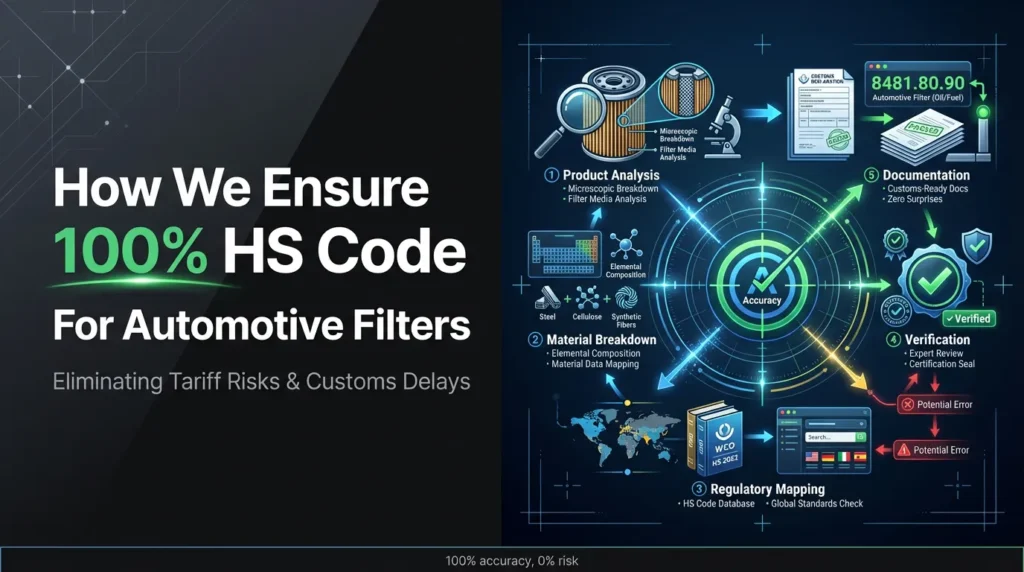
At Beling Filters, we treat Automotive Filter HS Code Accuracy as a critical part of our quality system – on the same level as checking dimensions, materials, and sealing. A correct HS code is not just a number on the invoice; it is part of how we protect your cost, time, and reputation.
Below is our structured process for getting HS codes right the first time, for every shipment.
Precise Categorization: Beyond Generic “Auto Parts” Codes
Many inexperienced suppliers use one generic “auto parts” code for everything simply to save time. On paper it looks easy, but in reality, it raises red flags with customs:
- Generic codes are often monitored more closely
- They do not match the actual nature and composition of the product
- They increase the chance that a customs officer decides: “We need to open this container.”
We do the opposite.
1.1 HS Classification by Product Function
Every SKU is classified according to what it actually does and how it’s constructed. We understand that Automotive Filter HS codes differ significantly by function and structure:
- Air Filters
- Typically classified under headings related to “air filters for internal combustion engines”
- HS sub‑classification often depends on the filtration media (paper / cellulose / synthetic) and intended application (passenger vehicles, trucks, machinery)
- Cabin Filters
- May fall under different lines depending on whether they are:
- Standard dust/pollen filters
- Or activated carbon cabin filters, which can be interpreted differently in some countries due to their additional adsorption function
- Oil Filters
- Spin‑on (metal canister type) vs. eco‑cartridge (element only) can fall under different sub‑headings
- Construction (metal housing vs. plastic, type of media, integrated valves) may influence local classification nuances
- Fuel Filters
- Can require distinct classification, especially for diesel applications, where some customs authorities have specific subcodes
- May attract differentiated duties depending on whether they are intended for off‑road equipment, commercial vehicles, or passenger cars
By mapping the exact HS code to the exact physical product, we ensure that your declaration corresponds precisely to what customs will see if they inspect the goods.
1.2 Internal HS Database by SKU
We maintain an internal HS database that links:
- Our SKU code
- Product category and structure
- Recommended HS code by region (e.g., EU, US, LATAM)
- Notes on special conditions or local interpretations
This means classification is:
- Consistent across shipments (no “different code every time” problem)
- Traceable (we can show why we chose a specific code)
- Auditable (easy to share the logic with your broker if needed)
Country‑Specific Customs Compliance
(EU, US, Middle East, LATAM & Beyond)
The HS system is internationally harmonized at the first 4–6 digits. But the last digits – and the interpretation – often vary from country to country.
A code that passes smoothly in Germany might trigger a query in Brazil. A code that is duty‑free in one market might carry an additional tariff in another.
We manage this complexity for you.
2.1 Adapting to Local Rules and Practices
We maintain working knowledge and references for our main destination markets:
- European Union (EU)
- Strong focus on material composition and exact product function
- Need to align with the Combined Nomenclature (CN) and often with customs rulings in specific member states
- For some filters, particular attention is required if they are used in industrial vs. automotive applications
- United States
- Alignment with the US HTS (Harmonized Tariff Schedule), which has its own detailed sub‑headings
- Close monitoring of Section 301 tariffs and potential exclusions or reclassifications affecting Chinese‑origin goods
- We can adapt codes and descriptions to minimize the risk of being misclassified into a higher‑tariff category
- Middle East (Saudi Arabia, UAE, etc.)
- HS codes must align with GCC customs practices
- Need consistency with SASO/ESMA related requirements for automotive components
- Documentation must match any local conformity assessment and pre‑registration systems
- LATAM (Brazil, Chile, Mexico, etc.)
- Complex NCM codes and national interpretations
- Higher risk of inspections, especially for automotive parts
- Some countries link codes to technical regulations or certificates, making correct classification essential to avoid long delays
2.2 Aligning With Your Broker & Local Practice
We don’t assume we know everything about your country’s practice. Instead, we:
- Share our recommended HS codes with your broker before shipment
- Adjust where necessary to match local rulings or internal company policies
- Document any agreed differences, so the same logic is used for future orders
This proactive alignment helps you avoid:
- Surprise duty increases at destination
- Inconsistent classification between shipments
- Customs audits accusing you of systematic under‑ or mis‑classification
Optimized Commercial Invoice Descriptions for Auto Parts
HS code accuracy doesn’t stand alone. The invoice description must support the code.
If an invoice simply says “Car Spare Part” or “Filter”, customs has no way to verify what the product actually is without:
- Opening cartons
- Inspecting the goods physically
- Potentially requesting technical documents
This costs time and money.
3.1 Customs‑Friendly Descriptions
We create descriptions that are short but clear enough for a customs officer to understand:
- Avoid: “Filter”
Use: “Automotive Air Filter (Cellulose Media) for Passenger Vehicle” - Avoid: “Oil Part”
Use: “Oil Filter (Spin‑on Type) with Threaded Base for Internal Combustion Engine” - Avoid: “Car Part”
Use: “Automotive Cabin Filter (Non‑woven Media) for HVAC System”
Our rule: an officer who has never seen your product should still be able to imagine what it is from the description alone.
3.2 Consistency Between Documents
We also ensure consistency across all trade documents:
- Commercial Invoice
- Packing List
- HS Code List or Appendix (if used)
- Certificates (if any)
- Carton Marks / Labels (as far as applicable)
This reduces the risk of:
- “Description mismatch” flags in customs systems
- Extra queries such as: “Invoice says filter; carton mark says engine part”
- Delays while brokers clarify information
The Pre‑Shipment Document Review:
“Measure Twice, Cut Once”
Many customs problems could have been avoided weeks before the vessel sailed – simply by reviewing documents together. That’s why we have a formal pre‑shipment document review process.
4.1 Draft Document Pack Before Loading
Before a single pallet is loaded into the container, we prepare a Draft Document Pack and send it to you (and, if you wish, directly to your customs broker or freight forwarder).
This pack typically includes:
- Draft Commercial Invoice
- HS codes for each line item
- Detailed product descriptions
- Quantities and unit prices
- Draft Packing List
- Carton count per item
- Net/Gross weight
- Pallet information (if required)
- HS Code Summary Sheet (if needed)
- Our proposed HS classification per SKU
- Notes on any special cases
- Carton Marking Samples
- To confirm they match the packing list, your internal codes, and local labeling requirements
You and/or your broker review these drafts and check:
- Are the HS codes correct according to your customs office and past practice?
- Are the descriptions clear enough and aligned with your internal standards?
- Are the values and quantities consistent with your purchase order and system?
- Do the carton marks align with your warehouse receiving process?
If something needs to be changed, we fix it before issuing the final documents and before stuffing the container.
This approach virtually eliminates:
- Last‑minute changes at the port of loading
- “Hold” statuses at destination due to unclear or inconsistent data
- Stressful calls and emails while the vessel is already at sea
Internal Controls: Treating HS Codes Like a Quality Parameter
For us, HS code accuracy is not a “paperwork detail”. We treat it like a quality characteristic of your shipment.
5.1 Training & Responsibility
We assign clear responsibilities internally:
- Export team trained on HS logic for automotive filters
- Regular updates when laws or practices change in major markets
- Internal checks for any unusual classification request (for example if a buyer wants to use an obviously incorrect “cheaper” code – we explain the risk and recommend a compliant alternative)
5.2 Documented Procedures
We have internal SOPs (Standard Operating Procedures) for:
- HS code assignment for new SKUs
- Validation of HS codes before issuing documents
- Communication flow with buyers and brokers on classification questions
This means our process is:
- Repeatable – not dependent on one person’s memory
- Auditable – you can see how we arrived at a classification
- Scalable – whether you buy 20 references or 2,000, the logic is the same
The Business Impact: Predictability, Profit, and Peace of Mind
Correct HS codes might seem like a technical detail, but they have a direct financial and operational impact on your business.
By partnering with a supplier that takes HS classification seriously, you benefit from:
6.1 Higher First‑Attempt Clearance Rate
Our goal with every shipment is 90–100% first‑attempt clearance success:
- No back‑and‑forth emails to “correct codes” after arrival
- No repeated customs holds on the same product
- Less time spent by your team chasing documents and clarifications
6.2 Lower Landed Costs
Correct classification avoids:
- Overpaying duties because a lazy or generic code was used
- Penalties and fines for repeated misclassification
- Retroactive duty adjustments after audits
Every percentage point of duty you save on high‑volume items goes straight to your bottom line. Over a year, this is often worth much more than squeezing a few extra cents off the unit price.
6.3 Reliable Lead Times & Customer Trust
With fewer unexpected delays at customs, you can:
- Plan your inventory more accurately
- Maintain service levels to distributors and workshops
- Build a reputation as a reliable brand that delivers on time
In the aftermarket, logistics disruptions quickly become market losses. A container held for 2–3 weeks during peak season can mean your competitors take your place on the shelf. Proper HS management is one of the tools to protect your market share.
What This Means for You as an Importer
When you work with Beling, you are not just buying automotive filters. You are partnering with a manufacturer that understands:
- Export compliance
- Customs expectations
- How documentation affects your cost and cash flow
We encourage you to:
- Involve your customs broker early in the process
- Share with us any local rulings or classifications you already have
- Build a standard HS framework with us for your product range
Once this framework is fixed, every new order becomes smoother, faster, and more predictable.
Need Support With Import Compliance?
Don’t let paperwork be the bottleneck in your supply chain. Work with a manufacturer that treats documentation and HS classification as part of the product quality itself.
If you are:
- Starting a new private label filter program
- Expanding your range of automotive filters
- Or facing frequent customs queries with your current suppliers
we can help you set up a clear, compliant HS code structure for your filter range and integrate it into our export process.
Connect with our Export Compliance Team:
Bruce Gong – Key Account Manager, Beling Filters
Email: bruce.gong@belingparts.com
WhatsApp: +86 150 5776 4729
LinkedIn: www.linkedin.com/in/brucegong-beling
Let’s make your next container not only high quality in products –
but also flawless in paperwork, from the factory gate to your warehouse.