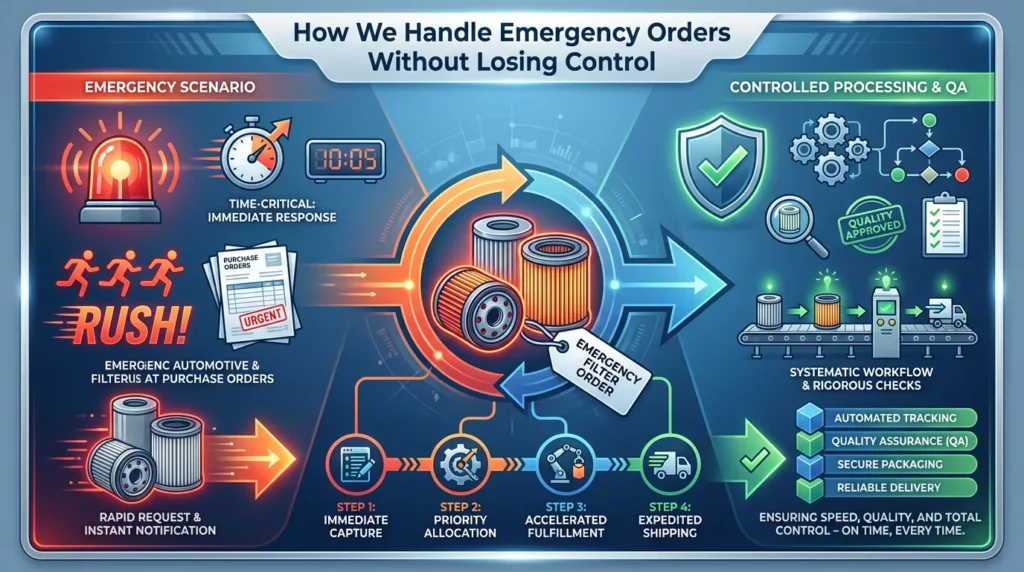
In the real world, even with solid planning and good forecasting, emergency orders still happen:
- A key customer launches a sudden promotion
- A fleet signs a contract earlier than expected
- A fastgrowing reference wasn’t captured properly in the forecast
The danger is not the occasional emergency. The danger is when every “exception” becomes normal – and the whole supply chain loses control.
At Beling, we accept that emergencies will happen. They are part of the reality of private label automotive filters.
Our job is to handle them without damaging:
- Your ongoing programs
- Our production stability
- Overall quality and lead time
This article explains how we manage that balance – and what you can expect from us when you face urgent demand.
First Rule: Protect the Base Business
1.1 Why the Base Pipeline Comes First
When an emergency order comes in, our first internal question is:
“How do we support this without hurting existing commitments?”
Your base business – your regular containers, scheduled orders, and Aitem availability – is what keeps your customers supplied and your brand trusted. If we handle emergency orders by pushing everything else into chaos, everyone loses:
- Your scheduled POs get delayed
- Other A items suffer stockouts
- Production quality risks increase under pressure
1.2 How We Protect Existing Commitments
So when an urgent request arrives, we always:
- Check the current production plan and confirmed POs first
- What orders are already in the pipeline?
- What is committed to other customers and markets?
- Ringfence capacity for A items already scheduled
- We identify which key SKUs must not be disrupted
- We protect the slots allocated to those critical references
- Avoid pushing existing orders into chaos
- We resist the temptation to “just push everything back”
- We calculate the domino effect before making a promise
If we can help, we will – but not at the cost of destabilizing your main pipeline.
Rapid Feasibility Check – Within 24 Hours
2.1 Speed With Structure
Emergency requests need fast answers, but not blind promises.
For urgent requests, we run a quick feasibility assessment, normally within 24 hours.
2.2 What We Check Internally
We quickly review:
- Available components and raw materials
- Do we have enough media, steel, plastic parts and packaging in stock?
- Are any components already allocated to other critical orders?
- Machine capacity in the relevant period
- Can we realistically fit extra batches into the schedule?
- Do we have enough trained operators on those lines?
- Impact on other customers’ orders
- Which POs would be affected if we resequence production?
- Are there contractual or critical commitments at risk?
- Possible loading windows and routes
- Next available container or truck slots
- Feasible ports, transit times and alternative routes
2.3 What You Receive From Us
Then we come back to you with clear options, not vague promises:
- Earliest realistic production completion date
- Possible shipment dates and modes(sea, truck, in rare cases air)
- Any tradeoffs(for example, prioritizing certain SKUs within the urgent order)
You get a concrete decision point, fast, so you can make choices based on real constraints instead of guesswork.
Priority Rules – When Everything Is “Urgent”
3.1 Why We Need Clear Priority Criteria
If we say “yes” to every urgent request without rules, no one wins:
- Lead times lose meaning
- Everyone’s orders become unstable
- Quality and planning discipline erode
So we use clear priority criteria when deciding how to treat an emergency order.
3.2 Our Priority Questions
For each urgent request, we ask:
- Does it affect ongoing availability of A items?
- Will a failure to support this order cause stockouts on top references?
- Is it linked to a critical key account or contractual penalty?
- Is there a tender, fleet or strategic customer involved?
- Is it caused by our side or purely by market demand?
- Did a delay, quality issue or planning error from us contribute?
- Or is this 100% due to unexpected demand or promotion?
- What is the frequency – oneoff or repeated pattern?
- Is this an exceptional event?
- Or does this SKU appear as “urgent” every few months?
3.3 When We Are More Flexible
We are more flexible when:
- It protects your key customersor strategic accounts
- It helps recover from an issue partly caused by us
But if emergencies become systematic, we won’t just keep reacting. We will raise the topic and work together on the root cause:
- Forecast quality
- Safety stock strategy
- Lead time expectations
- Range and A/B/C definitions
Our goal is not only to fix the symptom, but to avoid it repeating endlessly.
Smart Use of Overtime and Micro Slots
4.1 Creating Extra Capacity Without Chaos
When it makes sense to support an emergency order, the question is:
“How can we create extra capacity surgically, not destructively?”
Instead of throwing the whole plan into the air, we focus on targeted adjustments.
4.2 Tools We Use Internally
We look at options such as:
- Overtime shifts for a short period
- Limited, controlled overtime on specific lines
- Used to deliver peak volumes, not a permanent habit
- Small microslots between existing production batches
- Filling short gaps with urgent batches
- Avoiding major disruption to larger planned runs
- Aligning with planned production of similar SKUs
- Grouping similar filters to reduce changeover time
- Producing emergency quantities alongside existing batches
4.3 Result: Support Without a Chain Reaction
This approach allows us to create extra capacity where it matters most, so you:
- Get real support when you need it
- Avoid triggering a chain reaction of delayson all other POs
Your emergency is handled as an exception, not as a disruption to your entire supply chain.
Splitting Orders to Reduce Risk
5.1 Why “All or Nothing” Is Often the Wrong Question
One of our most effective tools is split solutions.
Instead of asking:
“Can you produce and ship everything urgently?”
We often propose a more strategic approach.
5.2 Typical Split Strategy
A common split solution looks like:
- Phase 1:
- A smaller urgent quantity for A itemsor critical SKUs
- Produced as fast as reasonably possible
- Shipped on the earliest viable departure
- Phase 2:
- The balance of the order
- Produced within the normal schedule
- Shipped with standard lead time and cost
5.3 Benefits of Splitting Emergency Orders
This approach offers clear benefits:
- You avoid stockouton key references that drive your sales
- We keep main production flow under controlfor all programs
- Total cost, risk and stressare much lower than trying to “rush everything”
In many cases, a partial urgent solution protects your market position better than a fullscale emergency that destabilizes your base pipeline.
Transparent Cost and Lead Time TradeOffs
6.1 Acknowledging the Real Cost of Emergencies
Emergency solutions often involve higher cost somewhere in the chain:
- Overtime in production
- Less efficient batch sizes and more changeovers
- Faster but more expensive transport options
We don’t hide this reality or bury it in the background.
6.2 Presenting Clear Options
Instead, we show you the real tradeoffs so you can decide:
- Option A: Faster, higher cost
- Shortest possible lead time
- Overtime and/or premium freight
- Used when stockout risk and penalties are very high
- Option B: Slightly slower, more economical
- Moderate acceleration of production and shipment
- Balanced impact on cost and schedule
- Option C: No change, if the impact is low
- Standard lead time
- No extra cost or disruption
6.3 You Stay in Control
By making these tradeoffs visible, we ensure:
- You keep control of where to spend and where to stay patient
- You can align choices with:
- Customer commitments
- Margin expectations
- Strategic priorities
Our role is to give you clear scenarios, not to decide for you behind the scenes.
Communication Rhythm During an Emergency Order
7.1 Avoiding Daily Chasing and Confusion
Once we agree on an emergency plan, the next risk is communication noise:
- Daily emails asking “Any update?”
- Confusion between urgent and regular POs
- Misalignment between your internal teams
We avoid this by building the emergency order into our existing communication structure.
7.2 How We Integrate Emergency Orders Into Reporting
We:
- Add the emergency order clearly into your weekly production / shipment reports
- Mark it as an emergency or priority line
- Show its status and timeline alongside your normal orders
- Mark it with priority status and expected completion date
- Easy to filter and monitor in your own systems
- Update you proactively if anything shifts
- Changes to completion date or ETD/ETA
- Immediate visibility of any new constraints
7.3 Visibility Without Extra Work
This way:
- You don’t need to chase us daily
- Your team can see where the emergency order sits relative to your main POs
- Internal planning and communication become simpler and more consistent
Emergencies are visible, but they are also controlled and traceable.
Turning Repeated Emergencies Into a Better Plan
8.1 When Emergencies Are a Symptom
If the same references are coming as “urgent” again and again, that’s not just bad luck. It’s a signal.
The signal might be:
- Underestimated demand on those SKUs
- Insufficient safety stock policies
- Promotional activities not reflected in the forecast
- Toooptimistic lead time expectations
8.2 How We Address Repeated Emergencies
We will proactively raise this pattern and suggest structural improvements, such as:
- Higher minimum stock on your sidefor those references
- More realistic forecast levels, reflecting what we now know
- Dedicated reserved capacity on our sidefor those A items
- Slightly shorter standard lead timefor a subset of critical SKUs, when feasible
8.3 From Crisis Mode to Planned Mode
The goal is simple:
What is an “emergency” today should be planned tomorrow.
By treating repeated urgent orders as planning signals, we help you:
- Reduce stress and firefighting
- Protect your brand and customer relationships
- Build a more predictable and resilientprivate label program
What This Means for You as a Buyer
With our emergency order approach, you can:
- Get real supportwhen the market surprises you
- Avoid destroying your overall supply stabilityto fix one issue
- Make informed decisionson cost vs speed
- Turn recurring crises into better longterm planning
We won’t promise the impossible.
But we will always:
- Respond quickly
- Explain clearly
- Offer structured options
- Protect the integrity of your supply chain as a whole
Because handling emergencies is not just about saying “yes” –
it’s about making sure that after the crisis, your business is still in control.
Beling – Save Your Time & Cost
Your valuable automotive filter partner since 2008.
Contact Our Team
Bruce Gong – Key Account Manager, Beling Filters
Email: bruce.gong@belingparts.com
WhatsApp: +86 150 5776 4729
LinkedIn: www.linkedin.com/in/brucegong-beling
We’re happy to share how we usually adjust pallets for EU vs Middle East vs Latin America markets, and help you fine tune palletization to your warehouse system.