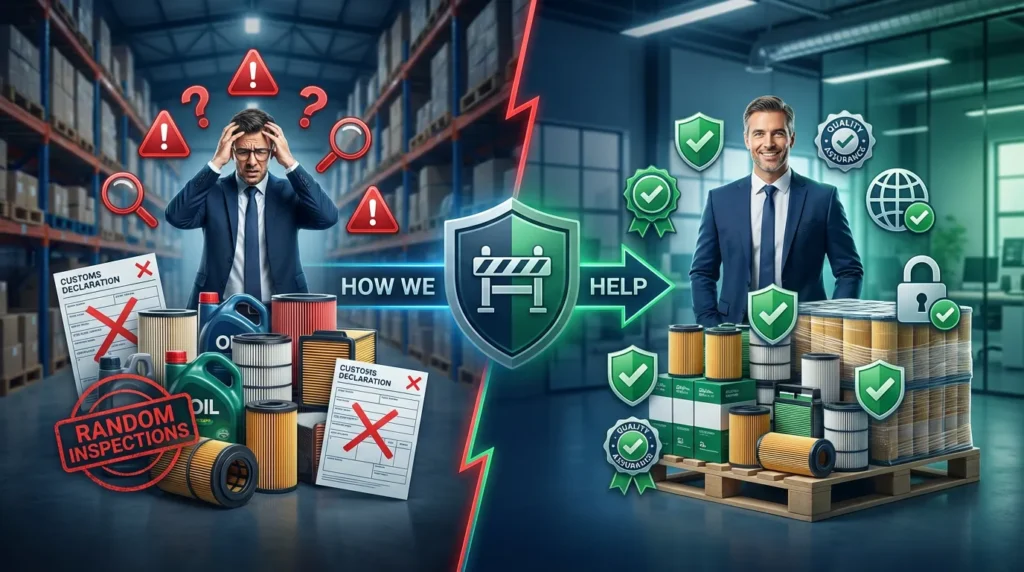
Many importers tell us:
“Customs picked our container for random inspection again…”
Sometimes, it really is random.
But many times, it’s not completely random.
Certain patterns, gaps and inconsistencies make a shipment look “interesting” to customs.
And “interesting” is not what you want when your container is sitting at the port.
At Beling Filters, we focus on those details before the container leaves, so that:
- Your shipments look low-risk on paper
- Your product descriptions help customs classify quickly
- Your shipment patterns look stable and logical
- Your labels and packing respect local rules
- If inspection happens, it is fast, clean and low-stress
In this article, we’ll explain:
- How clean, consistent export documents reduce customs red flags
- Why transparent product descriptions for automotive filters matter
- How stable shipment patterns for filter imports lower attention
- Why we focus on respecting local rules beyond origin
- How we prepare shipments for inspection even when it’s only “if”
Clean, Consistent Export Documents to Reduce Customs Red Flags 📑
(Customs Sees Paper First, Not Products)
Customs does not start by opening your container.
They start by looking at your documents.
If your paperwork looks messy, incomplete, inconsistent or illogical, your shipment starts to look like a risk.
1.1 What Customs Looks for in Documents
On a typical filter shipment, customs will review:
- Commercial invoice
- Packing list
- Certificate of Origin (CO)
- Other certificates or test reports, if required
They look for a clean story:
- Does the HS code match the product type?
- Do values, quantities and weights make sense together?
- Do invoice, packing list, CO and certificates refer to the same products, with the same codes and descriptions?
- Are there any “mystery items” or vague wording that hides what is really inside?
If they see gaps or contradictions, they are more likely to:
- Ask questions
- Trigger extra checks
- Decide that “a random inspection” might be useful
1.2 How We Keep Export Documents Clean and Consistent
For our automotive filter exports, we systematically check that:
- ✅ HS code matches product type
- Example: filters correctly classified, not thrown into a generic “auto parts” HS that can cause suspicion.
- ✅ Invoice, packing list, CO and certificates match each other
- Same product codes, same descriptions, same quantities and number of cartons.
- ✅ Values, quantities and weights are logical
- For example, the total gross weight is realistic for the number of filters and type of packing.
- ✅ No vague descriptions or “mystery” items
- We avoid unclear terms like “spare parts” when more detail is possible.
When the story on paper is clean, the shipment is less likely to attract the thought:
“Something is wrong here…”
That doesn’t guarantee no inspection, but it reduces avoidable red flags.
Transparent Product Descriptions for Automotive Filters 🛃
(Why Generic “Auto Parts” Can Trigger Extra Questions)
One of the most underestimated risk factors in customs clearance is how you describe the product.
Generic descriptions like “auto parts” or “filters” may look convenient, but they can actually increase customs interest.
2.1 Why Generic Descriptions Attract Attention
From customs’ point of view, generic descriptions create problems:
- They do not clearly support the HS code.
- They make it hard to understand what is really being imported.
- They can look like an attempt to hide something about the product.
So customs may:
- Ask for more detail
- Request technical documents or photos
- Decide to open cartons to see what is really inside
All of those mean delay and risk.
2.2 How We Describe Filters Clearly for Customs
For our filters, we use transparent, technical descriptions that help customs classify the goods faster.
We normally include:
- Product type
- Main use
- For motor vehicles / for passenger cars / for commercial vehicles / for engine intake system / for cabin filtration
- Material or key feature (where relevant)
- Non-woven synthetic media, paper media, plastic housing, metal end caps
This kind of description gives customs enough detail to say:
“I understand what this is; the HS code and value make sense.”
That reduces the need for them to stop the shipment to ask questions.
Transparent descriptions do not guarantee you will never be inspected, but they help your shipment look normal and explainable.
Stable Shipment Patterns for Filter Imports 📦
(Why Sudden Changes Can Invite Extra Attention)
Customs not only looks at one shipment.
They often look at patterns:
- How often you import
- What HS codes you usually use
- Typical volume, product mix, and suppliers
When patterns change suddenly, customs systems may flag the shipment as higher risk.
3.1 Shipment Pattern Changes That Attract Attention
Some examples of changes that can make a shipment “stand out”:
- Volume jumps from 1 pallet to 1 full container, without a history of gradual growth.
- An unusual mix of products that doesn’t look like your normal buying pattern.
- Introduction of new HS codes without history — especially if duty rates are lower or if the new code is often misused in that market.
None of these automatically mean something is wrong.
But in many customs risk systems, sudden change = worth a closer look.
3.2 How We Support Stable, Logical Patterns With Buyers
With long-term partners, we try to build a stable customs profile over time.
We do this by:
- Planning shipments gradually
- When you expand volume, we try not to go from tiny to huge overnight.
- Keeping product combinations logical
- Grouping filters in ways that fit your market’s buying and selling pattern.
- Informing you when a new HS might be needed
- When we introduce a new product type or new material that may require a different HS code, we highlight it early.
This makes your overall import pattern look consistent and explainable, supporting a lower risk profile in customs systems.
Again, this does not eliminate inspections.
But it reduces the chances of being flagged because “something suddenly looks different”.
Respecting Local Rules Beyond Origin and HS Codes 🌍
(Adapting Labels, Packing and Documents to Your Market)
Many exporters only focus on:
- Country of origin rules
- HS codes
- International documents
But many markets are also sensitive about local requirements, such as:
- Label language
- Mandatory information on labels or packaging
- Country of origin markings on cartons and products
- Specific local certifications or markings
If these are not respected, customs — or other local authorities — may:
- Hold the shipment
- Request re-labeling or re-packing
- Apply fines or require corrective actions
4.1 Asking the Right Questions About Local Practice
To reduce this risk, we actively ask our partners:
- “What did your broker request before?”
- Any specific label wording, language, or format?
- “Any past issues with our HS or descriptions in your country?”
- If a certain wording or code caused trouble before, we want to know and adjust.
- “Are there any mandatory label elements for filters in your market?”
- For example, local language, safety icons, recycling marks, or importer details.
4.2 Adapting Packing, Labeling and Documents
Based on your feedback and broker advice, we adapt:
- Carton labels and product labels
- Language, content, origin marking, any specific text.
- Packing arrangement
- Clear carton marking so warehouse and customs can identify products easily.
- Documents
- Descriptions, INCOTERMS, and supporting documents aligned with local expectations.
By respecting local rules and practices, not just international ones, we help reduce:
- “Formal” problems (legal/regulatory non-compliance)
- “Practical” problems (customs not understanding the shipment)
This again makes the shipment look more normal and compliant, reducing avoidable inspections.
Preparing Filter Shipments for Customs Inspection 🧾
(Planning for “If” – Not “If Ever”)
No exporter can honestly promise that you will never face a customs inspection.
Random checks are part of global trade.
But we can decide how ready we are when that inspection happens.
5.1 Our Mindset: Prepare for “If”, Not “If Ever”
We work with the mindset that:
“Inspection is always possible, so let’s be ready.”
That means, even when we hope the container is not stopped, we pack and document it as if customs will look inside.
5.2 What We Focus on for Inspection Readiness
For our automotive filter shipments, if customs inspects, we want them to find everything:
- ✅ Correctly labeled
- Cartons and inner boxes match the documents in terms of product code and description.
- ✅ Well packed and counted
- Quantities in each carton match the packing list.
- Carton numbering and marks match the shipping documents.
- ✅ Consistent with the documents
- What customs sees inside the container is exactly what is described on:
- Invoice
- Packing list
- CO and certificates
This way, if inspection happens:
- Customs can finish faster
- There is less stress for the importer, broker and our team
- The inspection is more likely to end with “OK, everything matches”
Random inspections will always exist.
But avoidable inspections, triggered by messy details, are the ones that hurt the most.
A Practical Pre-Shipment Checklist to Reduce Customs Inspection Risk ✅
(How We Review Shipments Before Containers Leave)
To make this approach repeatable, we use a simple internal pre-shipment checklist for filter exports.
Before the container leaves, we review:
- Document consistency
- Invoice, packing list, CO and certificates all show the same product codes, descriptions and quantities.
- HS code and description alignment
- Product description supports the HS classification and is clear enough for customs.
- Logical values, weights and volumes
- Total weight, CBM and invoice value are realistic for the type and quantity of filters.
- Label and packing compliance for destination market
- Labels include required language, origin marking, and any special information requested by the buyer or broker.
- Shipment pattern consistency
- No sudden unexplained jump in volume, strange product mix, or new HS not discussed with the buyer.
- Inspection readiness
- Cartons are clearly numbered and marked.
- Packing list layout is easy for customs and warehouses to follow.
This doesn’t give 0% inspection risk — nothing does.
But it significantly reduces the chance of being inspected because of avoidable doubts, and it makes any inspection that does happen smoother and faster.
Need Help Understanding Why Your Shipments Are Stopped?
If your shipments are frequently:
- Picked for “random” inspection
- Delayed by customs questions about HS, description or labels
- Flagged for inconsistencies in documents
and you’re not sure why, we can review your filter import case with you.
We can:
- Look at your current documents and descriptions
- Compare them with what customs usually expects for filters
- Suggest a more stable, transparent and consistent way to present your shipments
We also have a short pre-shipment checklist that we use internally to reduce inspection risk, and we’re happy to share a simplified version with serious partners.
Contact Our Team
Bruce Gong – Key Account Manager, Beling Filters
Email: bruce.gong@belingparts.com
WhatsApp: +86 150 5776 4729
LinkedIn: www.linkedin.com/in/brucegong-beling
Customs inspections may never disappear.
But with the right process, your shipments don’t have to be the ones that always get stopped.