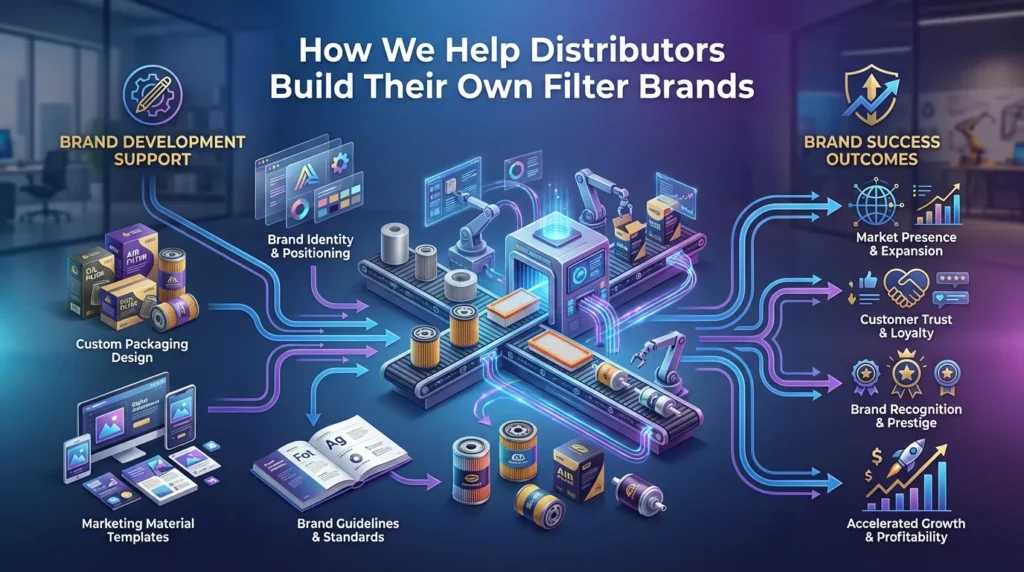
Many automotive parts distributors eventually reach a turning point:
“Why am I only selling other people’s brands?
Why not build my own filter brand and own the customer relationship?”
The idea is powerful. A successful private label filter brand can:
- Protect your margins
- Strengthen your bargaining power with customers
- Make your business harder to replace
But the challenge is doing it properly – with the right:
- Strategy and positioning
- Product range
- Packaging and identity
- Quality consistency and technical backup
- Data and operations
so the brand survives beyond the first few containers and becomes a real asset.
At Beling, a big part of our work is helping distributors and importers create and grow their own filter brands – not just buy neutral products. This article explains how we support that process step by step.
Start With the Strategy: What Kind of Filter Brand Do You Want?
Before talking about logos and boxes, we always start with a simple but essential question:
“What kind of brand are you trying to build in your market?”
1.1 Defining Your Target Segment
We help you clarify which segment you want to target:
- Budget / economy
- Focus on price competitiveness
- Basic but stable quality
- Suitable for very pricesensitive markets
- Midrange “value for money”
- Balanced quality and price
- Suitable for most independent workshops and retailers
- Often the best starting point for a new private label
- Higherspec “premium independent brand”
- Higher performance and reliability
- Positioning closer to OE or big global brands
- Requires strong technical story and consistent execution
1.2 Understanding Your Main Customers
We also look at who you mainly sell to:
- Wholesalers and subdistributors
- Retail shops / parts stores
- Independent garages and workshops
- Fleets, transportation companies, or industrial users
Each customer type expects a different:
- Price level
- Service level
- Brand message
We align the private label concept with your real customer base, not just a theoretical plan.
1.3 Mapping the Competition in Your Market
We then analyze your main competitors:
- Global OE brands(OEM/OES)
- Big independent brandswith strong marketing
- Local private labelsand “noname” imports
Together, we define:
- Where your brand should sit on the price ladder
- Which value pointsyou can realistically claim
- How to avoid direct conflict with players you cannot or should not fight headtohead
1.4 Output: Clear Positioning, Not Just a Logo
From this strategy discussion, we help you define:
- Target price level
- Target quality leveland warranty expectations
- Required product range depth(fast movers vs long tail, number of SKUs for launch)
This avoids the classic trap:
“Premium design on the box, economy quality inside.”
That combination creates shortterm sales but kills a new brand very fast once problems appear.
Range Building: You Don’t Need 500 SKUs on Day One
For a new filter brand, you do not need “everything.”
You need the right references, at the right time.
2.1 MarketFocused Range Building
We start from your real vehicle parc and market structure:
- You share key information:
- Main vehicle brands
- Typical models and years
- Key fuel types (diesel / petrol)
- We propose an initial Arange:
- High rotation oil, air, fuel, and cabin filters
- Covering a high percentage of vehicles with a compact, manageable list
The goal is not to impress on paper with a huge catalogue, but to build a range that sells and turns stock.
2.2 StepbyStep Expansion Plan
A common starting point is:
- 80–150 referencesfor the first phase, depending on your market size
After the first 1–2 seasons, we review together:
- Real sales data
- Stock rotation
- Feedback from your customers
Based on this, we:
- Add missing fast movers
- Move very slow movers into later phases
- Adjust the range structure as your brand gains traction
This stepbystep approach keeps your stock level and risk under control, while still growing the brand.
2.3 Cross Reference and Data Support
A private label is difficult to sell without clear technical cross references.
We provide:
- OE references
- Major aftermarket brand crosses
- Basic application data to help you create:
- Your paper or PDF catalogue
- Excel master lists
- Your webshop or ecataloguestructure
Result:
You launch with a sellable, stockfriendly range, not just a long part list that looks impressive but drains your cashflow.
Brand Identity: Logo, Packaging and Practical Positioning
Once the strategy is clear, we move to the visible part of your brand: how it looks and how easy it is to work with in daily operations.
3.1 Logo and Color Direction
Depending on your situation:
- If you already have a logo:
- We adapt it for packaging and labels
- Ensure readability on small and large boxes
- If not, we can:
- Work with your designer, or
- Connect you with partners to create:
- Logo proposals
- Color schemes
- Basic brand elements
Our focus is to keep the design:
- Recognizable
- Practical for print
- Consistent across different filter types
3.2 Packaging Design and Structure
We support you with:
We help define:
- Where part number, barcode, QR code, and language versions should be placed
- How to keep information consistent and easy to read
From the factory side, we also share practical advice:
- Which combinations of colors and finishes still look premium, but keep printing costs reasonable
- How to design boxes so they:
- Stack safely
- Are easy to identify in a dark warehouse
- Survive longdistance shipping without heavy damage
3.3 Labels, Barcoding and Part Number Logic
Confusing labels and part numbers create daily problems in warehouses and at counters.
We help you define:
- A simple and scalable part numbering logic
- Easy to understand
- Flexible enough for future references
- Label layout including:
- Your logo
- Part number
- OE cross (if required)
- Vehicle info (if required by your market)
- Barcoding format:
- EAN / GTIN
- Or your internal code format
Goal:
A brand that looks consistent across every reference and is practical in daily warehouse, catalogue and counter work.
Quality Level and Consistency: The Foundation of Any Brand
A filter brand is not just a box. It is the promise behind the box.
4.1 Quality / Price Positioning
Based on your chosen segment, we recommend:
- Media type and grade:
- Cellulose
- Synthetic blends
- Nonwoven media specifications
- End cap and sealing materials:
- PU, plastics, metal
- Gaskets and Orings suitable for your climate and fuel types
- Appropriate test standards for your segment:
- Filtration efficiency
- Pressure drop
- Burst pressure
- Collapse resistance
This ensures the technical performance of your brand matches its visual and price positioning.
4.2 Internal Standards and Validation for Your Brand
For your private label, we typically:
- Create golden reference samplesfor each part number
- Register agreed specifications and test resultsin our internal system
- Make sure every new batch is produced within that defined window, not just “similar”
This internal standardization is crucial to avoid:
- Batchtobatch surprises
- “This lot feels different” feedback from workshops
4.3 Complaint Handling and Technical Backup
No brand has zero complaints forever. The difference is how they are handled.
If there is any complaint in your market:
- We trace the exact batchshipped to you
- Retest or reproduce the conditions if needed
- Work together on:
- Root cause analysis
- Technical explanation
- Corrective actions and communication to your customers
This gives your brand real technical backup, which is critical when you stand in front of big customers or fleets.
Documentation and Marketing Support: Making the Brand Real
To make your brand real in the market, you need more than product. You also need data, visuals and technical points.
5.1 Structured Data Files
We provide structured Excel master files including:
- Part number
- OE cross references
- Major aftermarket brand crosses
- Basic application information (engine, model, year – depending on availability)
You can use this data to build:
- Printed or digital catalogues
- Webshop or ecatalogue
- Internal ERP and inventory systems
5.2 Product and Packaging Photos
Where available, we can support you with:
- Neutral or cobranded product photos
- Packaging photos
You can use these in:
- Catalogues and brochures
- Your website or webshop
- Social media and marketing materials
5.3 Technical Marketing Points
We help you identify technical selling points your sales team can use, such as:
- Use of specific media grades
- Application of ultrasonic weldingor PU technology
- Our quality system (IATF 16949)
- Internal testing processes (efficiency, burst, leakage, etc.)
This gives your sales team concrete arguments, not just “good quality, good price.”
Operational Setup: MOQs, SKUs and Stock Strategy
Starting a private label can become expensive if the operational model is not planned carefully. We help you design something realistic.
6.1 Minimum Order Quantities (MOQs) and Container Planning
We work with you to define:
- Reasonable MOQ per referencefor a new launch
- How to combine referencesefficiently to fill containers
- Which items can share packaging formats to simplify logistics
The goal is to balance factory efficiency with your financial and warehouse reality.
6.2 SKU Role and Stocking Strategy
Not all SKUs should be treated equally.
We help you decide which references should be:
- Always in stock(Aclass high movers)
- Seasonalor ordered on request
- Tested first with smaller quantities
We also share experience from other markets:
- Typical ABC product structure
- How many SKUs vs lines per year distributors of your size usually handle successfully
- How to balance breadth of rangevs stock value and cashflow
This helps you grow the brand without overstretching your capital and warehouse.
LongTerm Partnership: Evolving the Brand Together
A good private label is not a onetime project. It should grow and adapt with your market.
We support you long term by:
- Adding new references for new vehicle models as they enter your parc
- Improving existing parts when there are:
- Updated OE designs
- New market requirements
- Field feedback
- Reviewing your sales structure together and proposing:
- Range optimization
- Possible premium sublineor fleet/HD line if your market needs it
Our aim is not just to sell you filters, but to help you build an asset – a brand that belongs to you and increases the value of your company.
If you are considering starting or upgrading your own filter brand and want a manufacturing partner who can support you on strategy, range, design, quality and operations – not only price – we are ready to walk through the plan with you step by step.
Beling – Save Your Time & Cost
Your valuable automotive filter partner since 2008.
Contact:
Bruce Gong – Key Account Manager, Beling Filters
Email: bruce.gong@belingparts.com
WhatsApp: +86 150 5776 4729
LinkedIn: www.linkedin.com/in/brucegong-beling
Let’s make sure your next shipment is not only technically correct –
but also perfectly labeled for customs, warehouses, and workshops worldwide.