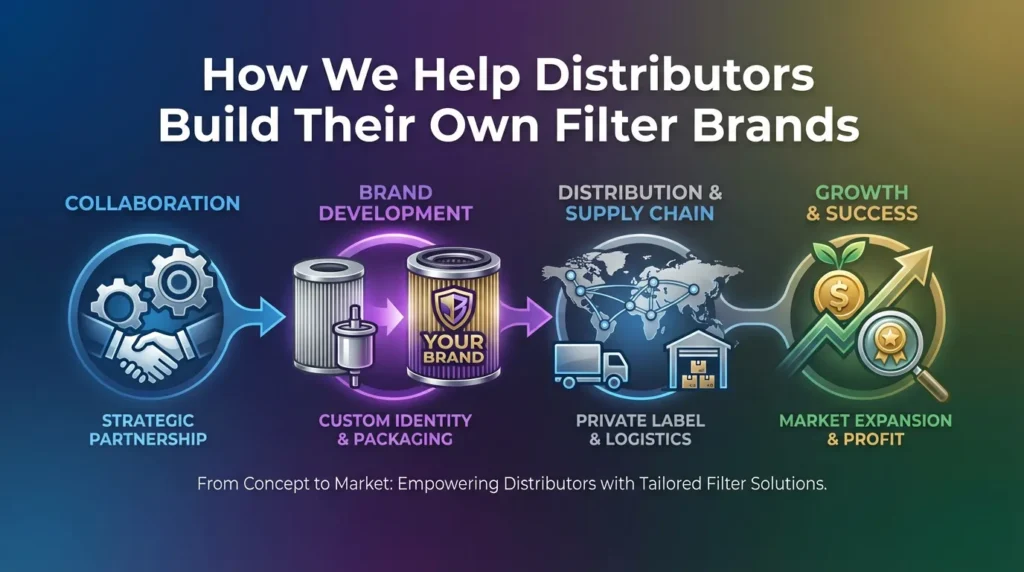
More and more automotive distributors are telling us the same thing:
“We want to launch our own filter brand, but we’re not sure where to start.”
They understand the business case perfectly:
- A private label brings better profit margins
- You create stronger customer loyalty
- You gain full control over pricing, positioning, and territory
Most importantly, you are no longer building someone else’s asset.
You are building your own.
But the process can feel confusing and risky:
- How do you choose the right SKUs for your market?
- How many references do you need to launch?
- How do you design packaging that looks professional and trustworthy?
- How do you avoid dead stock sitting in your warehouse?
At Beling Filters, we don’t see private labeling as a simple transaction:
“Send logo → print boxes → ship.”
We treat it as a step-by-step business project that needs planning, data, and long-term thinking.
Below is the 5‑step framework we use to help distributors and importers build successful, profitable filter brands.
Market Analysis and Brand Positioning
A successful brand starts with the market, not the logo.
Before we design a single box or confirm a single SKU, we sit down with you to clarify your strategy and positioning.
1.1 Asking the Hard Questions First
We start with questions like:
- Which Segment Are You Targeting?
- Budget-conscious fleets and taxi/ride-share operators?
- General independent workshops and parts retailers?
- Premium workshops and dealerships seeking OE-level alternatives?
- Who Is the Primary Buyer?
- Garage mechanics making the purchase decision?
- Retail parts shops and counters?
- End consumers buying online or at retail?
- What Is Your Brand Promise?
If you had to describe your brand in one sentence, what would it be? For example:- “The best value for fleets”
- “OE quality without the OE price”
- “Professional filters for professional workshops”
Your answer to these questions will affect:
- Product range and quality level
- Price positioning
- Packaging design and message
- Sales and marketing strategy
1.2 Why Positioning Comes Before Design
Without clear positioning:
- Every decision feels random or based on “gut feeling”
- Sales teams are unsure how to explain the brand
- Your brand looks like “just another box” on the shelf
By defining the target segment, buyer, and promise early, every later decision—from SKUs to pricing—becomes simpler, faster, and more effective.
Strategic SKU Selection (Phased Approach, Not “Everything at Once”)
One of the most common (and expensive) mistakes is trying to launch “the full catalog” from day one.
- Cash flow becomes tied up in slow-moving references
- Warehouse space is consumed by items that rarely sell
- The risk of dead stock increases dramatically
Instead, we recommend a phased approach based on data.
2.1 Phase 1 – Launch (Core Turnover Range)
Focus on a lean, profitable starter range:
- Typically 80–150 core SKUs
- Carefully selected fast-moving references based on your market
- Designed to generate consistent, predictable turnover
We analyze:
- Your local sales data (if available)
- Your current brands’ best sellers
- Our global coverage database of high-demand references
The result:
A data-backed “Starter List” that gives you maximum movement with minimum risk.
2.2 Phase 2 – Expansion (Coverage Building)
Once the initial range is moving well:
- We add SKUs strategically to reach 80–95% market coverage
- Focus on vehicles and engines commonly found in your region
- Consider fleet customers, aging vehicle parc, and new model trends
This phase turns your brand from “good selection” into a “mainline solution” for most customers.
2.3 Phase 3 – Niche & Strategic References
After your core range is stable:
- We add niche or strategic SKUs for:
- Luxury brands
- Heavy-duty or light commercial vehicles
- Specific regional imports or special applications
These SKUs might not be high volume, but they:
- Help you win key accounts
- Strengthen your brand image as complete and professional
By building the range in phases, you:
- Control your investment
- Learn from actual sales behavior
- Grow your brand with real data, not guesses
Translating Technical Specs into Real Selling Points
Internally, we speak the language of engineers:
- Micron ratings
- Media permeability
- Pressure drop curves
- Dust-holding capacity
But your sales team and customers often speak a different language:
- “Does it protect the engine?”
- “Will my mechanic complain?”
- “Can I trust this for my fleet?”
Our role is to bridge this gap.
3.1 Turning Technical Advantages into Simple Messages
We help translate OE-level technical specs into practical messages that sell:
- “High Efficiency”
→ “Protects engines longer and reduces wear.” - “Precise Dimensions”
→ “Fits perfectly every time—no workshop complaints.” - “OE-Grade Materials”
→ “Warranty-safe performance your customers can trust.” - “Burst & Leakage Tested”
→ “Safe even under extreme driving conditions.”
3.2 Tools We Provide
We can support you with:
- Technical Data Sheets (TDS)
- Filtration efficiency, burst pressure, media type, etc.
- Simple Sales Bullet Points
- For catalogues, brochures, and website content
- Training Content for Your Sales Team
- Short explanations they can use with workshops and retailers
The result:
Your salespeople don’t need to be engineers to explain why your brand is reliable.
Custom Packaging Design and Branding
Your box is your silent salesman.
In many cases, the workshop or retailer sees:
- The box
- The part number
- The brand name
long before they see the filter itself.
That’s why packaging is not just about printing a logo; it’s about projecting trust and professionalism.
4.1 Building a Visual Identity That Matches Your Positioning
Our design support includes:
- Visual Identity Development
- Colors, fonts, and graphic style aligned with your brand promise
- Different design routes for “economy,” “mid-range,” or “premium” positioning
- Information Architecture
- Clear, readable part numbers
- Cross-reference codes (OE and competitor brands)
- Vehicle application information where appropriate
- Technical Icons & Claims
- Simple visual icons for “OE-level quality,” “100% leakage tested,” etc.
- Supported by real test data from our production
4.2 Modern Features for a Professional Brand
We can also integrate:
- QR Codes
- Linking to your online catalog
- Installation videos or instructions
- Warranty and contact information
- Consistent Labeling System
- For individual boxes, master cartons, and pallets
- Makes warehouse handling and scanning easier
4.3 Visualizing Your Brand Before Production
To give you confidence, we provide:
- Realistic 3D and photo mockups of:
- Boxes
- Labels
- Master cartons
- Pallet layouts
This allows you to “see” your brand on the shelf before placing your first full packaging order.
Low MOQ and Inventory Risk Management
The biggest fear for any distributor launching a new brand is simple:
“What if I get stuck with dead stock?”
Filters that don’t move:
- Occupy warehouse space
- Tie up working capital
- Slowly damage confidence in the project
We address this concern with flexible production terms and smart planning.
5.1 Realistic MOQ to Get Started
We work with practical Minimum Order Quantities (MOQ) to support brand launches:
These quantities are:
- High enough for efficient production
- Low enough to control risk in the first 6–12 months
5.2 Smart Mix of A/B/C Items
We help you structure your first order with a balanced mix of:
- “A” Items – High-volume, fast-moving references
- “B” Items – Medium movers that round out your range
- “C” Items – Strategic SKUs for specific customers or applications
This approach helps:
- Maintain a healthy inventory turnover
- Avoid over-investing in low-demand references
- Support both short-term sales and long-term growth
5.3 Post-Launch Data Review
After 3–6 months, we review:
- Your sales performance by SKU
- Stock levels and movement speed
- Market feedback from workshops and retailers
Based on this data, we:
- Adjust your next order quantities
- Add or remove SKUs strategically
- Fine-tune your range and stock levels so your inventory remains lean and profitable
A Co-Developed Brand, Not Just an Order
For Beling, private label manufacturing is not a one-time transaction.
We don’t just print your logo and disappear.
We see ourselves as your long-term technical and manufacturing partner.
Our goal is to help you:
- Launch a professional filter brand with confidence
- Grow it sustainably over years, not months
- Turn it into a real asset on your balance sheet
If you are a distributor or importer thinking about launching your own filter brand, but feel unsure about:
- Where to start
- How many SKUs to choose
- How to position and package the brand
we’re ready to guide you through it step by step.
We have a simple, practical “Brand Launch Checklist” that we use to plan successful projects with new partners.
Ready to Build Your Own Asset?
If you’re ready to stop building other people’s brands and start building your own, let’s talk.
Contact:
Bruce Gong – Key Account Manager, Beling Filters
Email: bruce.gong@belingparts.com
WhatsApp: +86 150 5776 4729
LinkedIn: www.linkedin.com/in/brucegong-beling
Let’s co-develop a filter brand that combines:
- Your market knowledge and customer relationships
- Our engineering, manufacturing, and quality systems
so you can build a profitable, long-term private label filter business.