For distributors, predictable lead time is often more important than a “theoretical” fast lead time that changes with every order.
Unstable suppliers force you to:
- Increase safety stock “just in case”
- Say “I’m not sure” when customers ask for delivery dates
- Miss seasonal peaks, tenders, and promotion windows
- Spend time firefighting instead of growing the business
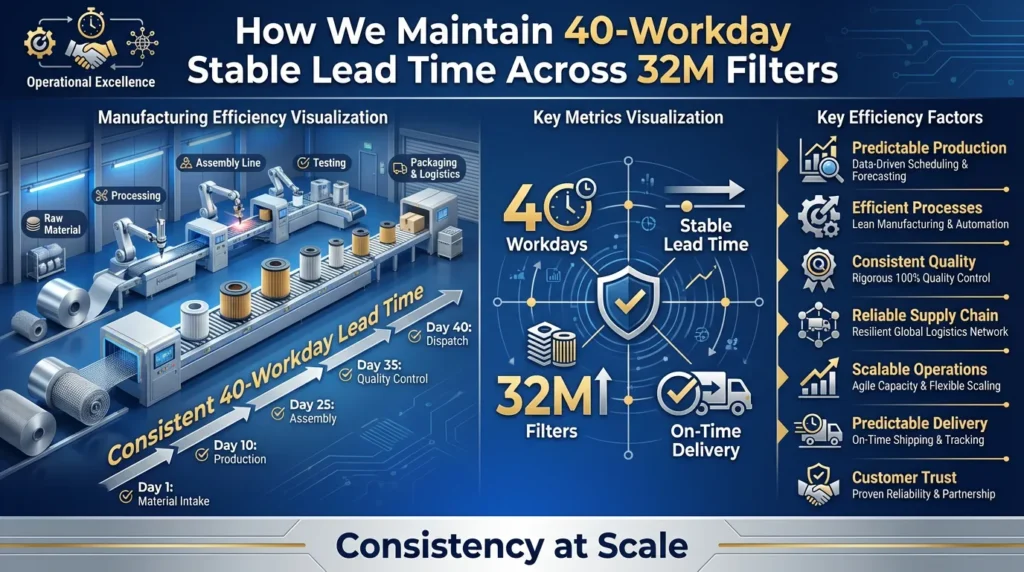
At Beling, we commit to a stable 40 workday lead time (FOB) across an annual capacity of 32 million filters – and we protect that number carefully.
This article explains how we structure our operation so that 40 days is a reliable promise, not a marketing line.
Capacity Planning Backwards From the Lead Time Target
1.1 Why We Start From 40 Workdays, Not From “Maximum Output”
Many factories start from the question:
“How many filters can we produce if everything is perfect?”
They then push orders into the system until they are overloaded – and lead times explode.
We reverse the logic. We start from the service level we want to guarantee:
“40 workdays from order confirmation to ready for shipment (FOB) for private label orders.”
Then we plan capacity backwards from that promise.
1.2 How We Allocate Capacity
To protect the 40day lead time, we:
- Allocate production slots to existing contracted customers first
- Set a maximum loading per production lineto avoid overbooking
- Keep buffer capacityavailable for:
- Urgent orders
- QCrelated rework
- Seasonal peaks or unexpected market demand
This means we do not “chase volume” beyond what fits into a realistic 40day schedule.
1.3 Result: Lead Time as a Design Constraint
By treating 40 days as a design constraint, not an “average”, we:
- Avoid sudden jumps to 60–90 days when orders increase
- Maintain service even when the market is strong
- Give distributors a time frame they can plan around for:
- Promotions
- Catalogue launches
- New program rollouts
ABC SKU Classification for Production Priority
2.1 Not All Filter SKUs Are Equal
In any automotive filter range, some SKUs move much faster than others. Trying to treat them all the same is a guaranteed way to create delays.
We classify items into three main categories:
- A items:
- High rotation
- Key references for most markets
- Critical for your daily sales
- B items:
- Medium rotation
- Important but less frequent
- C items:
- Low rotation
- Special applications and niche references
2.2 Production Rhythms by Class
Each class has a defined production rhythm:
- A items
- Produced in shorter, more frequent cycles
- Kept under closer monitoring for availability
- B items
- Regular, mediumsized batches
- Balanced between efficiency and availability
- C items
- Consolidated into efficient runs
- Still planned within the 40day lead time envelope
2.3 Why This Structure Matters for Distributors
Without this structure, factories often face the classic problem:
“We can make the special items, but then your best sellers are delayed.”
Our ABC approach ensures:
- Your key selling referencesare always prioritized
- Niche items are produced efficiently, without blocking the line
- The overall product mix remains inside the 40day window
Component and Filter Media Stock Strategy for Stable Lead Times
3.1 The Risk of “OrdertoOrder” Raw Material Purchasing
Stable lead time is impossible if every order depends on:
- Freshly ordered raw materials
- Long procurement cycles
- Singlesource suppliers
We manage critical components using a tiered stock strategy.
3.2 How We Manage Core Raw Materials
For core filter media and steel components, we:
- Maintain safety stock levels based on:
- Historical consumption
- Agreed forecasts with key customers
- Use multiple approved suppliers for key media types, to:
- Reduce supplier risk
- Maintain flexibility on volumes
For specific end caps, plastic parts and PU molds, we:
- Forecast usage with each major customer
- Keep tooling and fixtures ready for repeat runs
For packaging materials, we:
- Stock generic elements in advance:
- Inner boxes
- Outer cartons
- Master cartons and standard inserts
- Plan customerspecific printed packaging as ongoing programs, not oneoff purchases
3.3 Result: Orders Don’t Wait for Basic Materials
This stock strategy ensures that when your order enters our system:
- Production does not wait weeks for basic components
- Only truly special or new items require extra procurement time
- The 40day lead time is based on real material readiness, not assumptions
Standardized Processes for Private Label Projects
4.1 Where Many Factories Lose Control of Lead Time
New private label projects are where many suppliers:
- Mix project work with normal production
- Count artwork and sampling inside “lead time”
- Lose visibility of deadlines
We separate the process into two clear phases.
4.2 Part 1 – OneTime Project Phase (Outside the 40 Days)
This includes all setup work:
- Packaging artwork design and approval
- Sampling and validation (filters and packaging)
- SKU and barcode finalization
- Any specific customer quality approvals
We treat this as a project with:
- Defined milestones
- Clear responsibilities
- Transparent timing
Because this phase is onetime, we do not count it inside the 40 workdays.
4.3 Part 2 – Regular Order Phase (Inside the 40 Days)
Once the project is frozen:
- SKUs are marked as “production ready”in our system
- Packaging and labels have fixed codesand positions
- All materials are fully mapped with suppliers and internal processes
From this point, your repeat orders follow the same 40day lead time rule as any standard reference.
This separation avoids:
- Projects delaying regular orders
- “Surprises” caused by lastminute artwork changes
- Unclear expectations about timing
Integrated Production and Packaging Planning
5.1 The Common Gap Between Production and Packing
Many suppliers can produce filters on time, but then delay happens at the packaging stage:
- Filters wait for labels, boxes, or printed materials
- Packaging is done in a separate location or by subcontractors
- Final packing and palletizing are not aligned with production
This breaks the lead time promise.
5.2 Our Integrated Planning Approach
We integrate:
- Filter production
- Inprocess and final quality control
- Packaging and labeling
- Carton packing and pallet preparation
into one coordinated schedule.
This means:
- Filters are not left “naked” waiting for packaging
- Packaging lines are loaded in harmony with production lines
- Export documentation timingis aligned with final packing and FOB date
5.3 Why This Enables a Realistic 40Day Cycle
Because everything is planned together:
- We avoid hidden bottlenecks in packaging
- We can give realistic loading dates to your forwarder
- The 40day cycle is repeatable, not just a “best case” scenario
Order Entry Rules That Protect Reliability
6.1 Avoiding the “Yes to Everything” Trap
Some suppliers say “yes” to every order and every requested date… until the system collapses and lead times double.
We use clear order entry rules to protect the stability of our 40day commitment.
6.2 How We Process Each Order
When you send an order, we:
- Check capacityagainst current loading and commitments
- Confirm whether your volume fits within the standard 40 days
- If it does not fit, we offer:
- Split shipments:
- A items first
- C items slightly later
- Or a realistic extended lead timefor the extra volume
6.3 Why We Prefer Controlled “No” Over Unreliable “Yes”
We prefer to:
- Give a controlled “not possible within 40 days for this extra volume”
- Instead of promising 40 days and then missing it
This policy:
- Protects existing customers from surprise delays
- Keeps our overall planning stable
- Builds longterm trust with distributors who depend on reliability
Transparent Milestones Inside the 40Day Lead Time
7.1 The Problem of “Black Box” Production
For many buyers, production lead time feels like:
“We place an order and wait. Somewhere inside the factory, something happens… and one day we get a shipment.”
This lack of transparency makes planning difficult and creates stress.
7.2 Our Internal Milestones
Within the 40 workdays, we work with defined internal milestones such as:
-
- Day 1–5:
- Order confirmation
- Detailed planning
- Material availability check
- Day 6–25:
- Filter production
- Inprocess quality checks (dimensions, media, sealing, etc.)
- Day 26–32:
- Final quality control
- Packing and labeling into final packaging
- Day 33–40:
- Palletizing
- Export documentation
- Booking with forwarder and final dispatch (FOB)
7.3 How This Helps Distributors
This structure:
- Allows us to see deviations early
- Gives your account manager clear status pointsto communicate
- Facilitates coordination with your logistics team for:
- Container booking
- Consolidated shipments
- Deadlines linked to promotions or tenders
You get predictable visibility instead of vague promises.
Strict Change Control During Ongoing Orders
8.1 How MidOrder Changes Kill Lead Time
A very common reason for delayed shipments is:
- Midorder changes to:
- Packaging design
- Logos or colors
- Codes and text
- Technical or documentation specifications
Without control, one small change request can block a whole production batch.
8.2 Our Change Control Rules
To safeguard lead times, we apply structured change control:
- Any change (new logo, updated text, part number modification, etc.) is:
- Implemented from a defined future order, not midbatch
- Treated as a miniprojectwith its own timing and approvals
We do not mix:
- Old and new versions in the same production run
- Unapproved artwork into running orders
8.3 Impact on Lead Time Reliability
This approach:
- Prevents artwork or document changes from blocking a running plan
- Keeps the 40day system stable for all customers
- Ensures changes are implemented cleanly and traceably
Quality Built in, Not “End of Line Only”
9.1 Quality Problems as Lead Time Killers
Unexpected quality issues can destroy lead time:
- Whole batches needing rework
- Extra inspections added last minute
- Disputes about performance or specifications
We focus on building quality into the process, not just checking it at the end.
9.2 Our Quality Approach for Stable Lead Time
We reduce the risk of disruption by:
- Approving new parts via PPAPstyle procedures for key customers and markets
- Using inprocess controls:
- Dimensional checks
- Filtration performance (where applicable)
- Leak and sealing tests
- Fixing root causes quickly instead of:
- Reworking the same problems again and again
9.3 Why Quality and Lead Time Go Together
Stable quality means:
- Fewer surprises
- Fewer urgent reworks
- Fewer disputes or returns that block shipments
In other words: stable quality = stable lead time.
Forecasts and Framework Agreements With Key Partners
10.1 The Power of Visibility for Capacity Planning
With serious distributors, we often work with:
- Rolling forecasts:
- Nonbinding but indicative
- Updated regularly as market situations change
- Frame orders / annual agreements on key SKUs
10.2 How We Use Forecasts Internally
This allows us to:
- Preplan production wavesfor A and B items
- Maintain appropriate raw material and packaging stocks
- Reserve line capacityfor your business in advance
The result is that even as your volume grows:
- The 40day lead time remains realistic
- We can absorb seasonal peaks with less stress
- You can launch new programs with greater confidence
What This Stable 40Day Lead Time Means for You
Because of this structured system, our customers gain:
- A clear standard lead time:
- 40 workdays production (FOB), not “it depends”
- Higher reliability in their own promises to:
- Workshops
- Dealers
- Key accounts and tender customers
- Reduced need for:
- Emergency air shipments
- Panic stock builds
- Expensive lastminute solutions
- Easier planning of:
- Promotions and campaigns
- Catalogue launches
- New range introductions
If your current filter supplier gives you a different lead time every order, we can show you how a designed production system keeps a stable 40day cycle, even at 32 million filters annual capacity.
Beling – Save Your Time & Cost
Your valuable automotive filter partner since 2008.
Contact Our Team
Bruce Gong – Key Account Manager, Beling Filters
Email: bruce.gong@belingparts.com
WhatsApp: +86 150 5776 4729
LinkedIn: www.linkedin.com/in/brucegong-beling
We’re happy to walk through your current shipping pattern and see where moving from LCL to FCL (or structuring a mix of both) can protect your margin and your reputation.