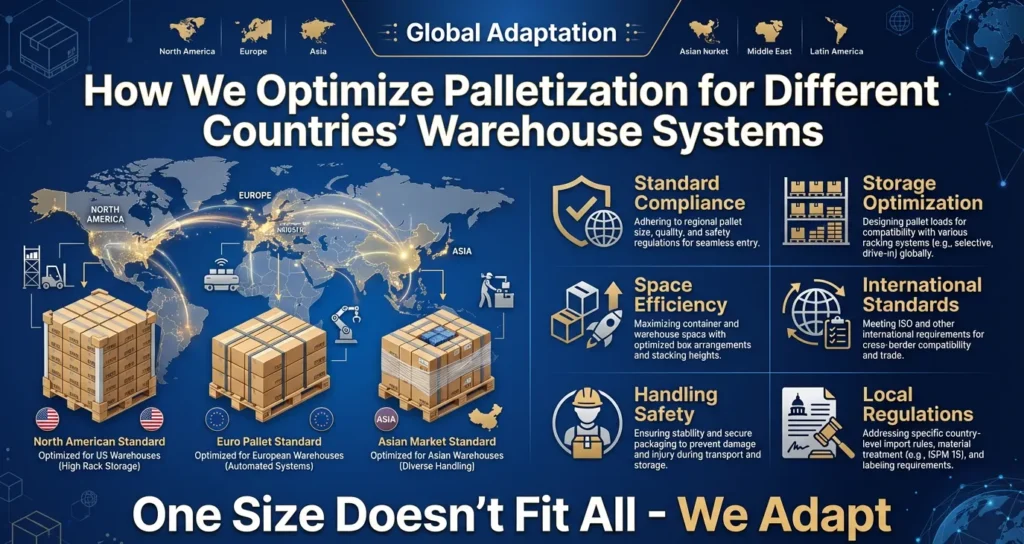
Many people think palletization is only about fitting more in the container.
In reality, good palletization starts from the destination warehouse. 🏬📦
- Forklifts
- Racks
- Aisles
- Local pallet standards
- Automation level
All of these vary country by country – sometimes even warehouse by warehouse.
If a pallet is “perfect” in the container but hard to handle in your warehouse, you pay the price in:
- Extra labour
- Re-palletizing
- Higher damage rate
- Unnecessary stress for your warehouse team
At Beling Filters, we design palletization around where the pallet will live and move after it leaves the container, not just how it fits inside the box.
In this article, you’ll see how we adapt our palletization to different warehouse systems by:
- Starting with the destination pallet standard
- Matching pallet height to racking and manual handling
- Designing carton patterns for stability and easy picking
- Adjusting stretch wrap strategy by route and warehouse style
- Using clear markings for multi-warehouse operations
- Improving continuously based on warehouse feedback
If your current suppliers never ask about your warehouse setup, there is almost certainly room to improve.
Start With the Destination Pallet Standard for Each Country 📏
(Footprint First: Avoid Overhang and Wasted Space)
Not all pallets are 1200×1000.
Different regions use different standard pallet sizes:
- Europe: 1200×800 (Euro pallet) is very common
- North America: 48″ × 40″ (approx. 1219 × 1016 mm)
- Some Asia / Middle East / Latin America:
- Local custom sizes
- Mixed use of Euro / industrial / non-standard pallets
- Sometimes “no standard” at all
If we ignore these differences and ship everything on the same pallet size and pattern, you will pay for it in:
- Overhang on racks
- Wasted space in your warehouse
- Extra re-palletizing work
1.1 Asking the Right Questions Before Designing Pallets
With new partners, we start from your warehouse, not from our container:
We ask:
- “What pallet size works best in your warehouse?”
- Euro pallet or industrial pallet?
- Any local standard your racks and forklifts are set up for?
- “Any specific restriction from your racks or forklifts?”
- Minimum / maximum pallet dimensions
- Special requirements for automated systems
Based on your answers, we design the pallet footprint to:
- Avoid overhang beyond pallet edges
- Make sure pallets sit correctly in racks
- Reduce wasted space between pallets in your storage layout
1.2 Why This Matters in Real Operations
When pallet footprint matches your warehouse standard:
- Pallets move more safely on forklifts
- They fit into racks without improvisation
- You avoid “creative” solutions like mixing pallets or double-handling
This is the foundation for smooth inbound handling.
Match Pallet Height to Racking and Manual Handling Limits 📐
(The “Perfect” Container Pallet Can Be a Problem in Your Warehouse)
A pallet that is “perfect” for container filling can be a nightmare in the warehouse.
- Too high →
- Doesn’t fit in racks
- Unstable when moving
- Risk for sprinklers and lighting fixtures
- Too low →
- Too many pallets to handle
- Higher labour and forklift movements
- More space used than necessary
We don’t aim for “maximum height” by default. We aim for operational fit.
2.1 How We Decide Pallet Height for Different Markets
We adjust pallet height based on:
- Rack clear height
- The usable space between beams, minus a safety gap.
- Typical stacking pattern
- Do you double-stack pallets on the floor?
- Do you place pallets in very high racks?
- Safety margin for sprinklers and lights
- Making sure loaded pallets do not interfere with fire safety or ceiling installations.
We actively ask:
- “What is your maximum pallet height (including pallet) for racking?”
- “Do you double-stack on the floor? If yes, what is your typical max height?”
2.2 Result: Pallets That Go Straight Into Your System
When pallet height is adapted to your warehouse:
- Pallets can go directly from the container to the rack
- No need to manually remove top layers
- Less re-stacking and repalletizing
- Better utilisation of your racking system
In practice, this reduces:
- Incoming congestion
- Handling damage from unnecessary rework
- Labour cost and forklift congestion at inbound
- Daily stress on your warehouse team
Carton Pattern for Stability and Easy Picking on Pallets 📦
(Not Just Piling Boxes Until “It Looks Full”)
We don’t just stack cartons “until it looks full”. 😅
The carton pattern on the pallet is critical for:
- Stability during transport and handling
- Protection of carton corners
- Efficiency in picking and inventory counting
3.1 Designing a Stable Carton Pattern
We pay attention to:
- Interlocking patterns
- Alternating carton orientation layer by layer where needed, so stacks interlock and are less likely to lean.
- Avoiding “mushroom” shape
- No cartons hanging over the pallet edges.
- Overhang makes corners very vulnerable to forklifts, walls and other pallets.
- Even weight distribution
- Heavy cartons not all on the same side.
A stable pattern reduces:
- Leaning pallets after long transport
- Crushed corners and edges
- Risk of collapse when handled by forklift or pallet jack
3.2 Labels and Barcodes Facing Outward
We also consider operations inside your warehouse:
- We keep labels and barcodes facing outward where possible.
- We avoid burying key information inside the pallet.
This makes life easier for:
- Your forklift drivers
- They can quickly identify pallets and avoid wrong moves.
- Your picking team
- They can scan or visually confirm SKUs without dismantling half the pallet.
- Your inventory counting
- Visible labels on the outside reduce confusion and miscounts.
Result:
- Less broken corners from unnecessary handling
- Less re-stacking during stock checks
- Faster, cleaner inbound and picking process
Different Markets, Different Stretch Wrap Strategy 🎞️
(Humidity, Automation and Handling Style All Influence Wrapping)
Not all routes and warehouses need the same wrapping strategy.
For some customers, over-wrapping wastes time and film.
For others, under-wrapping leads to damage and instability.
We adapt our stretch wrap strategy to:
- Route conditions
- Climate
- Warehouse equipment
- Handling style (automated vs manual)
4.1 Examples of Wrap Strategies for Different Situations
A few typical patterns:
- Humid, long distance sea routes
- Thicker or higher quality stretch film
- More wraps for stability
- Top plastic cover to protect from condensation or rain at ports
- Very automated warehouses
- Very tidy edges, no loose film hanging out
- Stable, “clean” pallet profile for conveyor systems and automated storage
- Consistent wrapping height so machines can handle pallets reliably
- Manual handling environments
- More emphasis on corner protection
- Robust but not overly tight wrapping that still allows manual picking from pallets
4.2 Parameters We Adjust for Each Warehouse System
We adjust:
- Film thickness & number of wraps
- Enough to stabilise the pallet without over-wasting material.
- Use of corner protectors
- More protection for fragile cartons or when manual handling is common.
- Top sheet vs no top sheet
- Used for moisture and dust protection where needed, left out when not necessary.
We ask:
- “Do you use automated pallet handling systems?”
- “Do your teams often pick directly from the pallet in the warehouse?”
- “How long do pallets typically stay in your warehouse before moving again?”
This helps us design wrapping that fits your actual flow, not a generic average.
Clear Markings for Multi-Warehouse and Multi-Region Operations 🏷️
(Less Chaos at Inbound, Faster Cross-Docking)
Many distributors serve more than one:
In such setups, clear pallet markings are crucial to avoid inbound chaos.
5.1 What We Put on Pallet Labels
On pallets, we normally include:
- Large, visible pallet labels
- Readable from a distance by forklift drivers.
- Destination code / warehouse code
- For distributors serving several warehouses, each pallet can carry a simple code indicating its final destination.
- PO number and customer reference
- Easy linking to your ERP and inbound bookings.
- SKU range and total quantity
- Indicating which SKUs are on the pallet and total units on that pallet.
These markings are agreed up front and can be adapted to:
- Your internal codes
- Your WMS (warehouse management system) fields
- Language or numbering preferences
5.2 How Clear Markings Help Your Team
Good pallet labelling helps your team:
- Cross-dock faster
- Direct pallets immediately to the right outbound truck or warehouse.
- Direct pallets to the right warehouse or sub-region
- No mixing of stock for different locations.
- Reduce picking mistakes
- Clear visual separation of pallets for different customers or regions.
Result:
- Less chaos at inbound
- Fewer routing mistakes
- Less time spent searching for the “right pallet”
Good palletization, including smart labelling, is the basis for smooth multi-warehouse operations.
Continuous Improvement Based on Warehouse Feedback 🔁
(Every Container Is a Chance to Make Handling Easier and Safer)
We don’t assume our palletization is “perfect” from the first shipment.
With long-term partners, we treat each shipment as one more data point to improve:
- Safety
- Efficiency
- Usability in your warehouse
6.1 How We Work With Your Warehouse Team
We actively:
- Ask warehouse teams for feedback
- Not only purchasing or logistics managers – we value input from the people who actually handle pallets every day.
- Adjust pallet height / size / carton pattern
- If they report repeated issues (e.g. pallets too tall, labels not visible, cartons difficult to access), we adapt.
- Test small changes on next shipments
- We don’t change everything at once – we test, measure and refine.
Examples:
- Reducing pallet height by one carton layer to fit a specific rack row
- Change label position so it’s visible from the most common approach angle
- Slightly modifying the pattern to stabilise certain carton sizes
6.2 The Goal: Easier, Safer Handling for Your People
Every container is a chance to make handling a bit easier and safer for your people:
- Less bending and re-stacking
- Fewer damaged cartons
- Less time spent fixing “bad pallets”
Over time, this leads to:
- More efficient inbound workflows
- More predictable handling times
- Lower damage and claim rates
Palletization is not just a “logistics detail”.
It directly affects:
- Warehouse efficiency
- Damage rate
- Labour cost
- Daily stress in your operations
If your current suppliers never ask about your warehouse setup, they are likely optimising for their own convenience, not for your entire supply chain.
How We Usually Adjust Pallets for EU vs Middle East vs Latin America 🌍
(Adapting Palletization to Different Regional Realities)
Different regions often have different realities:
- Local pallet standards
- Typical warehouse design
- Climate and humidity
- Handling practices (manual vs automated)
We typically see patterns such as:
- EU markets
- Strong preference for Euro pallets (1200×800)
- High use of racking and structured inbound processes
- Often more automation and stricter safety requirements
- Middle East markets
- More variation in pallet standards
- Often very hot and sometimes humid climates
- Warehouses can range from simple floor storage to high-end facilities
- Latin America markets
- Mixed pallet standards, sometimes adapted to local transport constraints
- Manual handling still quite common in some countries
- Transit routes can be long and complex
For each of these, we adjust:
- Pallet footprint
- Typical pallet height
- Wrapping strategy (film, corner protection, top cover)
- Labelling and markings
If you’d like, we can share some standard patterns we use for each region and adapt them to your specific warehouses.
Want to See How We Adjust Pallets for Your Market?
If you often feel that:
- Pallets arriving from suppliers are too high or unstable
- Your team spends a lot of time re-palletizing or re-stacking
- You see unnecessary damage on the bottom layers
- Inbound days are chaotic when containers arrive
there is likely latent savings and efficiency in better palletization.
We can:
- Review photos or specs of your current inbound pallets
- Understand your racks, forklifts and handling flow
- Propose a country- and warehouse-specific palletization setup for your filters
Contact Our Team
Bruce Gong – Key Account Manager, Beling Filters
Email: bruce.gong@belingparts.com
WhatsApp: +86 150 5776 4729
LinkedIn: www.linkedin.com/in/brucegong-beling
We’re happy to share how we usually adjust pallets for EU vs Middle East vs Latin America markets, and help you fine tune palletization to your warehouse system.