Most professional distributors are not afraid of selling.
They’re afraid of audits:
- Internal audits
- Customer audits
- Tax audits
- Customs audits
No matter who is auditing, sooner or later they ask the same question:
“Can you prove what you bought, from whom, and under what conditions?”
That is where documentation quality suddenly becomes more important than any sales pitch.
For automotive filter distributors, poor documentation can mean:
- Extra questions from auditors
- Delays in tax refunds or customs processes
- Disputes with key accounts about what was supplied
- Pressure from compliance and finance teams
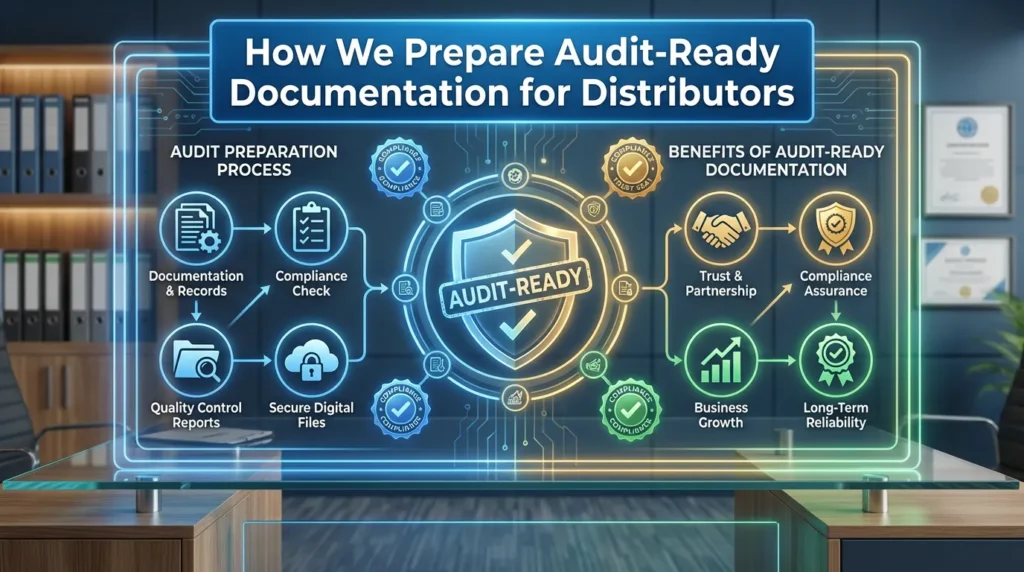
At Beling Filters, we build our export documentation with audit readiness in mind, so that when auditors visit our distributors, they see:
- One consistent story
- Clear traceability
- Easy access to origin and compliance evidence
In this article, we’ll explain how we:
- Create clear, consistent commercial documents for each shipment
- Support traceable product identification across the supply chain
- Keep origin and compliance evidence ready to show
- Use digital archiving for long term partners
- Maintain a simple structure for fast retrieval
Clear, Consistent Commercial Documents for Filter Shipments 🧾
(So Auditors See One Story, Not Three Versions)
Every audit, regardless of who performs it, starts by comparing:
- What your system says
- What your supplier’s documents say
- What your warehouse and customers say
If these don’t match, auditors start to ask more questions.
For each filter shipment, we prepare and keep a complete commercial documentation set:
- Proforma Invoice (PI)
- Commercial Invoice
- Packing List
- Contract or Purchase Order (PO)
- Certificates (where required – origin, quality, conformity, etc.)
1.1 Why Consistency Across Documents Matters in Audits
Auditors typically cross-check:
- Part numbers and descriptions across invoice, packing list and your ERP
- Quantities and total amounts against warehouse receipts and payments
- Brand and country of origin against what you claim to customers and authorities
- Incoterms, payment terms and dates against your accounting and contracts
If they see three different stories, you will need to spend time explaining:
- Why documents don’t match
- Whether it was a mistake or something more serious
- How you control your supplier documentation
1.2 How We Ensure Clear, Consistent Commercial Documents
For each shipment, we make sure that:
- Part numbers, descriptions and quantities match
- The same filter codes and descriptions appear on the PI, invoice and packing list.
- Brand and country of origin are consistent
- No mix of old/new brand, no missing or conflicting origin information.
- Incoterms, payment terms and dates are traceable
- PI, contract and invoice all show compatible Incoterms and payment conditions.
- Shipment date and document dates make sense together.
The result is that when auditors compare:
- Your system records
- Our invoices and packing lists
- Your warehouse receipts
they see one coherent story rather than three versions of reality.
Traceable Product Identification for Filter Distribution 🔍
(Making It Easy to Answer “Which Product Did You Supply?”)
Filters often move through several steps:
Supplier → Distributor → Wholesaler → Workshop / End User
By the time an audit or complaint happens, the product may have moved far from the original shipment.
A common audit or key account question is:
“Which exact product did you supply to this customer and under which reference?”
To answer that confidently, you need traceable product identification.
2.1 Why Product Traceability Matters for Distributors
Without clear product identification and traceability, you may struggle to:
- Link a customer complaint to a specific batch
- Prove that you supplied the correct filter for a certain vehicle
- Explain to auditors how you manage product codes and substitutions
- Justify price differences between similar items
This can create doubts about:
- Quality control
- Master data management
- Commercial fairness
2.2 How We Support Traceable Product Identification
We support distributors with:
- Stable part numbers over time
- We avoid frequent, unnecessary part code changes that break history.
- Cross reference lists
- Linking our filter codes to:
- OE (original equipment) references
- Competitor references
- Distributor internal codes
- Linking carton labels to invoice item codes
- The code on the carton and individual box matches the code on the invoice and packing list.
This allows you to:
- See which Beling part number was used for each customer order
- Know which OE/competitor code that part corresponds to
- Quickly prove, during audits, exactly which product was supplied in each case
When an auditor or key account asks, “Which exact product did you supply to this customer?”, you can:
- Show the invoice
- Show the packing list
- Show the label layout or photo
- Show the cross-reference
And everything aligns.
Origin and Compliance Evidence Ready to Show 🌐
(Answering “Where Is It From?” and “Is It Classified Correctly?”)
Many distributors are asked to show evidence about:
- Country of origin
- HS (tariff) classification used for imports
- Compliance with local rules (safety, labeling, quality standards, where applicable)
If you rely only on random old emails or unstructured PDFs, audits become painful.
3.1 What Auditors Typically Ask About Origin and Compliance
In customs, tax or customer audits, common questions include:
- “Can you prove the country of origin of these filters?”
- “Why did you use this HS code?”
- “Do you have any quality certificates or conformity evidence for this product range?”
If you cannot provide this quickly and clearly, auditors may:
- Question your declared duties or tax treatment
- Doubt the correctness of your HS classification
- See your compliance system as weak
3.2 How We Keep Origin and Compliance Evidence Audit Ready
For our shipments and long-term partners, we prepare and keep:
- CO (Certificate of Origin) copies and serial numbers
- So origin evidence links clearly to each shipment.
- HS code records used for customs
- What HS code was used for which product type and destination market.
- Quality certificates and product conformity statements
- Copies of relevant ISO / IATF certifications, where applicable.
- Product conformity or performance statements, if required by customers.
So when someone asks:
- “Why did you use this HS code?”
- “Is it really made in this country?”
- “Do you have any documentation proving quality or conformity?”
you don’t need to search through old email chains.
We can provide a clean set of supporting documents linked to that shipment or product line.
Digital Archiving for Long Term Filter Distribution Partners 💾
(Because Paper Gets Lost and Emails Get Buried)
Good documentation is not just about what you send today, but also what you can find years later.
For long term filter distributors, we often see problems like:
- Paper copies lost during office moves
- Old PDFs buried in personal email accounts
- ERP or warehouse system changes that break old document links
When you face a multi-year audit or a long-term customer dispute, this becomes a serious headache.
4.1 Digital Archiving Structure for Distributors
To reduce these issues, we maintain a digital folder per customer.
For long term partners, we typically store:
- All commercial invoices and packing lists
- Copies of Certificates of Origin (where issued)
- Quality certificates and key compliance documents
- Label layouts and packaging versions (so you can show what information was on the box at that time)
We also keep a history of packaging and marking versions, showing:
- When a brand design changed
- When origin wording was updated
- When any important label or marking element was added or removed
4.2 When This Digital History Becomes Critical
This digital archiving helps in situations like:
- A multi-year audit, where authorities want to see old shipments
- A customer dispute about what label or product was supplied in a previous year
- A system change (new ERP or WMS) where some older document links are lost
In these cases, we can resend any document set on request so that:
- Your audit file is complete
- You can prove what was shipped and when
- You don’t rely only on your internal archives
Simple Structure for Fast Retrieval of Audit Ready Documents ⚙️
(Audit Ready Doesn’t Mean Complicated)
“Audit ready” does not mean building a complex documentation system that no one wants to use.
Our philosophy is:
Simple structure, clear naming, fast retrieval.
5.1 How We Structure Audit Ready Shipment Documentation
For us, the rule is:
- Each shipment = one clean document set
- All related documents for that shipment are grouped logically.
- Naming and structure are standard
- File names and folders follow the same pattern (e.g. Customer + Shipment Date + Invoice No.).
- No “mystery PDFs” with unclear content
- Each file name indicates what it is: invoice, packing list, CO, certificate, label layout, etc.
This makes life easier for:
- Your team
- When they prepare for internal or external audits.
- Your auditors
- When they request specific documents for a product, shipment or time period.
- Our team
- When we need to quickly resend documentation for an old shipment.
A clear, simple structure means less time searching and more time answering the real questions.
How We Help Filter Distributors Build Audit Ready Documentation Packs 📁
Selling is the visible part of distribution.
Documentation is the part that protects it.
If you manage a filter distribution business and your team spends too much time searching for:
- Old invoices and packing lists
- Certificates of origin or quality
- Label layouts and packaging history
every time an audit happens, we can help you build a more audit friendly structure.
We can:
- Share a sample documentation pack list that we use for audit ready shipments
- Review your current documentation workflow and highlight common gaps
- Align our export documentation structure with your ERP and internal processes
The result is that the next time someone in your company says:
“We have an audit coming…”
you and your team will be able to respond with confidence, not panic.
Want a Sample “Audit Ready Documentation Pack” List?
For serious distributors, we’re happy to share a sample list of what we include in a documentation pack for each shipment, such as:
- Core commercial documents
- Origin and compliance evidence
- Packaging and label references
This can help you:
- Benchmark your current documentation
- Identify gaps before auditors point them out
- Standardise how your team requests and stores documents from us
Contact Our Team
Bruce Gong – Key Account Manager, Beling Filters
Email: bruce.gong@belingparts.com
WhatsApp: +86 150 5776 4729
LinkedIn: www.linkedin.com/in/brucegong-beling
Audits will never completely disappear.
But with audit ready documentation, they become manageable instead of stressful.