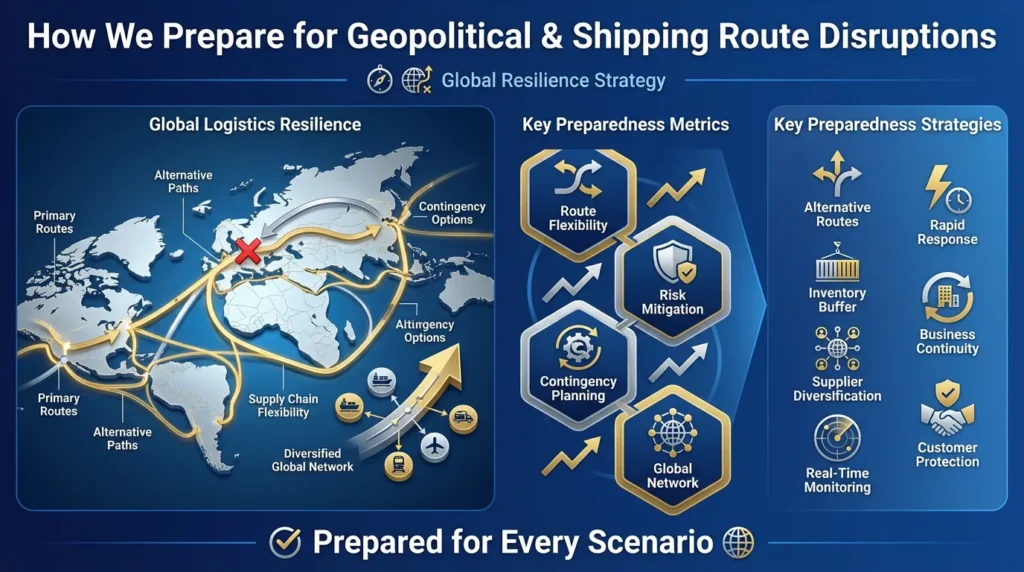
Every distributor now lives with the same question:
“What happens to my stock if a canal closes, a conflict escalates, or a trade route suddenly changes?”
The last years have shown that events like canal closures, sanctions, regional conflicts, strikes and sudden regulatory changes are not rare exceptions. They are recurring realities of global trade.
For a private label automotive filter program, these disruptions can mean:
- Containers stuck at sea or in transshipment ports
- Sudden transit time doubling
- Freight rates spiking overnight
- Stockouts right in the middle of your peak season
At Beling, we decided not to treat these as “black swans” we can’t plan for. Instead, we design our supply chain around them so that your private label filter program keeps moving, even when shipping routes don’t.
Below is how we structure our logistics, planning and cooperation with distributors to manage geopolitical and route disruption risk in a practical way.
Multiple Shipping Route Scenarios Planned in Advance
1.1 Why We Don’t Wait for the News to React
Many companies wait until:
- A major canal closes
- A conflict blocks key waters
- A large carrier changes its routing
…before they start asking, “Now what?”
By then, it’s often too late. Capacity is already tight, rates have spiked, and everyone is fighting for alternative routes.
We chose a different approach: plan route scenarios in advance.
1.2 Primary, Secondary and Tertiary Route Scenarios
For key destinations, we maintain preplanned route scenarios:
- Primary route
- Usual, most costefficient solution
- Standard transit time and port pair
- Used under normal conditions
- Secondary routes
- Alternative ports and/or transshipment hubs
- Slightly different transit times and cost levels
- Designed to bypass specific chokepoints or congested ports
- Tertiary (emergency) routes
- Highcost options such as:
- Shortsea + rail combinations
- Shortsea + longhaul trucking
- Airfreight for a limited set of critical SKUs
- Used only when necessary to protect continuity
1.3 PreDefined Parameters for Each Scenario
For each scenario we maintain internal guidance on:
- Approximate transit time
- Typical rate levelsand cost impact
- Operational constraints, such as:
- Weight and volume limits
- Equipment availability (e.g. 20’ vs 40’, HC vs standard)
- Carrier or alliance preferences
So when a route is disrupted, we are switching to a predefined plan, not improvising from zero under pressure.
Buffer in Production and Material Planning
2.1 When Route Disruptions Become Critical
Route disruptions become truly critical when:
- Production is already late, and
- There is no bufferbefore you reach stockout in your warehouse
In that situation, even a small delay in transit can force stockouts and emergency measures.
2.2 Building Upstream Buffers at Beling
To reduce this risk, we:
- Maintain safety stock of key materials, supported by our
dual supplier system for critical components - Protect Aitem capacity on our production lines:
- A items (top sellers) always have reserved capacity
- We avoid overloading lines with lowpriority products
- Build in a small time buffer inside our 40 workday lead time:
- The 40 working days already include some contingency
- We don’t schedule every day at full theoretical capacity
2.3 Using Buffers Proactively
These buffers give us room to:
- Advance production of your critical SKUsif a route risk appears
- Consolidate shipments earlierbefore a potential bottleneck
- Adjust production sequences to support containers that need to leave earlier
In practice, this means we can react earlier on the factory side, not just at the port side.
Early Warning Monitoring With Our Freight Forwarders
3.1 Why Forwarders Are Part of Our Risk System
We work closely with experienced freight forwarders who act as our early warning system for global logistics.
They provide:
- Weekly updates on:
- Port congestion and waiting times
- Vessel delays and blank sailings
- Space constraints on specific services
- Alerts on:
- Sanctions and trade restrictions
- Route closures or navigational risks
- Strikes and labor actions in key ports
- Alternative routing suggestions based on current conditions
3.2 Turning Information Into Early Action
Internally, we treat this as an early warning system:
- If a key route starts to show consistent delaysor congestion, we immediately review:
- Your open orders
- Current ETD/ETA vs your stock situation (if we have your data)
- Options to:
- Reroute upcoming shipments
- Advance production and bookings
- Split shipments if needed
This buys us time before disruptions become your emergency at the customer level.
Flexible Port and Carrier Choices
4.1 The Risk of Being Locked Into a Single Port Pair
Being locked into one export port and one import port is a major vulnerability. If:
- That port faces congestion,
- A specific terminal is blocked, or
- One carrier alliance cuts capacity
…you’re stuck.
4.2 Building Flexibility Into Port Choices
Where practical and logistically efficient, we maintain flexibility on:
- Export ports
- Primary port
- Backup export port options
- Import ports on your side, if your logistics allow it
- Alternative gateways into your country or region
- Combined with inland trucking or rail
- Carriers and alliances
- We avoid dependency on a single carrier network
- This gives more options when services are reduced or rerouted
4.3 Benefits of Flexible Port and Carrier Strategy
This flexibility allows us to:
- Move bookings to less congested routes
- Combine sea + land options:
- Alternate ports with inland trucking or rail
- Keep cargo flowing even when:
- Specific terminals are blocked
- Certain services are suspended
For you as a distributor, this means your supply does not depend on a single fragile path.
Scenario Planning Together With Key Distributors
5.1 Joint Planning Instead of Crisis Conversations
For serious partners, we don’t wait for a crisis to talk about risk.
We proactively discuss:
- Your minimum service levelduring disruptions:
- Example: keep 80–90% of A items available
- Which SKUs are mission criticalfor your market
- How much safety stockyou want to hold locally on those SKUs
- Whether you are open to:
- Temporary partial shipments
- Split routesor alternate ports
5.2 Aligning Plans Across Both Sides
Once we define those points, we align:
- Our production plan:
- Extra priority for your critical SKUs
- Flexibility around expected peak periods
- Your forecast and ordering rhythm:
- Order windows aligned to realistic transit times
- Earlier order placement where necessary
- Route options and transit time assumptions:
- Primary and backup routes integrated into your planning
- Shared understanding of “normal” vs “disruption” transit times
5.3 Result: Executing a PreAgreed Plan
When something happens, we are not:
- Starting from zero
- Sending panic emails
- Guessing at what to protect first
Instead, we execute a joint preagreed plan for your business, which reduces pressure for everyone involved.
Prioritization Rules When Freight Capacity Tightens
6.1 Capacity as a Scarce Resource During Disruptions
In times of severe disruption, freight capacity can become:
- Limited
- Unreliable
- Or very expensive
In that scenario, not everything can move at once. Without clear rules, decisions become chaotic and political.
6.2 Our Internal Prioritization Logic
We use transparent internal rules to decide what moves first when space is tight:
- A items for longterm contracted partners
- Top sellers that drive market presence
- Critical to maintain your brand in front of workshops and dealers
- SKUs with highest risk of stockout, based on data you share with us
- Low days of cover
- No alternative in local stock
- Orders aligned to promotions or seasonal peaks
- Campaigns with fixed dates
- Seasonal demands (winter, summer, holiday spikes)
- Then B/C items and less timesensitive orders
- Niche, slow movers
- Can be pushed to later sailings if needed
6.3 Why This Matters for You
This mechanism helps ensure:
- Your frontline range remains available
- You don’t lose the market on your top references while slow movers travel
- Tradeoffs are made systematically, not emotionally
We also communicate these priorities so you understand why certain SKUs move earlier than others.
Packaging and Loading Optimization for Disruption Scenarios
7.1 When Every Cubic Meter and Kilo Counts
When routes change or capacity shrinks, every:
- Cubic meter
- Kilogram
- Container slot
…suddenly counts much more. Poor packing efficiency becomes very expensive very fast.
7.2 Optimizing Containers Around Key SKUs
We:
- Optimize packing density for key SKUs:
- Packaging designed to maximize units per pallet and per container
- Reduced “air” in cartons, within safe limits
- Prepare alternative packing plans if:
- Certain equipment types or routes have specific limits
- There are weight restrictions on particular services
- Use mixed containers strategically:
- Prioritize a higher share of A itemswhen space is tight
- Predefine which B/C items can be deferred to the next sailing
7.3 Outcome: Maximum Coverage per Container
This approach ensures that:
- Each container carries as much critical demand coverage as possible
- Your most important references move even if fewer containers can ship
- You get the maximum market impact per cubic meter shipped
Emergency Options for Critical Gaps
8.1 Using Emergency Transport as a Safety Valve
We treat airfreight and express multimodal routes as safety valves, not as standard practice.
Using them too often destroys margin and creates bad habits in planning.
8.2 When We Use Emergency Options
In extreme situations, we can:
- Ship small, highvalue or critical A SKUs by airto bridge a temporary gap
- Use sea + railor sea + truck combinations where available and faster
- Preposition limited stock in specific regions or hubsfor:
- Repeated risk scenarios
- Key customers with very tight service requirements
8.3 ROIBased Emergency Logic
Our goal is to:
- Limit costly emergency measures to truly critical situations
- Always assess the ROI:
- Value of avoided stockouts and lost sales
- Cost of the emergency transport
This keeps the system disciplined and protects both your margin and ours.
Transparent Communication Instead of Surprises
9.1 Why Uncertainty Is Often Worse Than Delay
During disruptions, uncertainty can be worse than the delay itself.
For distributors, the most damaging scenario is:
- Overoptimistic promises from suppliers
- Lastminute changes in ETD/ETA
- No clear explanation for what is really happening
This makes it almost impossible to communicate with workshops, dealers and key accounts.
9.2 Our Communication Commitments
We commit to:
- Giving realistic ETAs, not “best case” guesses
- Updating you quickly when:
- Routes change in a relevant way
- ETDs/ETAs shift materially
- We need your decision on alternative options
- Sharing the logic of our prioritization, so you can:
- Explain it credibly to your own customers
- Make informed decisions on promotions and stock allocation
9.3 Helping You Manage Your Own Stakeholders
With clear, honest updates, you can:
- Adjust local promotions or launches in time
- Reallocate stock between branches or countries if needed
- Maintain trust with your customers even in difficult periods
We see communication as part of the risk management system, not an afterthought.
What This Preparation Means for Your Private Label Program
By preparing for geopolitical and shipping route disruptions in our supply chain design, not just in words, we help you:
- Reduce the risk of sudden stockoutscaused by global events
- Maintain availability of your core Arangeeven in unstable times
- Plan your own inventory, promotions and tenders with more confidence
- Spend less time firefighting logistics and more time growing your market
When you choose a private label partner today, you are also choosing how they will handle tomorrow’s disruptions.
We’ve built Beling to:
- Combine stable 40day production lead time
- With realistic logistics scenario planning
- So your filter program keeps moving, even when the world doesn’t.
Beling – Save Your Time & Cost
Your valuable automotive filter partner since 2008.
Contact Our Team
Bruce Gong – Key Account Manager, Beling Filters
Email: bruce.gong@belingparts.com
WhatsApp: +86 150 5776 4729
LinkedIn: www.linkedin.com/in/brucegong-beling
We’re happy to share how we usually adjust pallets for EU vs Middle East vs Latin America markets, and help you fine tune palletization to your warehouse system.