Same products.
Same route.
But a very different risk level depending on how the supplier and freight forwarder work together.
In auto parts and filters, small mistakes in logistics can quietly destroy the margin of a whole shipment:
- Missed cut-off → roll-over → weeks of delay
- Wrong HS code → customs hold → extra costs
- Poor communication → wrong expectations → emergency airfreight
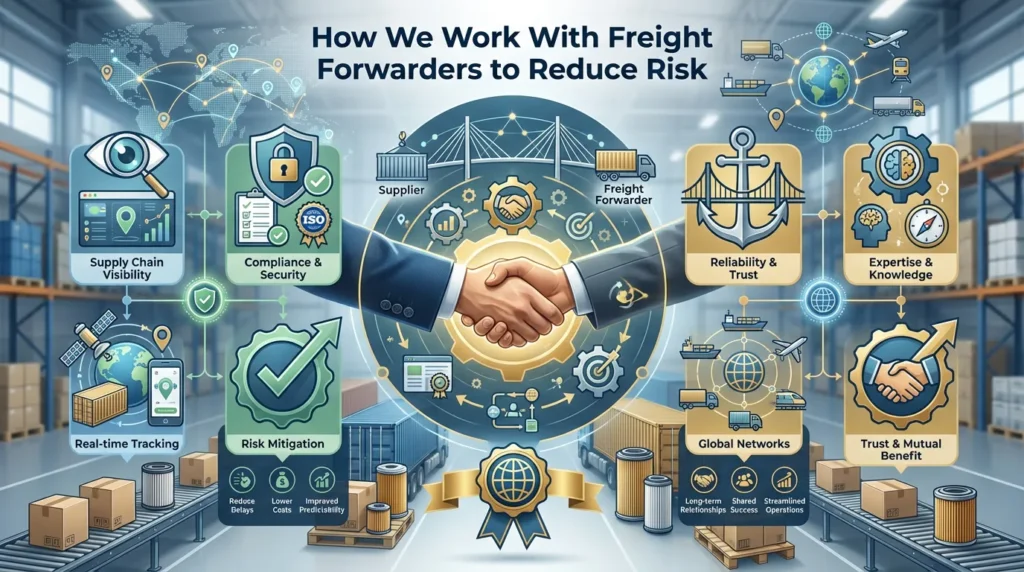
At Beling Filters, we treat freight forwarders not as “price providers”, but as risk management partners in the supply chain.
In this article, you’ll see how we cooperate with freight forwarders to keep risk under control:
- Clear roles from Day 1
- One source of truth for shipment info
- Documentation checked from both sides
- Routing and port choice: not only price
- Packing & handling notes shared upfront
- Real-time problem solving
- Long-term relationships, not one-off bookings
If your current shipments feel chaotic or always last minute, the problem is often not only the rate, but how everyone is working together.
Clear Roles From Day 1 With Freight Forwarders 🧾
(Confusion = Risk in Auto Parts Logistics)
Confusion in logistics almost always turns into risk.
So from the first shipment, we clarify roles between:
- Beling Filters (shipper)
- Freight forwarder
- Buyer / consignee
We specify who does what for each shipment, including:
- Who books space with the carrier
- Forwarder books with the shipping line (or NVOCC) based on agreed schedule.
- Who confirms cut-off time & VGM (Verified Gross Mass)
- Forwarder shares container cut-off, SI cut-off, VGM cut-off.
- We confirm loading schedule accordingly.
- Who prepares BL draft
- Usually the forwarder, based on our commercial invoice and packing list.
- Who checks local charges & surcharges
- Forwarder provides a breakdown of local charges at origin and destination.
- We or the buyer verify before confirming shipment plan.
We never assume.
We write it down in email and in the Proforma Invoice (PI) or shipping instruction.
This clarity avoids:
- “I thought you would do it” about booking or documentation
- Missing bookings because nobody confirmed the cut-off
- Disputes over who pays unexpected local fees
Clear roles from Day 1 = fewer surprises, fewer mistakes, and a smoother auto parts supply chain.
One Source of Truth for Shipment Information 📋
(Details Kill or Save a Shipment)
In international shipping, details kill or save a shipment:
- Wrong ETD → missed production or warehouse planning
- Wrong ETA → stockout or angry customers
- Wrong vessel name or voyage → tracking confusion
To avoid this, for each container or LCL shipment we keep one master booking sheet that includes:
- POL (Port of Loading) & POD (Port of Discharge)
- ETD (Estimated Time of Departure) & ETA (Estimated Time of Arrival)
- Container number & seal number (for FCL)
- Vessel name and voyage
- Incoterms & freight payer
- Contact list (forwarder, shipper, consignee, key emails & phones)
2.1 How We Use the Master Booking Sheet
The process is simple:
- The forwarder shares updates in one email thread.
- We update the same sheet when there are changes (new ETD, ETA, roll-over, etc.).
- The buyer can also access the same information (shared file or PDF).
This way:
- Everyone sees the same data
- There are fewer chances for wrong dates, wrong vessels, wrong expectations
- No more “which version of the schedule is correct?”
This “one source of truth” is especially important for:
- Multi-container projects
- Auto parts distributors managing several markets
- Peak season shipments where schedules move frequently
Documentation Checked From Both Sides for Auto Parts & Filters 📄
(Double Check Now Saves Big Problems Later)
Auto parts and filters are sensitive in terms of documentation and customs.
Risk areas include:
- HS code differences
- Country-specific requirements
- Brand / trademark wording
- Origin or quality certificates
A small mistake can lead to:
- Delays at customs
- Extra inspections
- Fines or reclassification
- Even seizure in worst cases
3.1 What We Ask Freight Forwarders to Check
Before issuing final documents, we ask the forwarder (and, where possible, the buyer’s broker) to check:
- BL consignee / notify party format
- Correct company name, address, tax ID if needed.
- HS codes vs local rules
- Are the HS codes used on invoice and packing list acceptable in the destination country?
- Any special local classification habits for filters or auto parts?
- Need for extra documents
- Fumigation certificate
- Certificate of Origin (CO) or Form A / Form E, etc.
- Any automotive-specific certificates for certain markets
3.2 Pre-Sending Draft Documents
We also:
- Pre-send draft documents (invoice, packing list, BL draft) to the forwarder and buyer for review.
- Get customs broker feedback where possible before finalising.
Double checking:
- Reduces the risk of amendments after shipment, which can be expensive.
- Avoids last-minute surprises when the container is already at destination.
For auto parts and filters, where HS code and brand wording can be sensitive, this extra step is cheap insurance.
Routing & Port Choice With Freight Forwarders: Not Only Price 🧭
(Cheap Freight Can Be Very Expensive in the End)
A route that looks cheap on paper can be very expensive in reality if it causes:
- Frequent roll-overs
- Long delays in congested hubs
- Unreliable transit times that hurt your stock and sales
We often see:
- A cheaper route with:
- 2 transshipments
- High roll-over risk
- A known congested hub
versus:
- A slightly more expensive route with:
- Fewer transshipment points
- Better on-time performance
4.1 What We Discuss With Reliable Forwarders
With good forwarders, we don’t stop at the rate sheet. We discuss:
- Historical on-time rate for certain routes
- Seasonal congestion at hubs
- Pre–Chinese New Year
- Golden Week
- Christmas peak, Black Friday, etc.
- Alternative ports when the main port is unstable
- Secondary ports with more predictable operations
Sometimes we accept a slightly higher ocean freight in exchange for:
- More stable lead time
- Fewer unexpected delays
- Lower need for emergency shipments
The forwarder provides options and risk profiles.
We choose together with the buyer, based on:
- Market urgency
- Stock level
- Customer commitments
This approach treats routing as part of risk management, not just a cost line.
Packing & Handling Notes Shared Upfront With Forwarders 📦
(So They Know What They Are Really Handling)
Even the best route is risky if the packing and handling are not adapted.
Forwarders need to understand the cargo:
- Palletized or loose cartons?
- Any height / weight limits?
- Fragile corners / branded boxes?
- Moisture-sensitive filters?
5.1 What We Share With Our Freight Forwarders
Before loading, we share:
- Pallet details & photos
- Pallet size
- Height
- Number of cartons
- Approx. weight per pallet
- Special handling notes
- “No top loading” if pallets shouldn’t be stacked on
- “Do not double-stack”
- “Keep upright”
- Warnings for fragile corners and branded cartons
- Moisture protection method
- Stretch film
- Top covers
- Desiccant bags inside the container
5.2 How This Helps the Forwarder Reduce Risk
With this information, the forwarder can:
- Choose a suitable CFS / terminal for LCL or special cargo
- Brief their warehouse and trucking teams about special handling requirements
- Allocate the right type of truck / chassis for heavy or high pallets
This reduces:
- Damage during loading/unloading
- Crushed cartons from top loading
- Moisture issues from poorly ventilated or unprotected storage points
Auto parts & filters have high value per CBM and often branded packaging. A bit of extra care in packing info goes a long way.
Real-Time Problem Solving With Freight Forwarders 🛰️
(Issues Will Happen – Speed and Transparency Make the Difference)
Even with the best planning, delays and issues still happen:
- Vessel delayed or changed
- Container suspected damaged
- Port suddenly congested
The difference between a small issue and a big crisis is usually:
- How fast everyone reacts
- How transparent the communication is
6.1 How We Manage Issues Together
We expect our forwarders to be transparent. In return, we are transparent with our buyers.
Examples of real-time problem solving:
- Vessel delay or roll-over
- Forwarder informs us with the new ETA and reason.
- We immediately share the update with the buyer.
- Buyer can adjust warehouse and sales planning.
- Container damage suspicion
- If there’s any sign of damage:
- Survey is requested where necessary.
- Photos and reports are collected.
- We coordinate with the buyer on inspection and potential claims.
- Port congestion becoming serious
- We analyse impact on current and future shipments.
- Discuss rerouting or using alternative ports or services for next shipments.
The rule:
No hiding, no excuses, just facts and solutions.
This builds trust and keeps the auto parts supply chain running as smoothly as possible, even in turbulent times.
Long-Term Relationships, Not One-Off Bookings 🤝
(Stable Supplier + Stable Forwarder + Stable Buyer = Lower Risk)
We prefer working with freight forwarders who:
- Know auto parts & filters
- Understand product sensitivity and documentation particularities.
- Know our main ports deeply
- Familiar with terminal behaviour, congestion patterns and local rules.
- Keep records of past performance
- Transit times, delay reasons, seasonal issues.
In return, when they deliver well, we stay loyal.
We are not constantly jumping from one forwarder to another for tiny rate differences.
A stable combination of:
- Stable supplier (Beling Filters)
- Stable forwarder
- Stable buyer / distributor
means:
- Fewer surprises
- Better preparation for peak seasons
- Lower overall risk and better total cost
Freight forwarders are not just “price providers”.
They are part of your risk management team in the auto parts supply chain.
If your shipments feel chaotic or always last minute, it is worth reviewing:
- How clear the roles are
- How information is shared
- How documentation and packing are coordinated
- Whether you are treating forwarders as partners or just spot vendors
Want Our Simple Booking + Tracking Sheet Template?
To support this way of working, we use a simple booking + tracking sheet with our forwarders and buyers that includes:
- Shipment reference
- POL, POD, ETD, ETA
- Vessel, voyage, container number, seal number
- Incoterms and freight payer
- Status updates and remarks
This template helps:
- Keep everyone aligned on dates and responsibilities
- Reduce email confusion
- Build a history of transit times for each route and port
If you’d like, we can share this template and help you adapt it to:
- Your internal processes
- Your forwarder’s workflow
- Your market needs
Contact Our Team
Bruce Gong – Key Account Manager, Beling Filters
Email: bruce.gong@belingparts.com
WhatsApp: +86 150 5776 4729
LinkedIn: www.linkedin.com/in/brucegong-beling
We’re happy to discuss how we can work together with your own freight forwarders (or ours) to reduce risk and protect your margins on auto parts and filter shipments.