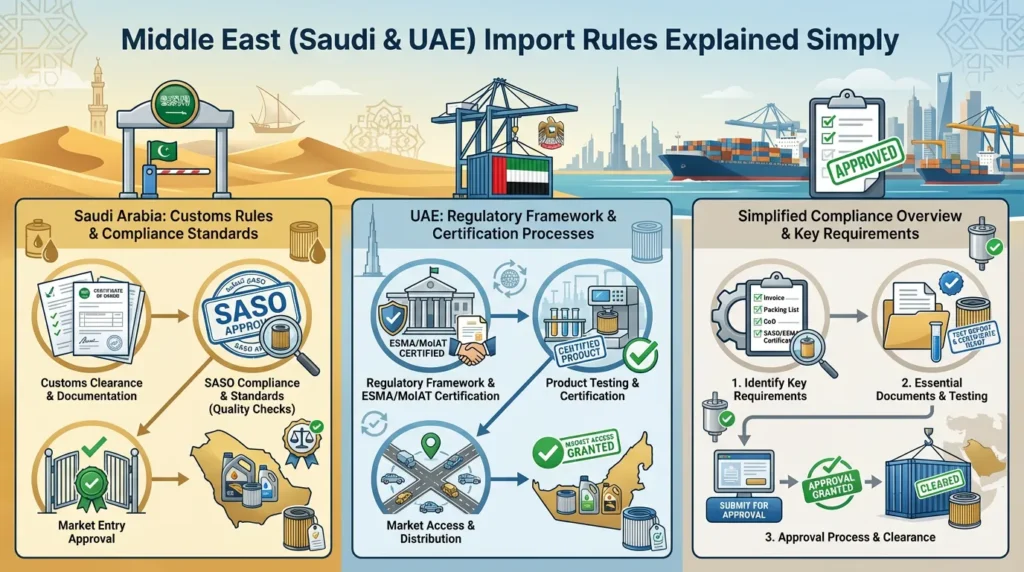
Importing automotive filters into Saudi Arabia (KSA) and the United Arab Emirates (UAE) can look complicated from the outside:
- Different platforms and portals
- Local conformity programs
- Arabic labeling expectations
- Documentation and HS code details
But in practical terms, it comes down to a few pillars:
Right product, right paperwork, right platform.
This guide explains, in simple terms, how the import rules work for automotive filters in KSA and UAE – and how we support Middle East importers as a manufacturer.
KSA vs UAE: Who Does What in Filter Imports
1.1 Saudi Arabia (KSA): SABER, Fasah & SASO
In Saudi Arabia, automotive filter imports sit within a more formalized conformity and registration framework.
Key elements:
- Key systems
- SABER: online platform for product and shipment conformity assessment
- Fasah: electronic platform integrating customs and logistics processes
- Key body
- SASO(Saudi Standards, Metrology and Quality Organization)
- Defines national standards and technical regulations
- Focus
- Ensuring product conformitywith Saudi/GCC standards
- Requiring correct registrationin SABER before shipment leaves origin
In practice, your local importer or agent in KSA is responsible for SABER registration and clearing the shipments, while the manufacturer (like Beling) provides the technical support and documentation.
1.2 UAE: ESMA and PortLevel Compliance
In the United Arab Emirates, the structure is a bit different:
- Key systems
- National and emiratelevel conformity and control (historically ESMAand evolving schemes)
- Port systems integrating customsand municipality controls
- Focus
- Proper documentation(invoice, packing list, COO)
- Correct HS code and origin
- Local compliance with any relevant technical rules
Customs and municipalities in ports such as Dubai (Jebel Ali, Port Rashid), Abu Dhabi, etc. will check:
- HS classification
- Origin
- Documentation consistency
- Any additional local requirements or certifications
1.3 Our Role as Manufacturer
As your manufacturer, we:
- Adapt to your local importer/agent’s processin each country
- Provide data, documents and labelingto fit:
- SABER and Fasah requirements in KSA
- UAE customs and municipality expectations
You stay in control of local registrations and licenses; we make sure the product and paperwork match what the system expects.
Product Conformity for Filters: Don’t Ship “Unknown” Goods
2.1 Why Product Conformity Matters in Saudi and the UAE
Especially in Saudi Arabia, authorities want to know that automotive filters:
- Are correctly described and categorized
- Meet national or GCC technical regulations, where applicable
- Are packed and labeled safely for transport and use
Sending “unknown” or poorly described goods is one of the fastest ways to trigger:
- Extra questions
- Delays
- Possible rejection or rework
2.2 Key Product Conformity Elements for Filters
Typical points for automotive filters:
- Correct technical description
- Type (oil, fuel, air, cabin)
- Intended use (automotive, heavy duty, industrial where applicable)
- Material and basic construction
- Safe, stable packaging and labeling
- Cartons suitable for handling, stacking and climate
- Clear labels and markings for identification
- Conformity with relevant GCC / national technical regulations
- Where applicable technical requirements exist (e.g., safety, labeling, materials)
2.3 How Beling Supports Product Conformity
We help by:
- Providing technical data and product specifications in English
- Filter type, application, materials
- Dimensions and performance data where needed
- Supporting your local agent or certifier with the information they need
- Certificates, declarations, or test reports (if required by your chosen body)
- Keeping packaging and labeling consistent with documentation
- Ensuring what appears on the box is aligned with what appears in SABER, customs systems, and your submissions
This reduces the chance of your filters being treated as “unclear” or “unidentified” goods.
HS Code & Country of Origin — Matching Across All Documents
3.1 Why Mismatch Causes Delays in KSA and UAE
Across both Saudi Arabia and the UAE, one of the most common reasons for delays is mismatch between:
- HS code on the commercial invoice vs HS code entered in local systems
- Country of origin shown on documents vs origin on the carton labels
- Descriptions in SABER or local portals vs physical packaging
These mismatches can trigger:
- Additional verification
- Resubmission of documents
- Delays and storage costs
3.2 Our Simple Rule: One Agreed HS Code, One Origin
We keep it simple and structured:
- We agree the HS codes with you in advance
- Based on your broker or local agent’s classification
- Applied consistently to each filter type
- We use the same HS code and origin on:
- Commercial invoice
- Packing list
- Certificate of Origin
- Any product or shipment certificates
- Carton markings and origin labels match the paperwork
- Country of origin printed clearly
- Descriptions aligned with documentation
3.3 Impact for Middle East Importers
When:
- HS code is settled up front
- Origin is clearly defined
- All paperwork and labels are synchronized
Then customs clearance in KSA and UAE is usually more straightforward, with less backandforth and fewer surprises at the port.
SABER, ESMA & Portals — Explained Simply
4.1 Saudi Arabia — SABER and Certificate of Conformity
For KSA, product conformity is normally managed through SABER, which involves:
- Registering the product in the system
- Obtaining a Certificate of Conformity (CoC)through an approved conformity assessment body
- Linking the certificate to shipments before they are cleared
In most cases:
- Your local importer/agentin Saudi Arabia handles the SABER process
- The manufacturer supports with technical and factory information
What You Typically Need for KSA Filters
For automotive filters imported into Saudi Arabia, you typically require:
- Product registrationin SABER
- Shipmentlevel Certificate of Conformity (CoC), issued by a recognized body
Our role as manufacturer:
- Provide factory details and product specs
- Share any test reports or declarationsrequired
- Adjust labeling if specific Saudi marking requirements apply
4.2 UAE — Clean Documents and Local Compliance
For the UAE, the approach is more focused on:
- ✅ Correct invoice, packing list and Certificate of Origin
- ✅ Correct HS code and origin declared consistently
- ✅ Any additional certificates requested by:
- Local authorities
- Municipalities
- Conformity schemes for certain categories
We work with your customs broker or local partner to align document formats and content so they can:
- Upload documents into the relevant systems
- Clear shipments without corrections or reissuance
4.3 Beling’s Role With Portals and Certificates
We:
- Cooperate with your chosen conformity assessment bodyin KSA
- Provide consistent, structured data and documents
- Remain available for clarifications required by:
- Saudi SASO/SABER
- UAE customs and municipalities
You manage the local portal accounts; we ensure the product information is solid and consistent.
Labeling & Arabic Requirements for Filters
5.1 Growing Focus on Labeling in Saudi and UAE
Both KSA and UAE are increasingly attentive to:
- Clear product labeling
- Brand / private labelidentification
- Proper country of origin marking
- In some cases, Arabic languagerequirements for certain information
For automotive filters, this often covers:
- Outer carton labels
- Product boxes
- Occasionally, product body markings
5.2 Typical Labeling Expectations
Authorities and local partners may ask for:
- Product description(e.g. “Automotive Oil Filter”)
- Brand or private label name
- Country of origin(“Made in …”)
- Sometimes, Arabic languageon:
- Product description
- Country of origin
- Other key information, depending on local rules
5.3 How Beling Supports Labeling and Arabic
We support Middle East importers by:
- Printing or applying labels according to your local rules
- English only, or English + Arabic where required
- Coordinating on label layout and content
- Brand logo, SKU, description
- Country of origin wording
- Any QR codes or barcodes you use
- Ensuring what’s on the box is exactly what’s in your:
- SABER or local registration
- Customs submission
- Commercial documents
This alignment helps avoid relabeling requests or compliance issues at Jeddah, Dammam, Dubai or Abu Dhabi.
Middle East Friendly Commercial Documents
6.1 Documentation as a Clearance Accelerator
For shipments to Saudi Arabia and the UAE, having clear and complete commercial documents is essential. “Almost correct” paperwork can easily cause:
- Broker questions
- Portal rejections
- Delays and storage fees at destination
6.2 Checklist: Invoices, Packing Lists and COO
For KSA / UAE shipments, we ensure the core document set is clean and complete:
Commercial Invoice
Includes:
- Full buyer / consignee details
- HS code and country of originper line (if requested)
- Incoterms and currency
- Detailed description of the filters:
- Type, brand/private label, part number
Packing List
Includes:
- Number of cartons and pallets
- Net and gross weights
- Dimensions if required
- Clear SKU and quantity per carton
Certificate of Origin
- Issued according to your chamber / authority requirements
- Matching invoice and packing list data
If you need attestation or legalization (e.g., by embassy or consulate), we coordinate document timing so your side has enough time to process it.
6.3 Beling’s Documentation Approach for the Middle East
We:
- Use stable, consistent formatsfor all Middle East shipments
- Keep HS, origin and descriptions aligned across every document
- Adjust invoice wording or structure according to your broker’s preferences
This makes each repeat shipment easier, as your local partners know exactly what to expect.
Typical Middle East Import Problems We Help Avoid
7.1 Common Issues at KSA and UAE Ports
Without proper preparation, importers can face:
- Containers delayed because:
- SABER registration or CoC is not ready in time
- Local certificates in UAE are missing or incomplete
- Extra costs due to:
- Wrong HS code chosen (higher duty or correction fees)
- Country of origin mismatches requiring redeclaration
- Relabeling or repacking requests at destination
- When labeling is considered insufficient or inconsistent
- Endless backandforth between your broker and supplier for corrected documents
- Revised invoices
- Updated packing lists
- Replacement COOs
7.2 Our Preventive Approach
Our approach is straightforward:
Agree the rules before production, not after vessel arrival.
That means:
- HS codes confirmed upfront
- Label content defined before printing
- Certificates and SABER / local requirements identified early
By working this way, we significantly reduce the chance that your containers get stuck because of preventable administrative issues.
How We Work With Importers in Saudi Arabia and the UAE
8.1 Alignment Before the First Shipment
With partners in Saudi Arabia and the UAE, we start by:
- Aligning early on:
- HS codes and product descriptions
- Labeling (English/Arabic, brand, COO)
- Required certificates and SABER or local portal needs
- Sharing all factory and product details needed for:
- SABER registration
- Local conformity assessments
- Customs/municipality paperwork
8.2 Stable Processes for Repeated Shipments
Once the framework is defined, we:
- Keep documentation formats stable
- So every new shipment follows the same pattern
- Your broker and local agent know what to expect
- Maintain consistent data and layout over time
- Only update when regulations or your preferences change
- Stay reachable for quick clarification if:
- Customs has questions
- A portal requires extra information
- A new rule appears at destination
8.3 Your Focus: Selling Filters, Not Fighting Paperwork
Our goal is that you can focus on:
- Building your aftermarket business
- Growing private label filter programs
- Serving workshops, fleets and distributors
Not spending energy on:
- Reworking documents
- Chasing certificates
- Solving preventable issues at Jeddah, Dammam, Dubai or Abu Dhabi ports
Beling – Save Your Time & Cost
Your valuable automotive filter partner since 2008.
Contact Our Team
Bruce Gong – Key Account Manager, Beling Filters
Email: bruce.gong@belingparts.com
WhatsApp: +86 150 5776 4729
LinkedIn: www.linkedin.com/in/brucegong-beling
We’re happy to share how we usually adjust pallets for EU vs Middle East vs Latin America markets, and help you fine tune palletization to your warehouse system.