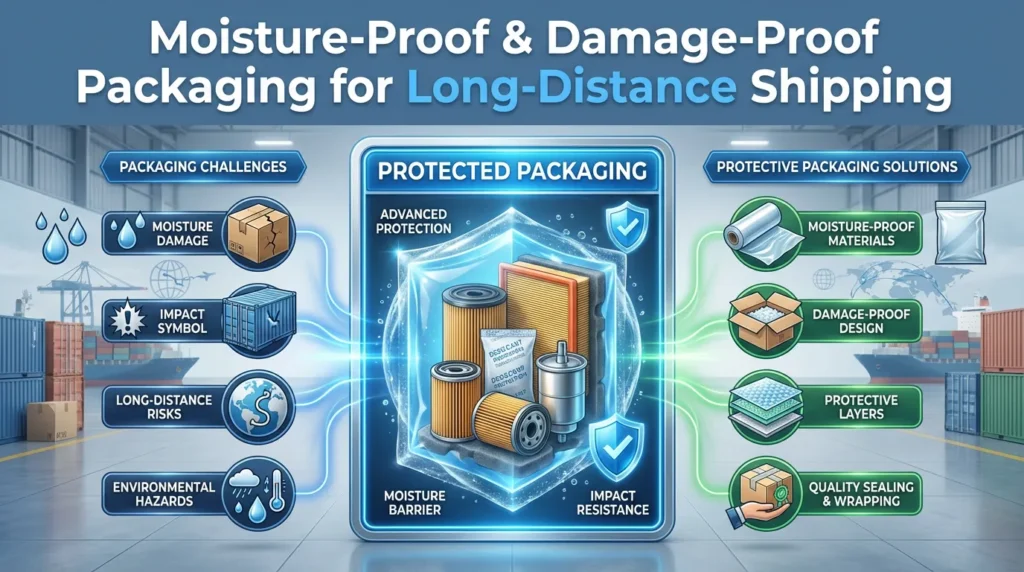
Selling good filters is one thing.
Making sure they arrive in good condition is another game. 📦🌍
When you ship automotive filters across continents, you face:
- Long routes
- Multiple trans-shipments
- Rainy ports
- Humid warehouses
- Rough forklift handling
If packaging is weak, your brand pays the price:
- Wet cartons
- Crushed boxes
- Dusty and dirty packaging
- Product claims and returns
- Lost confidence from your customers
At Beling Filters, we design our export packing so that filters arrive like they left the factory – clean, protected and ready for the shelf.
In this article, you’ll see how we design moisture proof & damage proof packaging for long distance shipments by focusing on:
- Inner protection: each filter packed for humidity
- Strong carton design, tested in real life
- Moisture control at carton and pallet level
- Palletisation for movement and handling, not only space
- Clear markings & branding without attracting theft
- Feedback loop from real deliveries
Inner Protection: Each Filter Packed for Humidity and Clean Handling 🛡️
(The First Barrier Against Moisture, Dust and Condensation)
We start from the product itself, not from the outside carton.
Every filter must be protected individually, because containers and pallets can sit:
- In tropical ports with heavy rain and high humidity 🌧️
- Under strong sun at terminals or yards ☀️
- In unconditioned warehouses with big temperature swings
When temperatures change, condensation can form inside containers or on carton surfaces. Dust and dirt also accumulate during long journeys.
1.1 How We Pack Each Filter for Moisture Protection
For inner protection, we typically use:
- Individual polybag or shrink bag
- Keeps dust and moisture away from the actual filter surface.
- Prevents staining or contamination on the media and rubber parts.
- Desiccant where needed for sensitive materials
- Especially for certain cabin filters or products where moisture can affect media, glue or anti-bacterial coatings.
- Clear label on each unit
- Part number
- Brand
- Basic application or model information
This means that even if:
- Outer cartons get slightly humid, or
- Pallets are opened in less-than-ideal conditions
the filter inside stays protected, clean, and clearly identified.
1.2 Why Inner Packing Matters for Long Distance Filter Shipments
Inner packing is the first barrier against:
- Condensation inside containers
- Dust and dirt at ports or warehouses
- Handling marks f写文章rom repacking or inspection
It also allows:
- Easier repacking if a carton is damaged but the inner units are fine
- Clear identification even when outer cartons are removed or reboxed
For distributors, this means fewer complaints like:
- “Filters look dirty when we open the boxes”
- “Packaging smells moldy after sea transit”
and more confidence when filters go directly to retail or workshop shelves.
Strong Carton Design for Damage Proof Filter Packaging 📦
(Not Just Nice Artwork – Real Strength for Real Transport)
Nice artwork and glossy printing are not enough for export.
Cartons must survive the journey, not only look good in photos.
In long distance shipping, cartons face:
- Stacking pressure from many layers
- Dropping or tipping during handling
- Long storage in humid conditions
2.1 Technical Focus: Carton Strength and Structure
We focus on the mechanical performance of cartons, including:
- Correct carton strength (bursting / edge crush)
- Matching paper quality and thickness to the weight and stacking height of the shipment.
- Double wall for heavy or long distance shipments
- For heavier filters or very long routes, we use double wall cartons to resist crushing.
- Optimised size to reduce empty space inside
- Too much empty space = movement = damage.
- We choose (or design) sizes so filters fit snugly, without unnecessary gaps.
To support this, we avoid:
- Oversized cartons with large voids
- Weak paper that collapses under load
- “Marketing only” designs without strength considerations
2.2 Real Life Testing: Stacking, Drop and Storage
We test our cartons in real life scenarios, not only on paper:
- Stacking tests
- Simulating several layers of pallets in warehouses or containers.
- Drop scenarios
- Testing what happens when cartons fall from typical handling heights.
- Long storage
- Observing how cartons hold up during extended storage under realistic conditions.
The goal is simple:
Filters should arrive in your warehouse looking as if they just left our factory – clean, undamaged and well-presented.
Moisture Control at Carton and Pallet Level for Long Distance Shipping 💧
(Minimising Wet Cartons, Mold Smell and Collapsed Boxes)
Moisture is one of the biggest enemies in sea transport, especially for:
- Tropical or rainy climates
- Long transit times
- Unventilated storage areas
Even strong cartons can become soft and weak when exposed to ongoing humidity or condensation.
3.1 Moisture Protection Inside the Master Cartons
Inside the master cartons, for higher-risk shipments and routes, we:
- Use liners or bags
- Adding an internal bag or liner for cartons going through very humid routes.
- Add desiccant for sea shipments to certain climates
- To help absorb moisture and reduce the risk of mold or smell, especially on longer transits.
This adds an extra layer of protection, beyond the individual polybags.
3.2 Moisture Protection at Pallet Level
At pallet level, we focus on keeping cartons as dry and stable as possible:
- Strong stretch film wrapping
- Helps block direct moisture contact and stabilises the load.
- Top plastic cover to protect from rain
- Particularly useful at ports where pallets may be exposed to rain during loading/unloading.
- Corner protectors for fragile pallet edges
- Protects edges from impact and helps cartons keep their shape under stretch film tension.
This combined strategy helps avoid:
- Soft, wet cartons at destination
- Mold smell after long transit
- Collapsed boxes in the warehouse
For distributors, this means:
- Less reboxing or repacking
- Better appearance for customers
- Lower risk of claims related to moisture damage
Palletisation for Movement and Handling, Not Only Container Space 🚚
(Because Most Damage Happens During Handling, Not at Sea)
A lot of damage doesn’t happen inside the container during ocean transit.
It happens during:
- Forklift loading and unloading
- Cross-docking in logistics hubs
- Moving pallets inside local warehouses
- Last mile delivery to distributors or large customers
If pallets are unstable or not designed for real handling, cartons suffer.
4.1 Designing Stable Pallets for Long Distance Filter Shipping
We design pallets with handling in mind, not just cubic utilisation:
- Stable footprint (no “mushroom” shape)
- Avoid cartons overhanging the pallet edges, which leads to crushed corners and instability.
- Reasonable height for stacking
- High pallets save space, but if they become too tall, they lean, tilt and damage lower layers.
- We balance height vs. stability.
- Clear marking of load direction and no fork zones
- Indicating where forks should enter and where they should not, reducing damage from incorrect lifting.
4.2 Results of Better Pallet Design
When pallets are designed for real movement, you see:
- Fewer leaning pallets after long transport
- Fewer crushed bottom cartons from excessive weight or poor stacking
- Fewer accidents when pallets are turned, pushed or double-stacked
For you and your warehouse teams, this means:
- Less time rearranging unsafe pallets
- Less product damage linked to internal handling
- More efficient storage and picking
Clear Markings and Branding Without Attracting Theft 🔍
(Balancing Visibility, Efficiency and Security)
Your brand needs to be visible.
Your warehouse team needs clear information.
But on some routes, very “attractive” packaging can also attract the wrong attention.
We therefore design our outer packaging to balance:
- Warehouse efficiency
- Brand visibility
- Security on riskier routes
5.1 Practical Marking Strategy for Export Cartons
We typically:
- Use clear side markings indicating:
- SKU or part number
- Quantity
- Purchase order or customer reference
- Country of origin / “Made in …” as needed
- Keep branding present but not exaggerated
- So the cartons are recognisable as your brand, but don’t scream “high value, steal me”.
- Provide neutral packing options for sensitive markets
- Where theft or pilferage risk is higher, we can ship in more discreet outer cartons.
5.2 Benefits of This Balanced Approach
This approach allows:
- Fast identification in the warehouse
- Easier stock counting and picking
- Reasonable brand presence on cartons
while reducing:
- Visibility to opportunistic theft during transport
- Unwanted attention in risky ports or trans-shipment hubs
For certain markets, we can discuss custom marking strategies that match local security realities.
Feedback Loop from Real Deliveries to Improve Packaging Continuously
🔁 (We Don’t Design Packaging on PowerPoint)
We don’t design our moisture proof & damage proof packaging only in the office. 😅
The real test is what happens:
- After long sea shipments
- In different climates
- Under different warehouse practices
6.1 How We Work With Feedback From Distributors
With long term partners, we actively:
- Ask for photos when damage occurs
- Pallets on arrival
- Close-up of damaged cartons or filters
- Conditions in the container or warehouse, if possible
- Analyse weak points
- Was the issue at the carton corners?
- Bottom layer crushing?
- Humidity marks or mold smell?
- Stretch film or banding failure?
- Adjust carton spec / pallet pattern / wrapping method
- We might change:
- Paper grade
- Double vs single wall
- Number of cartons per layer
- Pallet height or stretch wrapping pattern
6.2 Turning Complaints Into Better Packaging
Every complaint becomes an improvement input.
Our mindset is:
Next shipment should be better than the last.
Over time, for each route and each major customer, we fine-tune:
- Inner packing
- Carton specs
- Palletisation pattern
- Moisture protection level
This continuous improvement approach means that your packaging is not static; it evolves with real-world experience.
Why Moisture Proof & Damage Proof Packaging Protects Your Brand and Margin 💼
Good packaging doesn’t just protect filters.
It protects your reputation and margin. 🛡️
When packaging works:
- Your customers receive clean, solid cartons
- Your team spends less time dealing with claims and repacking
- Your brand looks professional and reliable
When packaging fails:
- You lose time and money handling damaged goods
- Your brand is associated with “wet boxes” and “crushed corners”
- You may have to discount or scrap inventory
If you are shipping filters long distance and sometimes receive:
- Wet cartons
- Crushed or leaning pallets
- Dusty, dirty looking boxes
we can share how we build our moisture proof & damage proof packaging setup, step by step.
We can also:
- Review photos of your current arrivals
- Suggest concrete improvements for inner packing, cartons and pallets
- Adapt protection level by route, climate and product type
Want Sample Photos of Our Export Packing (Inner + Outer + Pallet)?
If you’d like to see how this looks in practice, we can send:
- Sample photos of individual packed filters (inner protection)
- Photos of export cartons showing construction and markings
- Photos of palletised shipments with stretch wrapping, corner protection and top cover
This helps your team:
- Benchmark your current packaging vs ours
- Decide which elements to adopt or adapt
- Discuss improvements with your logistics or warehouse partners
Contact Our Team
Bruce Gong – Key Account Manager, Beling Filters
Email: bruce.gong@belingparts.com
WhatsApp: +86 150 5776 4729
LinkedIn: www.linkedin.com/in/brucegong-beling
We’re happy to walk you through our export packing standards and see how they can be applied to your key routes and customers.