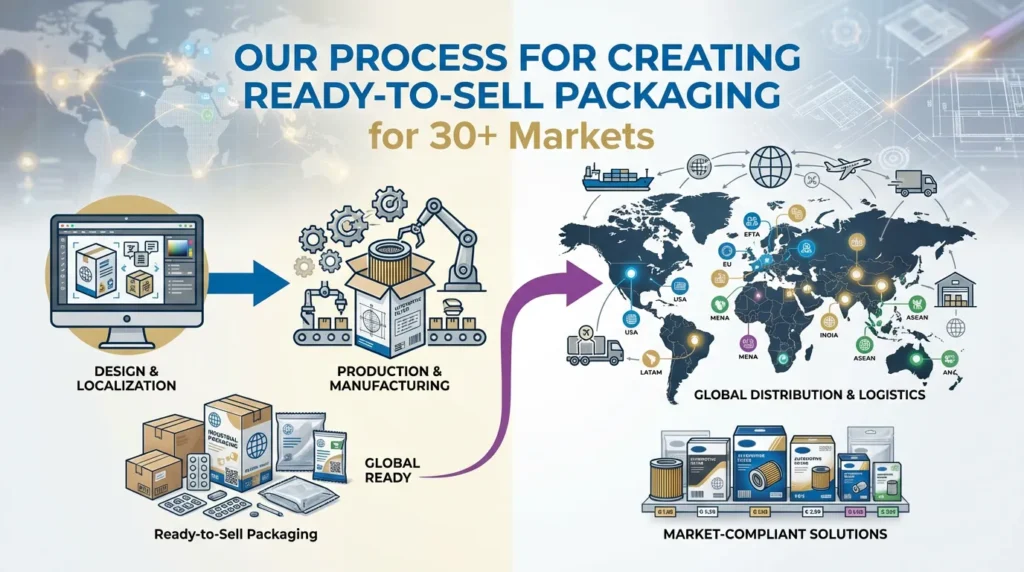
Many factories see packaging as cost.
Professional distributors see it as risk.
In the automotive aftermarket, wrong or weak packaging leads directly to:
- Wrong label → wrong part installed
- Missing language → non-compliance or customer confusion
- Weak carton → damaged filters and transport claims
- Poor barcodes → warehouse delays and scanning errors
Over time, at Beling Filters, we built a structured packaging process that works across Europe, the Middle East, Latin America, Southeast Asia, and more than 30 export markets.
For us, packaging is part of the product system.
Below is how we design ready-to-sell automotive filter packaging that works in real warehouses, retail shelves, and workshops—not just in design software.
Why Professional Automotive Filter Packaging Matters for Distributors
Before going into the steps, it’s important to see why packaging is strategic for importers and distributors:
- It affects warehouse efficiency (scanning, picking, stock rotation)
- It affects workshop trust (clarity, fitment confidence, perceived quality)
- It affects your finance team (fewer claims, fewer write-offs, faster turnover)
- It affects multi-market compliance (languages, safety information, barcodes)
That’s why we built a repeatable, documented process rather than handling each project as a one-time “print job”.
Below we break down our approach into six practical steps.
Automotive Filter Packaging Design Based on Shelf and User Context
We always start from the shelf, not the factory.
Before any design work, we ask very specific questions about where and how your filters will be sold and handled.
1.1 Where Will the Filter Packaging Sit?
We define the primary environment:
- Warehouse-only packaging
- Boxes will be seen mainly by warehouse staff and delivery drivers
- Priority: barcodes, part numbers, stacking strength
- Retail Shelf / Parts Store Counter
- Packaging is visible to end consumers and walk-in workshop customers
- Priority: brand impact, readability, key benefits on the front panel
- Workshop Counter / Service Reception
- Mechanics and service advisors see and handle the boxes
- Priority: part number clarity, application information, quick identification
This context influences:
- Box size and layout
- Which panel carries the primary information
- Whether we emphasise brand story or technical clarity
1.2 Who Reads the Automotive Filter Box?
We identify the main reader:
- Mechanic / Workshop Owner
- Wants to confirm quickly: Is this the right part?
- Needs clear part number, application, and cross-reference
- Retail Staff / Counter Sales
- Needs to scan and pick fast
- Needs clearly visible part number and barcode
- End Consumer
- Needs reassurance: Is this good quality and compatible?
- Needs simple messages like “Fits [Brand / Model]”, warranty info, and visible branding
1.3 What Must Be Visible in 3 Seconds?
We design for 3-second readability:
- Primary part number (bold, high contrast, consistent position)
- Brand logo (clear and recognisable)
- Optional: key application or series info, if space allows
This drives decisions on:
- Font size and weight
- Colour contrast (e.g., dark text on light background for part numbers)
- Label vs printed box elements
Design follows real-life usage, not just aesthetics.
Clear Label Logic for Automotive Filter Packaging and Warehousing
Random label layouts create chaos in warehouses and workshops.
We define a simple, repeatable label structure for all SKUs.
2.1 Standard Automotive Filter Label Structure (SEO: Automotive Filter Label Design and Part Number Logic)
For most private label and co-brand projects, we align on:
- Brand Name + Logo
- In a constant position on every box
- Maintains brand recognition and professionalism
- Part Number (Primary Visual Element)
- Large, bold, and easy to find from any shelf angle
- Same location and orientation across all SKUs
- Application / Model Info (Where Required)
- Main vehicle brand(s), engine type or model series
- Often placed on side panels or secondary label area
- Cross-Reference Information
- OE part numbers and key aftermarket brands
- Helps mechanics and parts staff quickly confirm interchange
- QR Code Integration
- Links to:
- Online catalogue
- Fitment instructions or installation video
- Warranty registration or product information page
This consistent logic makes it easier for warehouse teams, mechanics, and sales staff to find what they need quickly.
2.2 Label Logic for Multi-Brand Automotive Distributors
For distributors managing multiple brands and internal coding systems, we can:
- Include distributor internal SKU codes alongside the filter brand part number
- Show both OE reference and aftermarket cross numbers clearly separated
- Use icons or structured layout to avoid confusion between code types
We document this label logic in a packaging specification so it is applied consistently across:
- New part introductions
- Packaging updates
- Different filter types (air, cabin, oil, fuel)
Automotive Filter Barcode Management for ERP and Warehouse SystemsBarcodes are often an afterthought in packaging projects.
In practice, they are critical for:
- Warehouse scanning
- Inventory control
- Order picking accuracy
Bad barcodes cost time and money.
We treat barcode planning as a dedicated task.
3.1 EAN / UPC Barcode Strategy for Automotive Filters
We support distributors by:
- Defining a consistent EAN or UPC structure
- For example: per SKU, per packaging type, per region if required
- Ensuring uniqueness to avoid conflicts in ERP
- Avoiding risky practices like:
- Reusing the same barcode across different parts
- Mixing barcode types without documentation
For private labels, we can work with:
- Client-provided barcode ranges
- Or help generate a structured barcode list for newly launched SKUs
3.2 Real-World Barcode Readability Testing
Before approving packaging:
- We print physical samples with the actual artwork, colours, and finishes
- We test barcode readability with warehouse-grade scanners, not just on screen
- We avoid:
- Tiny barcode sizes
- Low contrast combinations (e.g., grey on dark colours)
- Excessive curvature or placement on box edges
For many partners, we generate and share barcode lists for their ERP before the first order, ensuring their system is ready when the first container arrives.
Multi-Language Automotive Filter Packaging by Market Cluster
Printing 10+ languages on a small box can create visual noise and confusion.
It also increases the risk of translation errors.
Instead of putting “everything on every box”, we organise languages by market cluster and use icons where possible.
4.1 Market-Based Language Clustering for Filter Packaging
(SEO: Multi-Language Automotive Filter Packaging for EU, MENA, LATAM, Asia)
We group markets strategically:
- EU Cluster
- Typically: English + one or more required local EU languages
- Can be further divided (e.g., DACH, Eastern Europe, Southern Europe)
- MENA Cluster
- English + Arabic
- Additional languages possible via labels if needed
- LATAM Cluster
- Spanish and/or Portuguese + English
- Adapted wording for regional terms where needed
- Asia Cluster
- English + selected local languages (e.g., Thai, Vietnamese, Bahasa, etc.)
This approach allows:
- Compliance with local language expectations
- Cleaner, more readable layouts
- Easier updates for specific regions
4.2 Text vs Icon Decisions for Automotive Filter Information
Not every piece of information needs to be written out in multiple languages.
We decide:
- What must be text (e.g., safety warnings, legal info, product description)
- What can be icons or pictograms (e.g., up/down orientation, “do not reuse,” installation steps)
Benefits:
- Easier cross-market standardisation
- Reduced translation workload and risk
- Faster artwork updates when regulations change
We work with partners to create a reference icon library that can be reused across product ranges.
Automotive Filter Carton Strength and Packaging Materials by Route
A carton that survives Germany only may fail in tropical humidity or long ocean routes.
We adapt packaging materials to match:
- Transport distance
- Climate and humidity
- Handling style in each region (manual vs pallet-based, single-box vs full-carton handling)
5.1 Board Selection and Strength for Filter Packaging
(SEO: Automotive Filter Carton Strength and Export Packaging Materials)
We adjust:
- Board Thickness and Type
- Heavier or double-wall for long-distance or harsh handling routes
- Lighter options for local or short-haul distribution where appropriate
- Glue and Print Finish
- Adhesives selected for humidity and temperature resilience
- Finishes (e.g., varnish, lamination) chosen to protect print and barcodes from abrasion
- Internal Protection
- Inserts or support where needed for heavy or sensitive filters
- Protection against deformation during stacking
5.2 Master Carton Design and Palletisation for Export Filters
We design master cartons and pallet patterns based on:
- Container loading optimisation (20’ / 40’ HQ)
- Maximum safe stacking height
- Typical handling in destination markets
This helps:
- Reduce transport damage
- Improve warehouse handling
- Lower shipping cost per unit through better space utilisation
For example, the specification for EU-bound pallets may differ from LATAM-bound pallets due to route, handling, and climate.
Sample, Test, and Lock: Automotive Filter Packaging Validation Process
We don’t move straight from design file to mass production.
Before we lock any packaging specification, we follow a simple but strict validation loop.
6.1 Physical Sample and Visual Confirmation
Before mass production, we:
- Produce real printed samples of individual boxes and labels
- Share high-resolution photos and videos from different angles
- Confirm:
- Label logic is clear
- Part numbers and barcodes are correctly placed
- Colours match the agreed brand identity
If needed, we send physical packaging samples so your team can test them in your own warehouse or store.
6.2 Basic Stacking and Drop Tests for Automotive Filter Packaging
We simulate typical handling by:
- Performing stacking tests (with realistic heights and durations)
- Conducting simple drop tests on full master cartons
The goal is not to replace certified lab testing, but to:
- Ensure cartons do not deform too easily
- Confirm contents are adequately protected for real-world logistics
6.3 Feedback from Warehouse and Operations Teams
We actively request feedback from:
- Your warehouse team (scan-ability, handling, stacking)
- Your logistics or operations manager (pallet configurations, labelling visibility)
Only after feedback is collected and adjustments are made do we:
- Freeze the packaging specification
- Add it to our internal packaging library
- Use it consistently for all future orders and replenishments
This reduces errors, speeds up reorders, and ensures packaging consistency across production batches.
Packaging as Part of the Automotive Filter Product System
For us at Beling Filters, packaging is not an afterthought.
It is part of the total product experience:
- Warehouse teams need clear labels and reliable barcodes
- Mechanics need confidence in fitment information and part identification
- Finance departments need fewer damage claims and stock write-offs
- Brand owners need consistent, compliant packaging across multiple regions
When we build private label or co-branded filter programs, this packaging process is integrated with:
- Our quality control systems
- Our SKU strategy and catalogue development
- Our regional export experience in 30+ markets
If you are selling into multiple countries and struggling to standardise packaging while staying flexible, we can share a simple “Packaging Setup Checklist” we use when starting new projects.
Work With a Filter Manufacturer That Understands Export Packaging
If you want a manufacturing partner who can support you with:
- Automotive filter packaging design aligned with your market positioning
- Multi-language and multi-market compliant packaging
- Export-ready carton strength and palletisation
- Barcode and label logic integrated with your ERP and warehouse
we are ready to help you set up ready-to-sell packaging for your filter brand.
Contact Our Team
Bruce Gong – Key Account Manager, Beling Filters
Email: bruce.gong@belingparts.com
WhatsApp: +86 150 5776 4729
LinkedIn: www.linkedin.com/in/brucegong-beling
Let’s design packaging that:
- Protects your products
- Simplifies your logistics
- Builds your brand in every market you serve