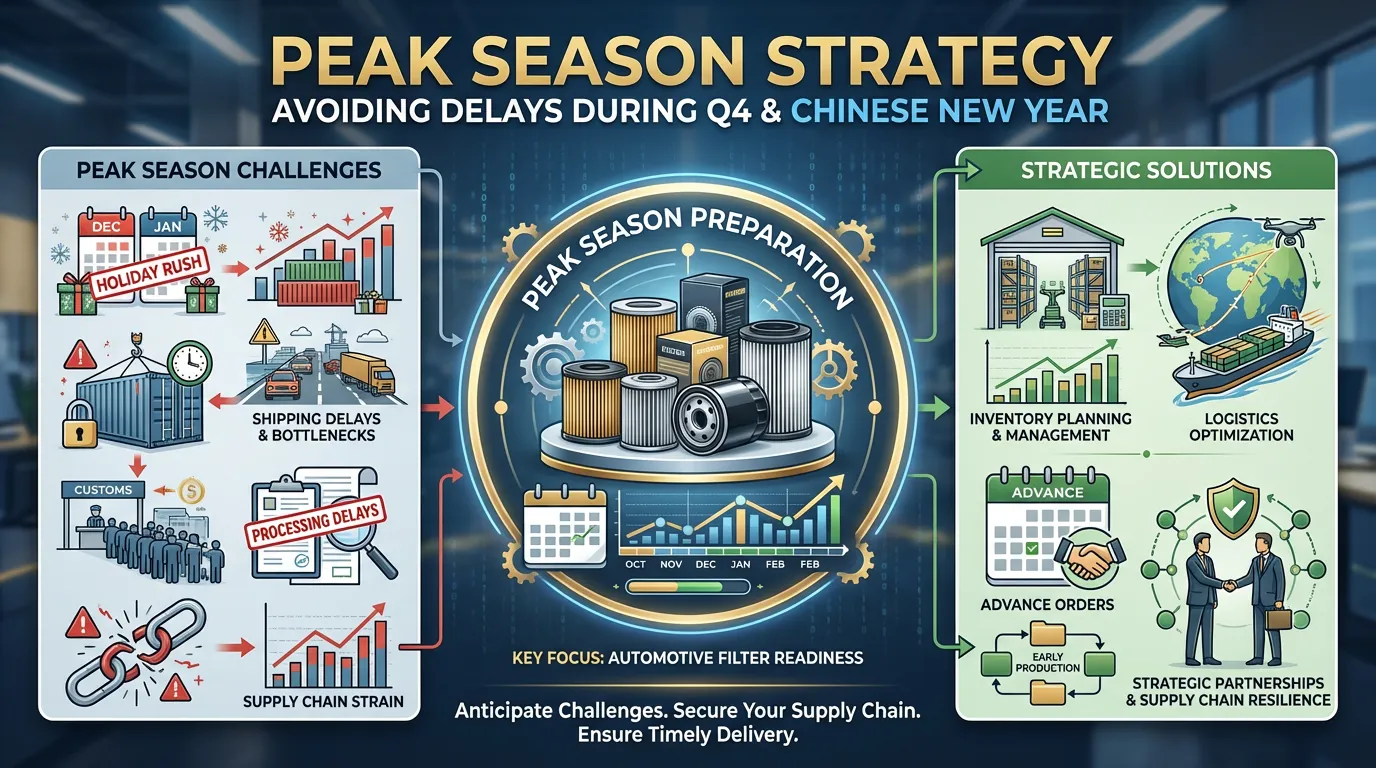
Every year it’s the same story.
- Q4 rush
- Chinese New Year (CNY) rush
- Freight rates up, space down
- Lead times going crazy 🚢📈
We can’t change the season.
But we can change how we prepare for it.
For automotive filter distributors, Q4 and CNY often mean:
- Unpredictable lead times
- Containers rolling to later vessels
- Higher freight costs than budgeted
- Firefighting to keep key customers supplied
At Beling Filters, we work with distributors across 30+ countries. Over the years, we’ve learned that peak season is not a surprise; it’s a recurring risk window that can be prepared for.
In this article, we’ll break down how we:
- Treat Q4 and Chinese New Year as one long risk window
- Lock in forecast and capacity early
- Bring forward critical purchase orders (POs)
- Prioritise A class SKUs, not everything
- Use flexible routes and documentation readiness
- Set clear communication checkpoints during peak season
If Q4 and CNY always feel like firefighting for your filter business, this is the structure we actually use with our partners.
-
Treat Q4 and Chinese New Year as One Long Risk Window 📆
(Not Two Separate, Isolated Problems)
Many companies plan for Q4 and CNY as if they were two separate events.
In reality, they are linked:
- Q4:
- Higher global demand
- Tight vessel space
- Year-end sales push in many markets
- Pre-CNY:
- Factories overloaded as everyone rushes to ship before holidays
- Ports and trucking networks congested
- Carriers adjusting schedules
- Post-CNY:
- Backlog of containers waiting to move
- Slow restart at factories and ports
- Irregular schedules and “catch-up” delays
If you only plan for December and January, but not for February and March, you miss part of the risk.
1.1 How We Define the Peak Season Risk Window
Internally, we mark a combined peak season window on our calendar, which roughly covers:
- Late Q3 / early Q4 (when early peak volumes start)
- Full Q4 (October–December)
- Pre-CNY period (several weeks before the holiday)
- Immediate post-CNY period (restart and backlog clearing)
The exact dates change each year (depending on CNY dates), but the principle remains:
We treat Q4 and Chinese New Year as one continuous risk window, not separate events.
1.2 Planning Backwards From Your Key Sales Months
Once this risk window is defined, we plan backwards from your market’s key sales months.
For example:
- If your strongest sales month is March, and you need stock in place by then, we calculate:
- Production and shipping cut-off dates before CNY
- Which orders must leave in December / early January
- Which SKUs must be prioritised to support those sales
This way, we align factory, logistics and your local sales calendar, instead of hoping that “normal lead times” will hold during peak season.
-
Lock in Forecast and Capacity Early With Filter Distributors 📊
(Why Peak Season Problems Often Start in September)
Most visible problems (no space, long lead times, container roll-overs) appear in Q4 and pre-CNY.
But root causes often start much earlier, usually around September.
If no one has discussed:
- Expected volume
- Key SKUs
- Critical markets
before the rush, everyone ends up fighting for production capacity and vessel space at the same time.
2.1 How We Lock in Forecast and Capacity Early
With long-term partners, we start by asking for a rough Q4 + CNY forecast, even if it’s not perfect.
We use that to:
- Block production capacity for key SKUs
- Reserving line time and materials for fast movers that we know you will need.
- Pre-agree priority rules if space becomes tight
- For example:
- Which country gets priority?
- Which customer projects or tenders have fixed deadlines?
- Which SKUs can afford a later shipment?
This doesn’t mean you must buy everything you forecast.
It means we reserve the option to move faster when you confirm.
2.2 Why This Helps You in Peak Season
By locking in capacity early:
- Your regular items don’t get pushed aside by last-minute urgent orders.
- We can pre-allocate space or confirm bookings earlier than the average shipper.
- We can plan materials and manpower for known demand instead of guesswork.
Forecasts don’t need to be perfect.
They just need to exist early enough to shape production plans.
-
Bring Forward Critical Purchase Orders Before Q4 and CNY 🧾
(Avoid “All in One Container, All at the Last Minute” Risk)
In normal months, the flow looks like this:
PO → production → booking → shipment
In peak months, this simple sequence becomes risky, because:
- Production slots are full
- Booking is harder
- Vessels are overloaded
So we adjust the way we suggest you place orders.
3.1 How We Adjust PO Timing During Peak Season
In Q4 and pre-CNY, we typically:
- Encourage placing POs 2–3 weeks earlier than usual
- So production and booking happen before the highest congestion point.
- Suggest splitting one big PO into 2 shipments
- Rather than waiting until everything is ready and sending it as a single, oversized urgent shipment.
- Avoid “all SKUs in one urgent container” risk
- If that single container is delayed, your entire order is stuck.
3.2 Example of Spreading Risk Across Shipments
Example:
- Instead of one January shipment with all SKUs, we might plan:
- Part of the order in December
- Part in early January
This way:
- If one vessel faces congestion, only part of your order is impacted.
- Critical SKUs can be included in the earlier shipment.
- You are less exposed to a single “congestion wave” at the port or carrier level.
For peak season, the philosophy is:
Don’t put all your demand into one late, oversized, ultra-urgent container.
-
Prioritise A Class SKUs, Not Everything, During Peak Season 🅰️
(Protect Your Core Business First)
Not all parts are equal.
Some SKUs move fast and drive most of your turnover; others are low volume, long tail items.
When everything is urgent, nothing is truly prioritised.
4.1 Identifying A, B, C Class SKUs With Distributors
Together with distributors, we often:
- Identify A class fast movers
- The small group of SKUs that generate a large part of volume and margin.
- Define B class and C class items
- B = medium importance
- C = slow movers or special items
Once this is clear, we can:
- Focus capacity and early shipment slots on A class filters.
- Make a deliberate decision that C class items may have longer lead time during peak.
4.2 How This SKU Prioritisation Works in Practice
During Q4 and CNY, we typically:
- Ensure A class SKUs have higher stock and earlier production
- Combine them in earlier or more secure shipments
- Accept, together with you, that some lower priority items may:
- Wait for a later vessel
- Take longer to ship
This way, during peak season:
- You protect your core business first
- You avoid a situation where you are “a little bit late on everything”
- Your main customers see stable supply of key references, even when logistics are tight
This approach is often more profitable and less stressful than trying to make every SKU move at full speed in a congested season.
-
Flexible Routes and Documentation Readiness During Peak Season 🌐🗂️
(Because Small Delays Multiply When the Network Is Full)
In peak season, small frictions can multiply into major delays.
Examples:
- A 2-day delay preparing documents results in missing a critical vessel.
- Slow decision on routing leads to loading on a congested service.
- Incomplete documents cause customs or booking issues.
5.1 Documentation Readiness to Avoid Missed Vessels
We reduce friction by:
- Being ready with commercial documents quickly
- Proforma, commercial invoice, packing list, HS code and origin confirmation.
- Standardising documentation formats with long-term partners
- So your team knows exactly what to expect and how to process it.
When documents move fast:
- Bookings can be confirmed earlier.
- You have time to react if a carrier or route changes.
5.2 Flexible Routing and Early Risk Warnings
We also stay flexible on routes where possible:
- Considering alternative ports or services when the main route becomes highly congested.
- Comparing current performance of different carriers, not only price.
- Giving early warning if a chosen vessel, service or port looks risky based on recent performance.
Sometimes, a 3–4 day earlier booking decision or a small route adjustment can:
- Save 2–3 weeks at destination
- Avoid a rollover or congestion wave
- Keep your arrival date within the planned window
Our goal in peak season is to remove unnecessary friction at every step we can control.
-
Clear Communication Checkpoints With Distributors in Peak Season 📡
(Silence Is Dangerous When Everything Is Under Pressure)
Silence is always risky in logistics, but during peak season it is dangerous.
If no one is talking while:
- ETD changes
- ETA slips
- Vessels roll
- Ports become congested
then by the time the delay is visible to you, it’s already late to react.
6.1 Setting Clear Peak Season Communication Checkpoints
For sensitive or critical shipments during Q4 and CNY, we set:
- Fixed update points
- For example, weekly status updates for key POs and containers.
- Alerts for any ETD/ETA change
- If the carrier updates schedule, we pass it on quickly.
- Shared understanding of the “latest acceptable arrival date”
- The date beyond which the arrival becomes a serious business problem (lost promotion, penalty, lost tender, etc.).
This shared understanding helps both sides:
- We know which shipments are truly critical.
- You know what is realistic, and when you need to adjust your downstream plans.
6.2 How This Helps Your Local Planning
With clear checkpoints, your team can:
- Adjust promotions and campaigns dates
- Plan deliveries to key accounts more accurately
- Manage cash flow and inventory exposure
- Decide whether to pull forward other orders to balance risk
Peak season will never be “easy”.
But with the right structure and communication, it becomes manageable instead of chaotic.
-
Reviewing Your Q4 and Chinese New Year Peak Season Plan Together 🤝
If you are distributing filters in markets where Q4 and CNY always feel like:
- Last-minute firefighting
- Surprises on lead time
- Stressful conversations with customers
we can sit down with you (online) and review your peak season plan together.
We typically look at:
- Your sales calendar and key demand months
- Your main import ports and routes
- Your current order patterns (timing, batch sizes, SKUs)
- Your A/B/C SKU classification
Then we share:
- A simplified Q4 + CNY planning structure
- Suggestions on when to place which POs
- How to split critical orders
- What priority rules make sense for your markets
-
Want a Simple Q4 + CNY Planning Checklist?
For long-term partners, we use a simple Q4 + CNY planning checklist that includes:
- Forecast and capacity alignment
- SKU prioritisation
- PO timing and splitting rules
- Documentation and routing readiness
- Communication checkpoints
If you’d like a sample of this checklist, we’re happy to share it and adapt it to your:
- Market mix
- Main ports
- Product structure
Contact Our Team
Bruce Gong – Key Account Manager, Beling Filters
Email: bruce.gong@belingparts.com
WhatsApp: +86 150 5776 4729
LinkedIn: www.linkedin.com/in/brucegong-beling
Peak season is not going away.
But with structured planning and a partner who treats Q4 and CNY as one managed risk window, you can turn chaos into a controlled process.