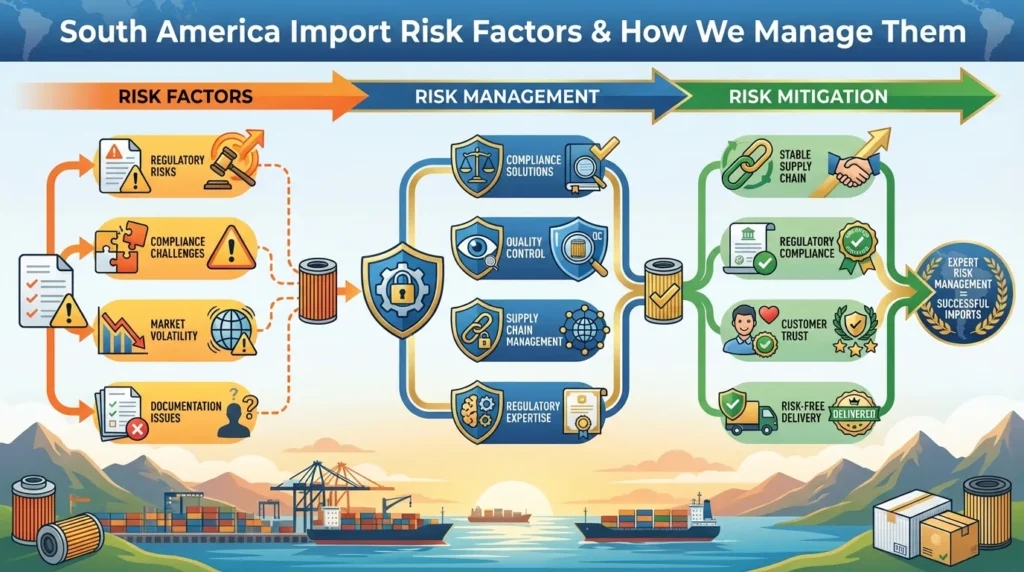
Shipping automotive filters into South America can be very profitable. Demand in the automotive aftermarket is strong, and wellorganized importers can build powerful brands.
At the same time, South America is one of the regions with the highest import risk if you do not prepare properly:
- Customs authorities scrutinize HS code and declared value
- Origin and trade defense measures can change your duty profile overnight
- Documentation mistakes can cause weeks of delay
- Port congestion and currency controls add extra layers of complexity
This guide breaks down the main import risk factors we see when supplying automotive filters into South America – and explains how we help partners manage and reduce those risks so they can focus on sales, not firefighting.
HS Code & Valuation Risk in South American Filter Imports
1.1 Why HS Code Classification Matters So Much
In many South American countries, customs authorities are highly sensitive to:
- Whether your HS code (tariff classification)is technically correct
- Whether that HS code fits the product description and technical spec
- Whether the classification triggers:
- Higher import duty
- Specific taxes
- Trade defense measures
If your classification does not match the authorities’ view, they can:
- Reclassify your filters into a different HS code
- Apply higher duties or taxes
- Question the legitimacy of your documentation
For automotive filters (oil, fuel, air, cabin), having the wrong HS code can be a very expensive mistake.
1.2 Customs Focus on Valuation
In addition to classification, many South American customs offices keep value reference databases. They may question your declared value if it looks:
- Too low compared to their database or historical imports
- Too inconsistent with similar products from other suppliers
- Too different from your own past shipments
If customs suspects undervaluation, they can:
- Delay clearance during verification
- Adjust the value upward
- Charge higher duties and taxes
- In serious cases, apply fines or penalties
In some countries, they may also compare the invoice to import licenses or preapproval documents. If quantities, HS codes or values do not match, this can trigger additional checks.
1.3 How Beling Manages HS Code and Valuation Risk
We reduce HS and valuation risk by:
- Aligning HS codes with your local customs broker before production
- You or your broker lead the classification decision
- We follow your chosen HS code as long as it is technically defensible
- Keeping unit prices stable and consistent with agreed valuations
- Avoiding sudden price drops that can trigger suspicion
- Agreeing in advance if there will be promotional pricing or adjustments
- Ensuring invoice description, HS code and product spec are clear
- Descriptions support your broker if customs has questions
- Technical details match your product registration or licensing, if any
This alignment doesn’t guarantee that customs will never question a shipment, but it greatly improves your broker’s ability to defend the classification and the price.
Country of Origin Scrutiny & Trade Defense Measures
2.1 Why Origin is Sensitive in South America
Several South American authorities pay close attention to country of origin because of:
- Antidumping dutieson certain categories or origins
- Preferential tariff schemes(e.g., Mercosur, FTAs, regional agreements)
- Political or trade tensions affecting imports from specific countries
If the origin is unclear or inconsistent, the authorities may:
- Apply higher or provisional duties
- Open an origin verification or investigation
- Hold containers at the port during the verification process
For automotive filters, this can affect your landed cost and delivery timing significantly.
2.2 Our Origin Management Approach
We treat origin as a critical compliance factor, not just a label detail.
We:
- Print clear “Made in [Country]” marking on unit boxes and outer cartons
- Ensure origin is identical on:
- Commercial invoice
- Packing list
- Certificate of Origin
- Any other certificates or product documents
- Share factory information and production proof if your broker needs it for:
- Compliance files
- Origin verification
- Trade defense investigations
This reduces the chance that your shipments trigger origin doubts and helps your broker respond effectively if customs initiates a verification.
Documentation Errors: Small Mistakes, Big Consequences
3.1 Why Documentation Has Such a Large Impact
In many South American ports, a small documentation mistake can cause large delays. Authorities often have limited tolerance for:
- Missing or incomplete invoice fields
- HS codes that don’t appear on the invoice or don’t match licenses
- Packing lists that don’t align with the physical cargo
- Certificates of Origin with:
- Wrong format
- Wrong issuing body
- Missing chamber stamps or signatures
Because of tight port space and sometimes strict procedures, even simple corrections can take days.
3.2 Our South AmericaFriendly Document Package
We reduce documentation risk by using a structured, regionalfriendly document set:
Commercial Invoice
- Detailed consignee and buyer information
- HS code and country of origin as required
- Clear product descriptions for each filter type
- Unit price, line totals, and grand total
- Incoterms, currency, and payment terms
Packing List
- Carton count, pallet count, net and gross weight
- Dimensions if needed by your broker or local rules
- SKU and quantity per carton
- Pallet breakdown when requested
Certificate of Origin
- Issued according to your chamber / consulate requirements
- Matching all key invoice and packing data
3.3 Consistency and Broker Alignment
We also:
- Doublecheck that quantities, weights and values match across:
- Invoice
- Packing list
- COO and other documents
- Adjust invoice format and field order to local broker preferences when needed
- Some countries prefer specific wording or layout
- We adapt to make life easier for your broker
The goal is that you can forward our documents to your broker and they can proceed without requesting corrections.
PreShipment Licenses & Import Permits
4.1 Licensing and PreApproval Risks
In certain South American countries, some importers or product categories may require:
- Import licenses or registrations
- Preapprovalof HS codes and quantities
- Local conformity registrationsor product registrations
If these are not ready when the ship sails, you risk:
- Containers arriving before the paperwork is complete
- Storage and demurrage charges while waiting for approvals
- In extreme cases, reexport or abandonmentif compliance cannot be achieved
4.2 How We Support Licensing and PreApprovals
We help importers manage these risks by:
- Sharing product details, HS codes and technical data early
- So you can apply for any necessary licenses or registrations in time
- Synchronizing shipment timing with your license validity or quotas
- Avoiding shipments that arrive after a license expires
- Adjusting quantities if quotas are tight
- Sending draft documents before shipment
- Your broker can review them against licensing terms
- Any needed changes can be done before loading, not at the port
This coordination between your licensing process and our production/shipment timing is crucial for avoiding portside problems.
Logistics & Port Congestion in South America
5.1 Structural Logistics Challenges
Many South American ports can be affected by:
- Congestion and strikes
- Seasonal peaks (harvest, holiday periods, yearend rush)
- Limited space, equipment or trucking capacity
These factors can lead to:
- Unpredictable transit times
- Containers waiting to be unloaded or gated out
- Extra storage, THC and demurragecosts
- Challenges maintaining stable inventory and service levels
5.2 How We Plan Around South American Port Risk
We work with partners to mitigate logistics risk through:
- Realistic lead times and buffer in planning
- Not just “ideal” transit times
- Including a safety margin to absorb typical delays
- Early sharing of ETD, ETA and vessel details
- Enabling your broker to prefile customs declarations where possible
- Allowing your logistics team to prepare trucking and warehousing
- Offering flexible shipment sizes and frequencies
- Full container loads and appropriate partial strategies (where feasible)
- Aligning shipping frequency with your inventory and cashflow strategy
By treating South American logistics as structurally variable, rather than expecting “perfect schedule” performance, we help you avoid constant emergency situations.
Currency, Payment & Bank Documentation Risk
6.1 Currency and FX Controls
Importing into South America often involves:
- Strict foreign exchange (FX) controlsin some countries
- Banks controlling access to USD or other foreign currencies
- Requirement to present exact documentsto release payment or FX allocation
At the same time, many currencies in the region can be highly volatile, affecting:
- Local pricing
- Profit margins
- Negotiation of longterm price lists
6.2 Bank Documentation and L/C Handling
Where Letters of Credit (L/C) or Cash Against Documents (CAD) are used, banks may be extremely strict about:
- Exact wording of item descriptions
- Consistency of:
- Incoterms
- Dates
- Quantities
- Values
- Presence of signatures, stamps, and documentary details specified in the L/C
If documents do not match L/C terms exactly, you risk:
- Payment delayswhile discrepancies are resolved
- Additional bank fees
- In worst cases, refusal to pay under the L/C
6.3 Our Approach to Currency and Bank Risk
We manage these risks by:
- Carefully following L/C terms when applicable
- Matching the required description, Incoterms, dates and signatures
- Coordinating with your team before issuing final documents
- Avoiding unnecessary wording on invoices that can cause bank questions
- Keeping descriptions precise and neutral
- Removing informal notes that could be misinterpreted
- Keeping price agreements clear and stable for a defined period
- Allowing you to manage FX risk on your side
- Reducing the need for constant price adjustments that can conflict with license or L/C data
This provides a more predictable financial environment for your South American import program.
Labeling & Spanish / Portuguese Requirements
7.1 Beyond Customs: Consumer and Local Rules
In many South American markets, importers must consider not only customs requirements but also:
- Consumer protection rules
- Local labeling regulationsfor automotive parts
- Preferences or requirements for:
- Spanishin Spanishspeaking markets
- Portuguesein Brazil
Authorities and customers may expect:
- Key information in local language
- Clear country of originmarking
- Local importer or distributor detailson packaging
7.2 How We Adapt Automotive Filter Packaging
We help minimize labeling risk by:
- Designing packaging with flexible zones for:
- Spanish or Portuguese text
- Importer name and address
- Any mandatory regulatory phrases
- Ensuring origin and product description on labels match:
- Commercial invoice
- Packing list
- Certificate of Origin
- Coordinating with your team on which label version is used for which country, for example:
- Dedicated Portuguese label version for Brazil
- Spanish label versions for different Spanishspeaking markets
This helps your brand look professional and compliant on the shelf, while reducing the risk of relabeling demands or consumer authority questions.
Our South America Import Risk Management Routine
8.1 Step 1 – PreAlignment
Before the first shipment, we conduct a prealignment phase:
- Agree on:
- HS codes and country of origin
- Price structure and valuation approach
- Labeling needs (language, origin style, importer info)
- Align with your customs broker on:
- Preferred invoice format
- Description style
- Any special notes or references they find helpful
This creates a clear shared framework for all future orders.
8.2 Step 2 – PreShipment Check
Before loading, we perform a preshipment check:
- Share draft documents(invoice, packing list, COO template) for your broker’s review
- Confirm license / permit statuson your side where relevant
- Adjust any wording or layout based on broker feedback, before the container is sealed
This step greatly reduces the chance of documents needing correction after departure, when changes are harder and slower.
8.3 Step 3 – Clean Loading & Document Release
After the container is loaded:
- We issue final documents immediately, including:
- Commercial invoice
- Packing list
- Certificate of Origin (as applicable)
- Any extra certificates you require
- We verify that all data is consistent across:
- Invoice
- Packing list
- COO
- Labels and packaging
You receive a complete, consistent document package in time for customs prefiling.
8.4 Step 4 – Support During Clearance
During customs clearance and bank processing, we:
- Provide fast responsesif customs or banks ask for clarification
- Offer extra technical or factory informationif your broker needs it for:
- HS code defense
- Origin verification
- Valuation explanations
This ongoing support helps you resolve issues quickly instead of letting containers sit at the port while information is gathered.
8.5 Outcome: Turning Risk into a Manageable Routine
By following this routine, you reduce the main South America import risks:
- Classification (HS code)
- Valuation
- Origin and trade defense
- Licensing and documentation
The result: South America becomes a stable, scalable market for your automotive filter brand, not a constant source of emergencies.
Beling – Save Your Time & Cost
Your valuable automotive filter partner since 2008.
Contact Our Team
Bruce Gong – Key Account Manager, Beling Filters
Email: bruce.gong@belingparts.com
WhatsApp: +86 150 5776 4729
LinkedIn: www.linkedin.com/in/brucegong-beling
We’re happy to walk through your current shipping pattern and see where moving from LCL to FCL (or structuring a mix of both) can protect your margin and your reputation.