Since 2008, working with overseas buyers of automotive filters in more than 30 countries, one thing has been very clear:
The importers who suffer the fewest problems are not the ones who negotiate the lowest price.
They are the ones who ask the right questions before placing orders.
Price is visible and easy to discuss. But longterm success depends much more on what you cannot see on the surface: who really makes your products, how stable quality is, how complaints are handled, how documents and labels are managed, and whether your supplier can grow with you.
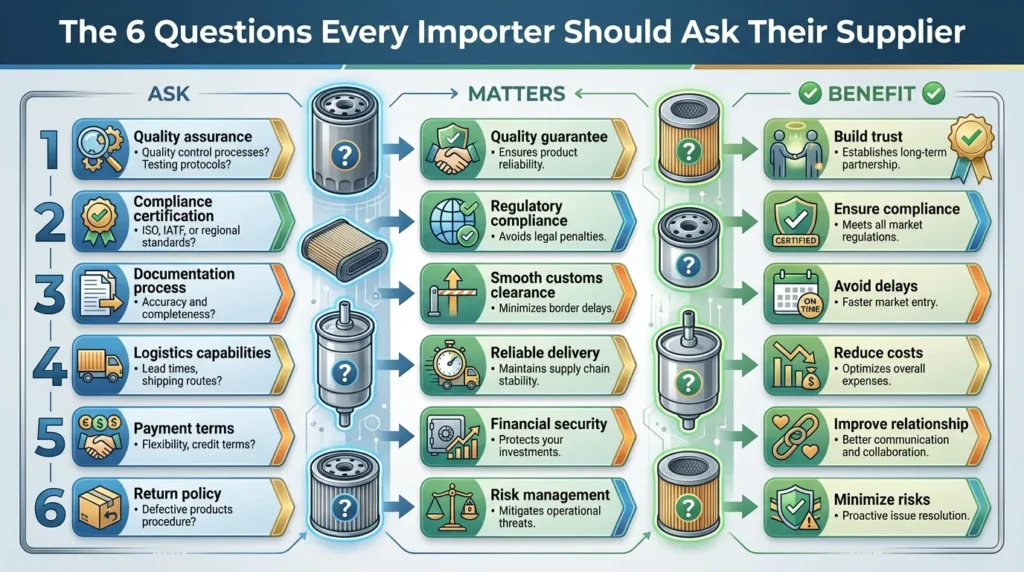
This article breaks down 6 key questions every importer and distributor should ask their automotive filter supplier before starting or expanding cooperation – plus one bonus step that turns these answers into a practical framework for partnership.
“Who Actually Produces My Goods?” – Understanding the Real Supply Source
1.1 Why This Question Matters
In the automotive filter business, many companies present themselves as “manufacturers”, “groups”, or “solution providers”. Some are real factories, some are traders, and many operate as a mix.
If you stop at answers like:
- “We work with many partner factories”
- “We have a strong network of producers”
…you still don’t know who actually produces your goods. This has a direct impact on:
- Quality consistency– Can the same process and standards be applied shipment after shipment?
- Complaint handling– Can root causes be traced and corrected at the production level?
- Longterm stability– Will your main references always come from the same controlled source?
1.2 Questions to Ask Your Supplier About Production
To get real clarity, ask your supplier:
- Are you a factory or a trader?
- If factory:
- What is your main product focus?
- What capacity do you manage inhouse?
- If trader:
- How do you select and manage partner factories?
- If you are a trader, which factory produces my goods?
- Is it always the same factory for each reference?
- Are there backup factories? Under what conditions do you switch?
- Can I visit or audit the factory?
- Are you open to onsite visits?
- Can you share basic factory certifications or profiles?
1.3 What the Answers Tell You
The way a supplier answers will show:
- How transparent they are about their real supply chain
- Whether they can offer traceability and stabilityover time
- How seriously they treat your brand and longterm business
At Beling, we openly explain which products come from which production base, and we welcome structured audits for serious partners who need longterm programs.
“What Exactly Is the Specification – On Paper?”
2.1 The Problem With Vague Specifications
Too many negotiations in the automotive filter world still use phrases like:
- “Same quality as market standard”
- “Similar to big brand quality”
- “Good for your market”
These phrases sound good but mean nothing technical. Without clear specifications, you cannot:
- Know what you’re really buying
- Compare offers from different suppliers properly
- Position your own brand clearly (budget / mid / premium)
2.2 Key Specification Questions to Ask
To move from vague to clear, ask:
- Do you have a technical data sheet for this product?
- For filters, this may include:
- Filter media type
- Filtration efficiency
- Burst pressure
- Flow rate
- Valve and gasket materials
- Which materials / components / key parameters are you using?
- Housing material
- Rubber compound type
- Media brand or grade
- What are your internal tolerances?
- For dimensions
- For performance parameters
- For critical safety points
2.3 Why Paper Specifications Protect You
Having clear specifications on paper helps you:
- Understand whether you’re buying entrylevel, standard, or premiumquality
- Compare different suppliers objectively, not just by price
- Support your own marketing and technical communication:
- Catalogs
- Tenders
- Fleet and workshop discussions
At Beling, we work with defined specification levels so buyers know exactly what performance and materials they are getting for each product line.
“How Do You Control Quality – Step by Step?”
3.1 “We Have QC” Is Not Enough
Almost every supplier will say:
- “We have QC.”
- “We follow strict quality control.”
But there is a big difference between real process control and simply “looking at parts at the end”.
To understand how serious a supplier is about quality, you must ask about their process in detail.
3.2 Quality Control Questions to Ask Your Supplier
Ask:
- What controls do you do on incoming materials?
- Do you test key raw materials (media, rubber, steel) before using them?
- Do you verify supplier certificates?
- Which inprocess inspections do you use?
- Do you check dimensions and assembly during production, or only at the end?
- How often are checks performed?
- Do you do final tests? How often and on what samples?
- Do you test pressure, leakage, flow, and functionality?
- What is your sampling plan (e.g. per batch, per shift)?
- Can you share examples of test reports?
- Real reports with data, not just templates
3.3 Why This Matters for Your Brand
Clear answers here:
- Separate suppliers who control the processfrom those who only inspect at the end
- Show whether they can keep quality stable over time, not just on the first shipment
- Give you solid arguments when customers or partners ask:
- “How do you guarantee quality?”
- “What kind of testing do your filters go through?”
At Beling, we share sample test reports and explain our control structure so buyers can confidently explain their quality assurance to their own market.
“What Happens If There Is a Complaint?”
4.1 Complaints Are Inevitable – How They’re Handled Is the Key
Even with good quality control, complaints will eventually happen:
- Incorrect applications
- Installation issues
- Unexpected field conditions
- Isolated production defects
The real test of a supplier’s attitude is how they respond.
If a supplier has no clear procedure, every complaint becomes:
- Emotional
- Slow
- Full of arguments and misunderstandings
4.2 Complaint Handling Questions to Ask
Ask the supplier:
- What is your complaint procedure?
- Do you have a defined path for receiving, analyzing and closing complaints?
- What information do you need from us to analyze?
- Photos, batch numbers, installation details, vehicle data, etc.
- How long do you take to give a technical answer?
- Typical response time for initial feedback
- Time for full technical analysis
- In what cases do you replace or credit goods?
- Clear conditions
- Limitations and responsibilities
4.3 Why Clear Complaint Rules Protect Your Reputation
Knowing this in advance:
- Shows whether the supplier is serious about aftersales support
- Avoids arguments later like:
- “We never promised this”
- “This is not our responsibility”
- Helps you protect your own reputation with:
- Distributors
- Workshops
- Fleet customers
At Beling, we define complaint handling rules with serious partners so both sides know how to react quickly and professionally when issues appear.
“Can You Match Our Documentation & Label Requirements?”
5.1 Documentation and Labels: Where Many Costs Really Appear
Many importers focus mostly on product and price, but in international trade for automotive filters, a large part of problems and costs come from:
- Documentation issues
- Label and shipping mark mistakes
If your supplier cannot adapt to your requirements, you may face:
- Customs delays
- Bank or L/C discrepancies
- Forced relabeling in your warehouse
- Returns due to confusing labels
5.2 Key Documentation and Label Questions
Ask your supplier:
- Can you adapt invoice and packing list formats to our broker or bank?
- Wording
- Field structure
- Data layout
- Can you follow our label layout, language, and codes?
- Your part numbers
- Barcodes / EAN
- Local language requirements
- Importer name and origin text
- Will you send draft documents before shipment for checking?
- Draft commercial invoice
- Draft packing list
- Possibility to adjust before issuing originals
5.3 The Benefits of a Supplier Who Can Adapt
When a supplier can match your documentation and label requirements, you benefit from:
- Fewer customs and payment delays
- Less relabelingin your warehouse
- Lower risk of returns, fines, and extra handling
At Beling, this is a core part of our service: we adapt documents and labels to each buyer and treat them as critical elements of supply chain reliability, not just “paperwork”.
“How Do You Plan Capacity and Lead Times for LongTerm Partners?”
6.1 Beyond the First Order: Can They Grow With You?
Before the first order, almost every supplier promises fast delivery and “no problem with capacity”.
But what really matters is:
- How they plan for repeat orders
- How they handle high season
- Whether they can support your growthwithout constant crisis
6.2 Capacity Planning Questions to Ask
Ask specific questions such as:
- What is your standard lead time for repeat orders?
- From order confirmation to shipment
- How do you plan capacity for main references?
- Do you keep raw materials or semifinished stock for key part numbers?
- Can you work with forecasts or annual plans?
- Are they willing to align production planning with your demand forecast?
- How do you handle seasonal peaks?
- Do they extend lead times?
- Do they prioritize longterm partners?
6.3 Why This Is Essential for Your Inventory and Sales
Clear, realistic capacity and lead time planning helps you:
- Plan inventory with more confidence
- Avoid stockoutsduring high season or promotions
- Build a stable programinstead of living in “orderbyorder firefighting” mode
At Beling, we encourage buyers to share forecasts and main references early, so we can plan production and materials accordingly and avoid surprises when your demand grows.
7.Bonus: Ask Them to Put It in Writing
7.1 Turning Answers Into a Practical Framework
For serious cooperation, it’s not enough to just talk. You should ask your supplier to summarize key points in writing, including:
- Specification level
- Technical data sheets
- Target performance and materials
- Quality control steps
- Main controls at incoming, inprocess and final stages
- Complaint procedure
- Process, requirements, response times, and compensation rules
- Document & label commitments
- Ability to adapt formats
- Draft review process
- Label layout and compliance rules
- Standard lead times and planning approach
- For standard and peak periods
7.2 How Written Commitments Strengthen the Partnership
This written summary becomes your practical framework for the relationship:
- It reduces misunderstandings later
- It gives both sides a reference when questions arise
- It shows whether the supplier is ready for longterm, professional cooperation
At Beling, we welcome these questions – not only to us, but also to other suppliers you compare us with. Clear answers upfront create stronger, more transparent partnerships and fewer problems later.
Beling – Save Your Time & Cost
We encourage buyers to ask these questions – to us and to other suppliers.
Clear answers upfront build stronger, more transparent longterm partnerships.
Your valuable automotive filter partner since 2008.
Contact Our Team
Bruce Gong – Key Account Manager, Beling Filters
Email: bruce.gong@belingparts.com
WhatsApp: +86 150 5776 4729
LinkedIn: www.linkedin.com/in/brucegong-beling
We’re happy to share how we usually adjust pallets for EU vs Middle East vs Latin America markets, and help you fine tune palletization to your warehouse system.