In the automotive filter business, the biggest risk for importers is not always price.
It’s what you cannot see:
- Were the right materials used?
- Was fitment checked against OE specifications?
- Did the filter pass any performance tests, or was it only visually inspected?
Two filters can look almost identical on the outside, but their performance and durability can be completely different — especially when the internal media, bonding, and structure are not properly controlled or tested.
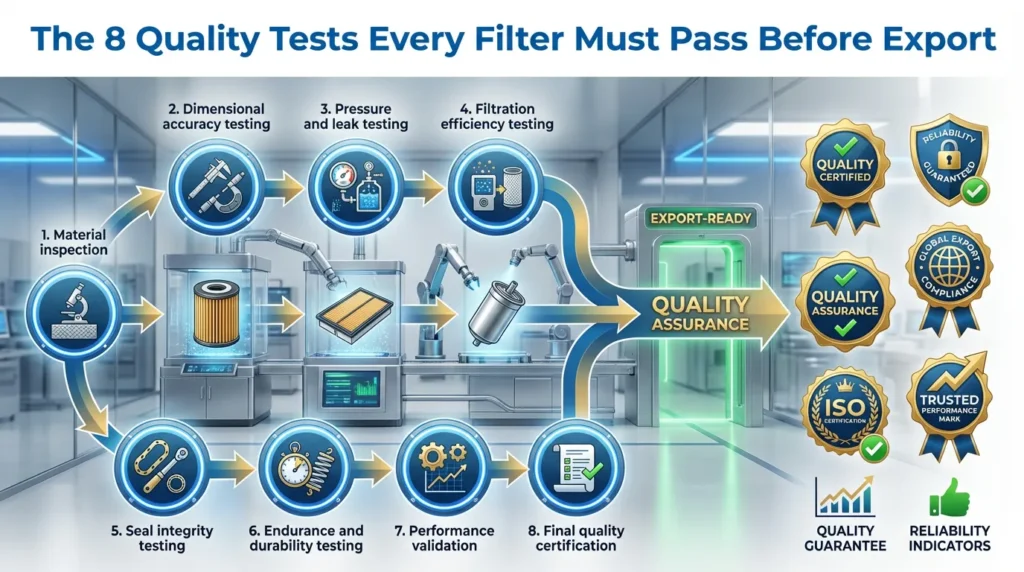
When we export air filters, cabin filters, oil filters and fuel filters, every batch must pass a standard 8‑step quality test routine before it leaves the factory.
This article explains:
- The 8 essential tests we run
- What each test checks technically
- Why each test matters for importers, distributors, and brand owners
- How this testing routine reduces your risk on every shipment
If you’re importing or building a brand in automotive filters, understanding these tests gives you a clear framework for evaluating suppliers and protecting your reputation.
Raw Material Inspection for Automotive Filters
Quality starts long before assembly. If you use the wrong media, rubber, plastic, or metal, no amount of inspection at the end can fix it.
That’s why our first step is raw material inspection.
What We Inspect Before Production
For every batch, we test key materials:
- Filter media
- Grammage (weight per square meter)
- Thickness
- Resin content and treatment
- Visual and physical consistency
- Rubber and plastic components
- Hardness (Shore A or Shore D as applicable)
- Elasticity and recovery
- Aging resistance (basic checks; deeper tests as required)
- Metal components (for oil and fuel filters, or reinforced structures)
- Coating quality (corrosion resistance)
- Thickness and tolerances
- Surface finish and edge quality
Why Raw Material Inspection Matters
For importers and brand owners, this step protects you against:
- Batches that look fine at first but fail early because the media was too weak, too thin, or incorrectly treated.
- Rubber gaskets that harden or crack prematurely, causing leaks.
- Metal parts that rust quickly or deform under pressure.
By controlling raw materials, we ensure that every filter starts from the right foundation — essential for real OE‑level performance and reliability.
Dimensional and Fitment Check vs OE Specifications
Even the best media and materials are useless if the filter does not fit correctly.
Filters must match OE housings, brackets, seals, and connectors within tight tolerances. Poor fitment leads directly to returns, complaints, and bypass issues.
What We Verify in Dimensional & Fitment Checks
We measure and inspect:
- Overall dimensions
- Length, width, height
- Outer and inner diameters (for spin‑on and cartridge filters)
- Thickness and profile for cabin and panel air filters
- Critical interfaces and sealing areas
- Gasket dimensions and shape
- Sealing lips and contact surfaces
- End cap interfaces and housing contact zones
- Clip and connector accuracy (especially for modern systems)
- Sensor interface positions
- Locking tabs and clips
- Positioning features and guides
We compare these values against:
- Engineering drawings
- OE reference parts
- Approved samples
Why Dimensional & Fitment Checks Matter
Correct fitment:
- Reduces “it doesn’t fit” problems in workshops
- Prevents installers from forcing parts into place or modifying housings
- Ensures proper sealing, avoiding unfiltered bypass air/oil/fuel
For distributors and brand owners, this means:
- Fewer returns and installer complaints
- Better trust from mechanics who rely on your brand to “fit like OE”
- Less risk of negative reviews due to fitment issues
Filtration efficiency is the core reason filters exist. A filter that looks good but doesn’t stop contamination is a liability.
That’s why we run filtration efficiency tests tailored to each filter type.
What We Measure in Filtration Efficiency
Depending on whether the filter is for air, cabin, oil, or fuel, we test:
- Particle size filtration efficiency
- How effectively the media captures particles across different sizes
- Applicable standards and test methods based on product type
- Dust holding capacity / contamination holding
- How much dust or contamination the media can hold before resistance becomes excessive
- Ensuring the filter stays effective throughout its service interval
- Performance across the service life
- Comparing initial efficiency vs efficiency after dust loading
- Checking that performance remains within acceptable limits over time
Why Filtration Efficiency Tests Matter
For your customers, the promise is simple: clean air, clean oil, clean fuel.
Without efficiency testing:
- Some filters allow too many fine particles to pass, leading to:
- Faster engine wear
- Injector or pump problems
- Cabin air quality issues
- Others might use overly dense media that restricts flow prematurely.
By testing and validating efficiency:
- You can confidently claim protection, not just “cheap replacement.”
- Your brand stands for performance, not just low price.
Pressure Drop and Flow Resistance Testing
A filter must protect the system without choking it.
Even if filtration efficiency is good, excessive flow restriction can:
- Reduce engine performance
- Increase fuel consumption
- Affect comfort (for cabin filters and HVAC systems)
What We Measure in Pressure Drop / Flow Resistance Tests
We test:
- Initial pressure drop at a specified flow rate
- For example, the pressure difference across the filter at a given air or fluid flow
- Ensuring it falls within a defined acceptable range
- Flow curve across different flow rates
- Measuring how resistance changes as flow increases
- Creating a performance curve for engineering validation
Why Flow Resistance Tests Matter
Without proper flow testing, a filter may:
- Over‑restrict the system, causing loss of power and efficiency
- Load too quickly, requiring premature replacement
- Create customer complaints that are hard to trace back to the filter
With tested and controlled pressure drop:
- You balance protection vs performance
- Engines and systems get clean flow without unnecessary restriction
- Your brand is not blamed for “the car feels weaker after service” issues
Burst and Pressure Resistance Tests for Oil and Fuel Filters
Oil and fuel filters operate under pressure. If the housing or seams cannot withstand the pressure peaks in real operation, the result can be catastrophic:
- Sudden leaks
- Cracks or ruptures
- Loss of lubrication or fuel delivery
- Serious engine damage
What We Test for Burst and Pressure Resistance
For oil and fuel filters, we perform:
- Burst pressure tests
- Gradually increasing internal pressure to see at what point the filter fails
- Ensuring a safety margin above typical operating pressures
- Housing and seam strength tests
- Verifying that welds, crimps, or joints remain intact under pressure
- Confirming that end caps and seals hold firmly
Why Burst and Pressure Resistance Tests Matter
For importers and brand owners, these tests:
- Reduce the risk of severe field failures that can damage engines
- Protect your brand from high-cost warranty claims
- Increase confidence when selling into markets with demanding driving conditions
A filter that fails under pressure can cause damage far beyond the value of the part itself. Burst and pressure tests are your protection against that risk.
Leakage and Sealing Tests for Automotive Filters
Even a small leak can defeat the purpose of a filter. If unfiltered fluid or air can bypass the media, all the efficiency and media quality are wasted.
That’s why we systematically test leakage and sealing.
What We Check in Leakage & Sealing Tests
We inspect and test:
- Gasket sealing under pressure
- Ensuring the gasket maintains its seal under working pressure
- Checking compression and recovery characteristics
- Glue lines and end cap bonding
- No gaps or voids that allow bypass
- Proper adhesive coverage and curing
- Housing joint tightness
- For spin‑on filters, cartridge housings, and panel assemblies
- Verifying that joints remain tight under operating conditions
Why Leakage & Sealing Tests Matter
If a filter leaks:
- Unfiltered air/oil/fuel bypasses the media completely.
- Engine and system protection drops to near zero.
- Problems may not be visible at installation — they appear later as wear or failure.
For you, passing leakage and sealing tests means:
- The system is actually being filtered, not just visually “equipped with a filter.”
- You avoid hidden failures that only show up months later as engine problems.
Durability and Endurance Simulation for Filter Service Life
Most filters are not meant to protect the system for a day. They are designed for a service interval — thousands of kilometers or operating hours.
A filter that passes a one‑time lab test but cannot maintain performance over its full life is not acceptable.
What We Do in Durability / Endurance Tests
Depending on the filter type and application, we perform:
- Temperature cycling
- Repeated exposure to hot and cold temperatures
- Checking for material fatigue, cracking, or deformation
- Vibration and mechanical stress tests
- Simulating engine vibrations and road conditions
- Ensuring components don’t loosen, crack, or shift
- Extended flow testing
- Running air/oil/fuel through the filter over an extended period
- Simulating the real service life
- Monitoring performance, pressure drop, and structural integrity
Why Durability Tests Matter
These tests ensure the filter is reliable from the first kilometer to the last:
- No premature collapse of media
- No loss of sealing after thermal or mechanical stress
- Stable performance across the entire service interval
For importers and brand owners, durability testing reduces:
- Late‑stage failures that appear only after months of use
- Warranty claims and customer dissatisfaction
- Risk of your brand being seen as “OK at first, but doesn’t last”
Final Visual and Packaging Inspection Before Export
Even if technical performance is excellent, final presentation still matters — especially when you sell under your own brand.
The last step before export is a thorough visual and packaging inspection.
What We Inspect Before Shipment
We check:
- Appearance and assembly quality
- Media pleating uniformity
- No glue overflow or contamination
- No deformation or dents
- No rust or surface contamination
- Labeling and identification
- Correct part number
- Brand and logo (for private label)
- Country of origin
- Batch code / date code for traceability
- Packaging and palletizing
- Box and carton condition
- Carton strength appropriate for export
- Correct labeling on cartons and pallets
- Proper palletization to prevent damage during transit
Why Final Visual & Packaging Inspection Matters
This final step ensures:
- You receive shelf‑ready products that look professional in your market.
- Every filter is traceable, allowing you to manage inventory and any potential quality issues effectively.
- Transport damage risk is minimized, reducing surprises when you open the container.
For your brand, good packaging and presentation support:
- Better perceived quality in the eyes of workshops and end users
- Easier stock management and logistics
- A consistent, professional appearance across all shipments
What These 8 Tests Mean for Importers, Distributors and Brand Owners
For our overseas partners, this 8‑step quality routine provides:
- Lower quality risk on each shipment
Because you know every batch has passed material, fitment, performance, sealing, and durability checks. - Fewer returns and complaints
Installers and end users experience consistent fitment and performance, leading to fewer issues in the field. - Stronger brand image
When your filters perform reliably, your brand stands out in a crowded market as a trustworthy choice. - Peace of mind
You can be confident that what leaves the factory is ready for your market — not just visually, but technically.
If you’re importing or developing an automotive filter brand and want more control over quality before the goods leave China, having a clear, documented testing routine is essential.
We’re happy to walk you through:
- Example testing reports
- How our 8‑test routine works for specific filter types
- How we can align testing and reporting with your brand requirements and positioningContact Our Team
Bruce Gong – Key Account Manager, Beling Filters
Email: bruce.gong@belingparts.com
WhatsApp: +86 150 5776 4729
LinkedIn: www.linkedin.com/in/brucegong-beling
We’re happy to walk you through how we integrate container loading photos into our export process and how you can use similar practices with all your suppliers.