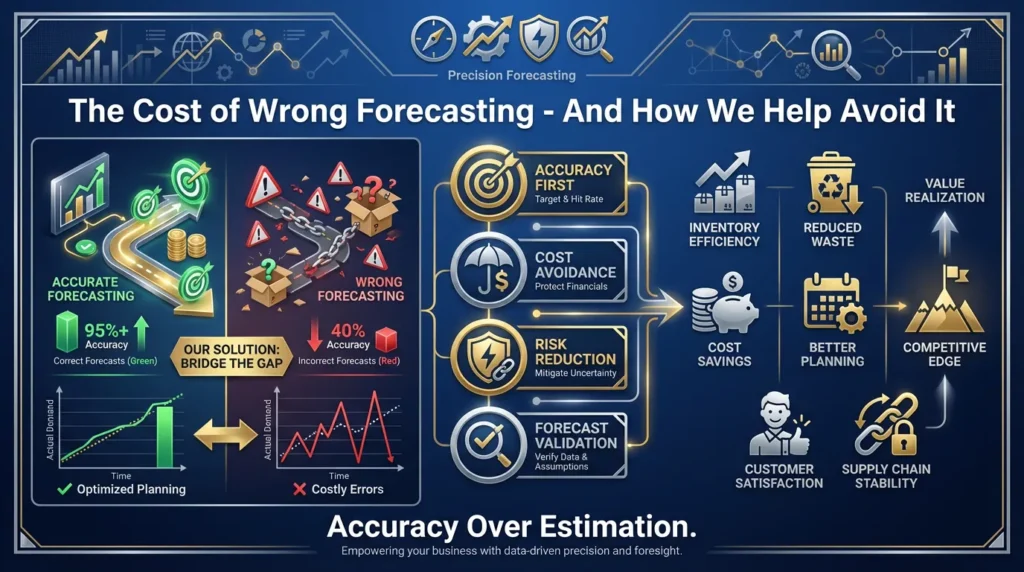
Overoptimistic or unclear forecasts don’t just “make planning harder”.
They quietly turn into real, measurable costs for both distributor and supplier:
- Excess stock that doesn’t move
- Stockouts on the SKUs that do move
- Emergency orders with high freight cost
- Unused production capacity blocked by the wrong items
We see this pattern often in private label automotive filter programs – and we’ve built our way of working at Beling specifically to reduce it.
This article explains:
- What wrong forecasting really costs you
- Why filters are particularly easy to misforecast
- How we work with you to build realistic, rolling forecasts
- How we connect production and reporting back into your demand planning
What Wrong Forecasting Really Costs Distributors
1.1 Four Main Cost Areas of Bad Forecasting
When forecast and reality don’t match, distributors usually pay in four ways:
- Dead stock
- Slowmoving SKUs filling warehouses
- Cash tied up in inventory that doesn’t turn
- Storage and handling costs for references that add little revenue
- Stockouts on A items
- Core references not ordered or forecasted correctly
- Workshops can’t find key part numbers
- Your brand loses “shelf presence” on crucial engines
- Rush orders and airfreight
- Emergency orders to cover gaps that could have been planned
- Airfreight or express transport erasing margin
- Extra internal workload for urgent replanning
- Lost sales and lost trust
- Workshops and fleets switch brands when key references are missing
- Distributors lose contracts or key accounts
- Damage to your private label brand credibility
A forecast that is “roughly right” and grounded is far better than a forecast that looks perfect in Excel but doesn’t reflect the real market dynamics.
1.2 How These Costs Add Up Over Time
Individually, each mistake might look small:
- One overstocked longtail reference
- One urgent shipment on a popular filter
- One disappointed fleet customer
But over 12–24 months, the cumulative effect can be:
- Tens of thousands in tiedup capital
- A steady trickle of lost margindue to emergency freight
- A weaker position in the workshop’s mindcompared to competitors
This is why we treat forecasting not as a paperwork formality, but as a core profitability lever for your program.
Why Automotive Filters Are Easy to MisForecast
2.1 Complexity of the Product Range
Automotive filters are deceptive. They look simple, but the forecasting environment is complex:
- A large number of references
- Different car parc structures by country
- A/B/C items that change over timeas vehicles age
- Seasonalityin some segments:
- Diesel vs. gasoline
- Fleets vs. private cars
- Agricultural and offhighway usage
Result: it’s easy to overforecast longtail references and underforecast core fast movers.
2.2 Typical Situations Where Forecasting Goes Wrong
We see misforecasting particularly in:
- New programs
- Overenthusiasm about how fast the range will move
- Limited historical data to base numbers on
- New ranges or extensions
- Adding many new SKUs at once
- Flat quantities across the board, ignoring real demand potential
- Situations where a distributor’s sales team is very optimistic
- Forecasts reflect targets, not realistic expectations
- No correction after first 3–6 months of sales data
Without structured guidance, this can quickly create the dead stock + stockout combination that hurts both sides.
How We Help New Programs Start on Realistic Numbers
3.1 Going Beyond “Send Us Your Forecast”
When launching or expanding a private label filter line, we don’t just say:
“Send us your forecast.”
We actively work with you to make that forecast more realistic and usable.
3.2 Inputs and Benchmarks We Share
We support you by:
- Sharing typical A/B/C splits for similar markets
- Approximate share of volume in top 20–50 references
- Expected longtail behavior by region or car parc maturity
- Highlighting SKUs that are often over or underestimated
- Filters for very new models (often overestimated)
- Highfleet density references (often underestimated)
- Suggesting initial order ranges by item class, instead of flat quantities
- Higher starting volumes for likely A items
- More conservative initial volumes for potential C items
- Considering your current brand volumes as reference where possible
- OEM or other aftermarket brand sales as a baseline
- Adjustments for price positioning and channel strategy
3.3 Outcome: Ambitious but Grounded First Orders
The outcome is a first order and forecast that is:
- Ambitious enough to support growth
- Grounded in market reality and benchmarks
- Less likely to create huge dead stock or critical gaps
We prefer realistic, correctable starting points over purely theoretical spreadsheets.
Building a Rolling Forecast, Not a OneTime Guess
4.1 Forecast as a Living Tool
Forecasts are not a contract for the next 12 months. Treating them as fixed numbers is a recipe for disappointment.
We see forecasts as a living tool that should evolve with:
- Real orders
- Market feedback
- Promotions and project wins
4.2 How Our Rolling Forecast Process Works
For serious partners, we work on a rolling 3–6 month view:
- You share updated demand assumptions each month or quarter
- We compare forecast vs actual orders and point out:
- Overforecast patterns
- Underforecast patterns
- Together, we adjust future months to reflect what the market is telling us
4.3 Risk Reduction Through Continuous Adjustment
This rolling process reduces the risk of:
- Huge overstockon references that didn’t take off
- Sudden urgent shortageson those that grew faster than expected
The goal is not to “never be wrong”, but to be less wrong over time and correct quickly.
Using A/B/C Classification to Focus Where It Matters
5.1 Not All SKUs Deserve the Same Effort
We don’t treat all SKUs the same.
Instead, we:
- Classify your range into A / B / Cbased on expected and actual demand
- Encourage more precise forecasting on A items
- Use broader, more flexible assumptions for C items
5.2 Different Approaches by Class
For example:
- A items
- Tighter minimums
- More frequent review
- Potential safety stockboth at your side and ours
- Priority in production capacity and logistics during disruptions
- B items
- Moderate forecast precision
- Monitored quarterly
- Balanced stock vs risk
- C items
- Produced more on demandor in small batches
- Lower inventory and obsolescence risk
- Simpler planning rules
5.3 Why This Reduces Forecasting Risk
By focusing forecasting effort where mistakes are most expensive (A items), we:
- Reduce the chance of stockoutson key references
- Avoid unnecessary capital tied up in slow movers
- Make your planning work more efficient and impactful
Feeding Production & Order Feedback Back Into Your Planning
6.1 Weekly Reporting as Forecast Input
Our weekly production and order reports are not only visibility tools; they are also feedback loops into your forecasting process.
Through these, we help you see:
- Which SKUs are consistently beating forecasts
- Which SKUs are slowing downcompared to expectations
- Which POs are repeats of urgent patterns(a sign of systematic underforecasting)
6.2 Concrete Signals We Share
We will explicitly flag:
- “These 10 references are much stronger than your forecast– consider raising your planned volumes.”
- “These 15 references are not moving as expected– let’s slow down future orders.”
6.3 Over Time: Sharper, Less Risky Forecasts
As you incorporate these signals, over 6–12 months:
- Your forecast errordecreases
- You build more confidencein your planning numbers
- Both sides can:
- Plan capacity better
- Reduce firefighting
- Protect margin and cash
Forecasting becomes a structured learning process, not a onetime bet.
Aligning Capacity With Your Forecast – and Its Limits
7.1 Using Your Forecast to Secure Capacity
We use your forecast to:
- Reserve production capacity for A items
- Plan material purchasesmore efficiently
- Reduce lead time volatilityby avoiding lastminute peaks
This gives you:
- More predictable lead times
- Better availabilityon strategic references
7.2 Being Honest About Capacity Constraints
At the same time, we are honest when forecasts are too high to be realistic.
If your forecast would require an impractical rampup, we:
- Show you what capacity we can actually commit
- Highlight where assumptions may be overly optimistic
- Work with you to set realistic ceilings
7.3 Align Early, Avoid Disappointment Later
It’s better to:
- Align expectations early
- Match growth targets with realistic factory and supply constraints
…than to:
- Promise capacity that can’t be delivered
- Face repeated late orders and frustration
This capacityforecast alignment is a key part of risk management for both sides.
Helping You Avoid Panic Reactions
8.1 The Classic Panic Cycle
A common reaction to stockouts is:
- One or more key SKUs run out
- Urgent orders are placed and maybe airfreighted
- In response, the next regular order is massively inflated
- Several months later, after the peak passes, you sit on overstock
This cycle damages margin and distorts reality.
8.2 Our Role in Breaking the Cycle
We help you avoid this trap by:
- Analyzing what caused the stockout:
- Forecast error
- Launch delay
- Promotion not reflected in planning
- Unusual onetime project
- Calculating what is truly needed to stabilize availability
- Accounting for transit time, current pipeline and realistic demand
- Suggesting phased increases instead of one big spike
- Progressive volume growth for the next 2–3 orders
- Buffer where needed, but not a full overreaction
8.3 Solving Today Without Creating Tomorrow’s Problem
This approach helps you:
- Solve today’s shortage
- Avoid creating tomorrow’s overstock
- Keep your program on a controlled, sustainable growth path
Our objective is not just to sell more in the next order, but to help you run a healthy business over years.
What This Means for You as a Buyer
Working with forecasting as a joint, ongoing process, not a onetime Excel file, allows you to:
- Reduce dead stockand tiedup capital
- Keep A items consistently availableto your customers
- Lower your dependence on emergency orders and expensive freight
- Grow your private label range with controlled risk, not guesswork
At Beling, we don’t expect perfect forecasts.
We expect:
- Honest collaboration
- Data sharing
- Regular review
In return, we design our capacity, purchasing, and reporting to support you.
Because in the end, the cost of wrong forecasting is paid by both sides. Our job is to make sure those costs stay as low as possible.
Beling – Save Your Time & Cost
Your valuable automotive filter partner since 2008.
Contact Our Team
Bruce Gong – Key Account Manager, Beling Filters
Email: bruce.gong@belingparts.com
WhatsApp: +86 150 5776 4729
LinkedIn: www.linkedin.com/in/brucegong-beling
We’re happy to share how we usually adjust pallets for EU vs Middle East vs Latin America markets, and help you fine tune palletization to your warehouse system.