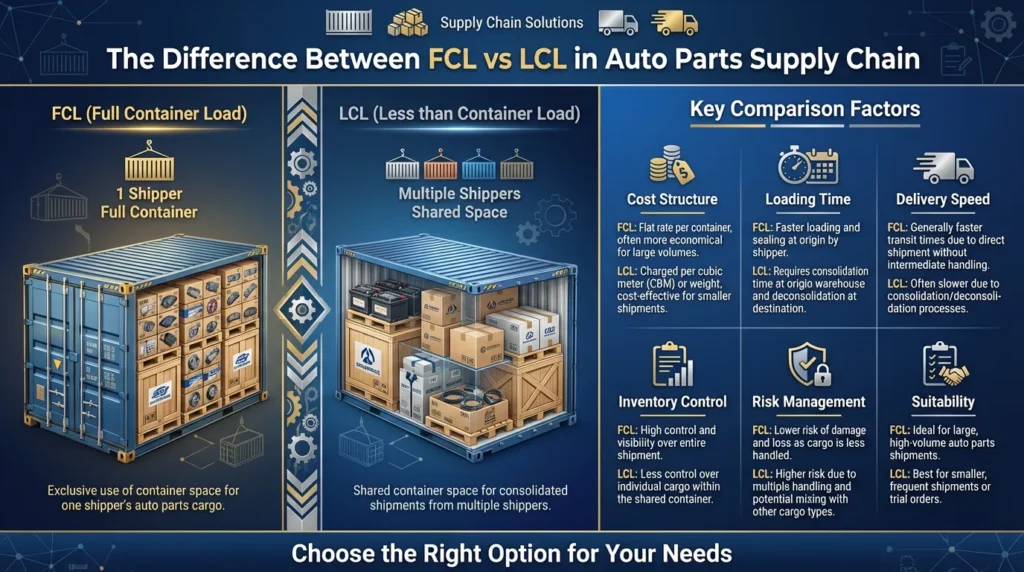
Same destination.
Same auto parts.
Two very different journeys: FCL vs LCL. 🚢📦
In filters and auto parts, choosing the wrong mode can quietly kill your margin:
- Extra damage
- Hidden local charges
- Longer lead times
- Unstable stock and cash flow
At Beling Filters, we look at FCL (Full Container Load) vs LCL (Less than Container Load) from a practical, total-cost and risk point of view – not just “which freight quote is cheaper today”.
In this article, we’ll break down:
- Product risk: damage, mix up, moisture
- Volume vs cost: beyond “cheaper freight”
- Lead time and predictability
- Stock strategy in the destination market
- Our approach as a filter manufacturer
- When LCL stops making sense – and how we calculate it with partners
If you’re not sure when to move from LCL to FCL for your auto parts, this framework will help you make better decisions.
Product Risk in FCL vs LCL: Damage, Mix Up, Moisture 🛡️
(Why Auto Parts Behave Differently From Bulk Commodities)
Auto parts – especially filters – are not like steel bars or plastic pellets. They are often:
- Fragile at the corners
- Packed in branded cartons
- Sensitive to moisture (paper media, glues, anti-bacterial coatings, etc.)
So the way they are handled during international transport matters a lot.
1.1 What Happens in FCL (Full Container Load)
When we ship FCL:
- You control packing and palletizing
- All cartons and pallets in the container belong to you.
- We can design pallet height, layout and blocking specifically for your cargo.
- There is less handling and fewer touch points
- Factory → container → port → vessel → destination port → your warehouse.
- The container is generally sealed at origin and opened at destination.
- It’s easier to manage moisture inside the container
- We can design a moisture control plan:
- Desiccants
- Container liners (if needed)
- Top covers on pallets
- Less opening/closing → more stable environment.
Result:
Lower risk of crushed cartons, corner damage, wet boxes or missing pieces.
1.2 What Happens in LCL (Less than Container Load)
In LCL:
- Your goods share space with other shippers’ cargo
- More loading/unloading happens at the CFS (Container Freight Station)
- Your pallets or cartons are moved, restacked, consolidated with others.
- Sometimes repalletized or rearranged.
This means:
- Higher risk of crushed cartons
- Other cargo might be heavier, poorly packed, or placed on top of your shipments.
- Higher chance of mix-ups or missing pieces
- Labels can be ignored or misread in busy CFS operations.
- Loose cartons or small boxes are especially vulnerable.
- Moisture is less under your control
- Container loading and unloading cycles, plus mixed cargo, make it harder to design a moisture strategy just for your goods.
For high value or sensitive auto parts, FCL is usually the safer route, even if the initial freight looks slightly more expensive.
Volume vs Cost: FCL vs LCL Is More Than “Cheaper Freight” 💰
(Looking at Total Landed Cost, Not Only Ocean Rate)
LCL often looks attractive when:
- Volume is small
- You are testing a new market
- Cash flow is tight
The ocean freight per CBM or per ton may look cheaper, but we always dig deeper.
2.1 Hidden Cost Components of LCL
When comparing FCL vs LCL, we consider:
- Per unit cost after all local charges
- LCL comes with more handling fees, CFS charges, documentation fees at both origin and destination.
- These can add up quickly on a per-unit basis.
- Extra handling / documentation fees
- CFS handling
- Consolidation / deconsolidation fees
- Terminal handling specific to LCL cargo
- Damage / shortage risk cost
- Even a small percentage of damage or loss can make the “cheaper LCL” more expensive per good unit sold.
When we calculate total landed cost, LCL is often not as cheap as it appears in the freight quote.
2.2 The 60–70% Container Fill Threshold
From practice, in many trade lanes:
- Once you reach 60–70% of a container,
FCL total landed cost per unit often starts to make more sense than LCL.
Why?
Because:
- The fixed LCL charges (CFS, handling, documentation) begin to outweigh the benefit of sharing a container.
- Per-unit costs from FCL become more competitive and more predictable.
2.3 How We Simulate the Cost With Partners
With distributors, we don’t guess – we simulate:
- 1×LCL vs 1×FCL per unit cost
- Including freight, origin and destination charges, damage estimates.
- Adding a few extra SKUs to fill the space
- Sometimes adding a few more fast-moving parts allows you to jump from 60% to 80–90% container fill.
- This can improve both price and stock security.
- Impact on safety stock in their market
- How much stock buffer does the FCL model provide?
- How does that support service levels and avoid stockouts?
This way, the decision is based on numbers + risk, not just on a cheap-looking LCL quote.
Lead Time and Predictability in FCL vs LCL ⏱️
(Why Planning Becomes Simpler With FCL Cycles)
Beyond cost, FCL vs LCL has a big impact on:
- Lead time
- Schedule reliability
- Planning predictability
3.1 Typical Lead Time Pattern for FCL
With FCL:
- Fewer stops
- Often more direct routes
- Less operational complexity at terminals and CFS
This usually means:
- Shorter total transit time (vs LCL on the same route)
- More stable schedule
- Easier to track containers end-to-end
Your team can plan:
- Arrival windows
- Inbound labour
- Promotions and sales campaigns
with more confidence.
3.2 Typical Lead Time Pattern for LCL
With LCL:
- Additional time is needed for consolidation at origin
- Additional time for deconsolidation at destination
- More handover points between different logistics providers
This results in:
- More chances for delay or misrouting
- More variability in actual lead time versus planned
- Sometimes “invisible” waiting times at the CFS
For stable, repeat orders of filters and auto parts, we usually push toward FCL cycles because they:
- Keep shelves consistently full
- Reduce planning stress
- Make forecasting and stock management simpler
LCL can be a good way to start, but relying on LCL for a mature, stable market often creates unnecessary complexity.
Stock Strategy in the Destination Market: FCL vs LCL 📊
(Balancing Frequency, Cash Flow and Safety Stock)
FCL vs LCL is not only a shipping question. It is also a stock strategy question.
We discuss with distributors:
- “Do you prefer more frequent small LCL shipments?”
- “Or bigger FCL shipments with better price and safer packing?”
Both options have pros and cons. Our job is to help you choose based on your market reality.
4.1 When LCL Makes Sense
LCL can be a good choice when:
- You are testing a new market
- You are introducing new reference numbers / new models / new brand
- Sales are still unpredictable and you want to limit inventory exposure
For example:
- First 1–2 shipments of new SKUs
- Trial volume for a new country or new segment
In this phase, the priority is learning the market and protecting your cash, not optimising every last cent of freight.
4.2 When It’s Time to Move From LCL to FCL
Once turnover is more stable, we usually recommend shifting to FCL with:
- An agreed order cycle (e.g. every 45–60 days)
- A standard packing plan per container
- Defined SKUs
- Planned quantities
- Pre-agreed pallet and packing configuration
This approach allows you to:
- Secure better per unit cost
- Reduce risk of damage and mix-ups
- Simplify planning for your purchasing and warehouse teams
Your stock strategy becomes:
- Fewer, more predictable shipments
- Enough safety stock between arrivals
- Less time and energy spent managing constant small LCL orders
We design this together based on:
- Sales data
- Seasonality (e.g. Q4, pre–Chinese New Year)
- Cash flow and storage capacity on your side
Our Approach as a Filter Manufacturer: FCL vs LCL in Practice 🏭
At Beling Filters, we don’t just quote a price and let you decide blindly between FCL and LCL.
We:
- Analyse annual and seasonal demand with partners
- Suggest when it’s time to move from LCL → FCL
- Design packing and palletization based on the chosen mode
5.1 When You Choose FCL With Us
For FCL shipments, we focus on:
- Strong palletizing
- Pallet size adapted to your warehouse
- Proper pallet height, stable carton pattern, no overhang.
- Moisture control
- Inner protection (bags, desiccants)
- Pallet wrapping and top cover
- Container-level moisture strategy where needed.
- Container loading photos
- We document pallets, packing, blocking and bracing.
- Provide visual QC evidence before the doors close.
This combination reduces:
- Damage risk
- Claims
- Surprises at destination
5.2 When You Choose LCL With Us
For LCL, we know your cargo will face more handling and contact with other goods, so we adjust:
- Extra focus on inner cartons & protection
- Stronger inner and outer cartons
- Good individual protection for each filter or auto part.
- Carton design to resist stacking and side pressure
- Because other boxes may be placed around or on top in CFS environments.
- Clear labelling to avoid mix-ups in CFS
- Big, readable markings with:
- Consignee name
- Destination port/city
- PO / reference numbers
We also recommend:
- Avoiding very small, loose cartons where possible
- Grouping SKUs in clearly identified master cartons
This doesn’t eliminate all LCL risks, but it significantly mitigates them.
5.3 Right Mode + Right Packing Often Saves More Than a Small Discount
Many importers put a lot of pressure on unit price discounts, but ignore:
- Mode choice (FCL vs LCL)
- Packing strength and design
In our experience:
The combination of the right mode + right packing often saves more money (and headaches) than a small discount on unit price.
You gain:
- Reduced damage and shortage
- Lower hidden costs at destination
- More predictable lead times and stock levels
FCL vs LCL: A Risk, Cash Flow and Stock Decision – Not Just Freight 🚢💹
To recap, FCL vs LCL is not only a freight decision.
It is:
- A risk decision
- How much damage, mix-up and moisture risk you are willing to take.
- A cash flow decision
- Small LCL shipments vs larger FCL cycles.
- A stock decision
- Safety stock, service level, and stability of supply.
If you are not sure:
- When LCL stops making sense for your auto parts
- When to start planning FCL cycles
- How to combine both in a growth phase
we can run a simple comparison together.
Want a Basic FCL vs LCL Calculator Template?
With distributors, we use a basic FCL vs LCL calculator that shows:
- Per-unit cost under both modes
- Impact of local charges, handling, and risk
- Effect of filling the container with additional SKUs
- How order cycle and safety stock change under each scenario
If you’d like, we can share this template and:
- Plug in your actual data (volumes, destinations, local fees)
- Test scenarios (e.g. 1×LCL per month vs 1×FCL every 2–3 months)
- Help you define a medium-term shipping strategy for your filters and auto parts.
Contact Our Team
Bruce Gong – Key Account Manager, Beling Filters
Email: bruce.gong@belingparts.com
WhatsApp: +86 150 5776 4729
LinkedIn: www.linkedin.com/in/brucegong-beling
We’re happy to walk through your current shipping pattern and see where moving from LCL to FCL (or structuring a mix of both) can protect your margin and your reputation.