Many importers ask a very common question: “Can you provide Certificate of Origin?”
But the next question should always be: “Which type of Certificate of Origin?”
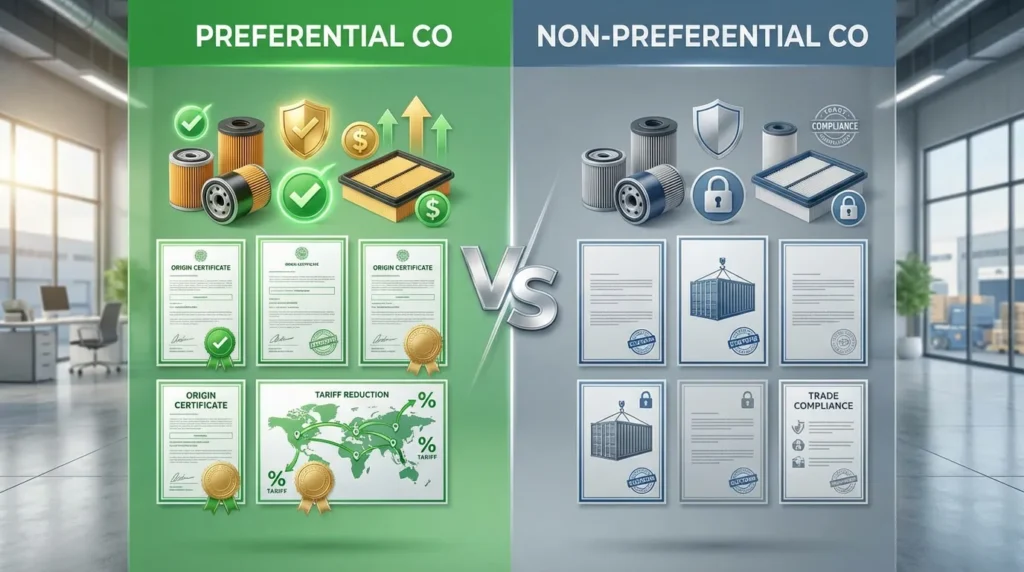
Because preferential CO and non-preferential CO are not the same.
They serve different purposes, follow different rules, and can have very different impact on the duty you pay when importing automotive filters.
Used correctly, the right CO can:
- Prove the true origin of your filters
- Help you comply with customs and banking requirements
- In some cases, reduce or even eliminate import duty
Used without understanding, it may:
- Give you no duty benefit at all
- Be rejected or ignored by customs
- Create confusion with your bank, broker, or end customer
Below, we break down the differences between non-preferential and preferential Certificates of Origin, and explain how we handle CO for our filter exports to help buyers save duty where possible.
Non-Preferential Certificate of Origin for Automotive Filters
A non-preferential Certificate of Origin is the standard CO most people know. Think of it as the basic passport of your goods.
1.1 What a Non-Preferential CO Does
A non-preferential CO mainly proves:
- Where the goods come from
- For example: “Country of Origin: China”
- For customs statistics
- Governments track how much value is imported from which countries.
- For general trade policy
- It may be used to apply anti-dumping duties, quotas, or other measures based on origin.
In other words, it tells customs: “This product is made in [Country].” But very importantly:
A non-preferential CO does not automatically give any duty reduction.
Even if it clearly shows “Made in China” or another origin, it does not mean you will get a lower duty rate.
1.2 When We Provide Non-Preferential CO for Filters
For our automotive filter exports, we provide non-preferential CO in situations like:
- The buyer needs it for normal importing
- Their customs office expects a CO for origin proof.
- The bank / Letter of Credit (L/C) requires it
- Many L/Cs explicitly list “Certificate of Origin” as a required document.
- The end customer requests origin proof
- A distributor, retailer, or OEM wants to confirm country of origin for their internal policy or labeling.
In all these cases, the non-preferential CO acts as an official confirmation of origin, typically issued or endorsed by:
- A Chamber of Commerce, or another approved local authority
It supports smooth trade and transparency, but you should not expect it to reduce import duty just by itself.
Preferential Certificate of Origin for Duty Savings (How Trade Agreements Can Help You Pay Less Duty)
A preferential Certificate of Origin is different.
It is directly connected to Free Trade Agreements (FTAs) or other preferential trade schemes between the exporting and importing countries.
When used properly, a preferential CO can help importers of automotive filters:
- Reduce import duties
- In some cases, pay 0% duty
- Improve their price competitiveness in the local market
2.1 When Preferential CO Is Possible
A preferential CO is only possible when:
- Your country and our country have a trade agreement
- For example, an FTA or regional trade agreement that covers industrial products like filters.
- The automotive filters meet the “rules of origin” under that agreement
- Rules of origin define how “local” a product must be to qualify as originating from a particular country or region.
- We use the correct form and format required under that agreement
- Different agreements may have different CO forms, names, and layouts.
Only when these conditions are met can a preferential Certificate of Origin be issued and accepted by customs to grant lower or zero duty.
2.2 What a Preferential CO Can Do for Filter Imports
If everything is in place, a preferential CO can:
- ✅ Reduce the import duty rate
- ✅ Sometimes bring duty down to 0%
- ✅ Make your selling price more competitive against imports from countries without such agreements
This is especially important in markets where:
- Import duties on automotive parts are relatively high
- Competition is tough and every percentage point on cost matters
However, this duty advantage is not automatic.
It depends on correct application of the trade agreement and rules of origin.
Understanding Rules of Origin for Preferential CO (Why Not Every Filter Automatically Qualifies)
Many importers assume: “If the goods are shipped from [country], we can always get preferential CO.”
In reality, rules of origin are more detailed.
3.1 What Are Rules of Origin?
Rules of origin determine whether a product can be considered as “originating” in a particular country or region for preferential treatment.
They typically look at:
- Where the materials came from
- Where the main processing or manufacturing took place
- Whether the product underwent a sufficient transformation, defined by:
- Change in HS code
- Value-added calculation
- Specific processing operations
For automotive filters, this can involve:
- Where the filter media, rubber, plastics, steel parts, etc. are sourced
- Where the final assembly and processing happen
- How the HS classification changes (or doesn’t change) through manufacturing
3.2 Why We Need to Check Before Promising Preferential CO
Because of these rules, we cannot simply say:
“Yes, we can always give preferential CO for every filter shipment.”
Instead, we must carefully check:
- Whether the destination country has a valid agreement with our country
- Whether our filter manufacturing process satisfies that agreement’s rules of origin
- Which specific preferential CO form is required
For example, special FTA forms, regional forms, or other official templates.
Only after confirming these points can we responsibly say: “Yes, for this specific shipment to this destination, preferential CO is available.”
This protects you from:
- Relying on a CO that customs will not accept for duty reduction
- Misunderstandings with your broker, bank, or tax authorities later
Our Approach to Certificates of Origin for Filter Exports (How We Help Buyers Choose and Use the Right CO)
Because CO can impact both risk and cost, we handle it in a structured way.
4.1 Clarifying Your CO Needs from the Beginning
When a new partner asks us:
“Can you provide CO?”
we do not just answer “yes” and send a random form.
We always clarify:
- Destination country
- So we know which trade agreements or preferential schemes may apply.
- Type of CO required by broker / bank / customer
- Some banks only ask for “Certificate of Origin” (often non-preferential).
- Some brokers or customers explicitly ask for “preferential CO under [specific agreement]”.
- Whether you are trying to get duty benefits
- Are you only complying with documentation requirements?
- Or are you specifically trying to reduce duty using an FTA?
This helps us understand what you really need, not just what is easy to print.
4.2 Matching CO Type to Your Situation
After clarifying, we:
- Propose the suitable CO type
- Non-preferential CO for basic origin proof and normal imports.
- Preferential CO (when available) for duty savings under an FTA or scheme.
- Check with our local authorities / Chamber of Commerce
- To ensure the CO is issued correctly and legally.
- To confirm that the goods qualify for preferential origin under that agreement.
- Align document wording with import side requirements
- Some customs authorities or banks have preferred wording or data format.
- We coordinate with you so that the CO matches what your broker or bank expects.
The goal is simple:
You should not receive a CO that customs “doesn’t recognise”
or that cannot be used for preferential duty even though you expected it.
Practical Scenarios: Which CO Type Do You Actually Need?
To make it more concrete, here are some typical scenarios we see with automotive filter buyers.
5.1 Scenario A: Normal Import With Basic CO Requirement
- You import filters for regular distribution in your market.
- Your customs office or bank simply asks for “Certificate of Origin” with the documents.
- There is no specific FTA benefit you are trying to use.
Most suitable CO type:
Result:
- You meet customs and banking requirements.
- You do not get extra duty reduction, but the entry is smoother and transparent.
5.2 Scenario B: Importing Under a Free Trade Agreement
- Your country has a Free Trade Agreement (FTA) with our country.
- Your broker or customs agent tells you that, with preferential CO, you may pay a lower duty rate (or 0%).
- You want to take advantage of this to improve your margin.
Our steps:
- Confirm the agreement details and whether it covers automotive filters (by HS code).
- Review whether our filters meet the rules of origin under that FTA.
- Identify which preferential CO form is required (e.g. specific FTA form).
- Apply and obtain the preferential CO from our local authority.
Result:
- If everything is in line, you can legitimately claim lower or zero duty at import.
- Your filter business becomes more competitive on total landed cost.
5.3 Scenario C: End Customer Requests Origin Proof for Their Own Compliance
- You sell filters to a retail chain, OEM, or large distributor.
- They are not necessarily using an FTA but need clear origin documentation for internal policies, labeling, or ESG reporting.
Most suitable CO type:
- Usually non-preferential CO is enough, unless they explicitly request preferential proof.
Result:
- You keep your key account comfortable with transparent, official origin proof.
- CO supports their brand, compliance, and audit needs.
Why CO Is Not “Just a Paper” in Global Filter Trade
In global trade, a Certificate of Origin is not just a random PDF you attach to a shipment.
Used correctly, it can:
- Protect your shipment
- Customs understands where the goods truly come from.
- Support your bank and trade finance
- L/C and payment documents are complete and aligned.
- Improve your margins
- Preferential CO under FTAs can reduce duty and strengthen your price position.
Used incorrectly or without understanding, it can:
- Lead to missed opportunities (you could have paid less duty)
- Cause customs questioning if the form or origin claim does not match reality
- Confuse your bank if the wording does not match L/C requirements
That’s why our approach with CO for filter exports is always:
- Case by case
- Agreement-based
- Aligned with local authorities and your broker/bank needs
If you are importing filters and are not sure which CO type is best for your market, we are happy to review your situation together and propose a practical solution.
Need Help Choosing the Right CO for Your Filter Imports?
If you:
- Have been asked by your bank or customs for “CO” and don’t know which type to use
- Want to check if your market has an FTA with our country that could reduce duties
- Want to avoid receiving a CO that customs doesn’t accept for preference
we can help you:
- Review your destination country and HS codes
- Check whether preferential CO is possible
- Recommend the right CO type and form for your case
We can also share a simple one-page explanation we use with new partners that summarises CO options and how they impact duty and compliance.
Contact Our Team
Bruce Gong – Key Account Manager, Beling Filters
Email: bruce.gong@belingparts.com
WhatsApp: +86 150 5776 4729
LinkedIn: www.linkedin.com/in/brucegong-beling
Let’s make sure your next container of filters has the right CO, and that you’re not leaving duty savings on the table.