For many automotive parts distributors, “private label” sounds complicated and risky:
- How do I start?
- What information does the factory need?
- How long will it take before the first container ships?
- How do I keep the quality and brand image consistent over time?
In reality, when the process is clear and structured, a private label filter program can be simple, predictable, and scalable.
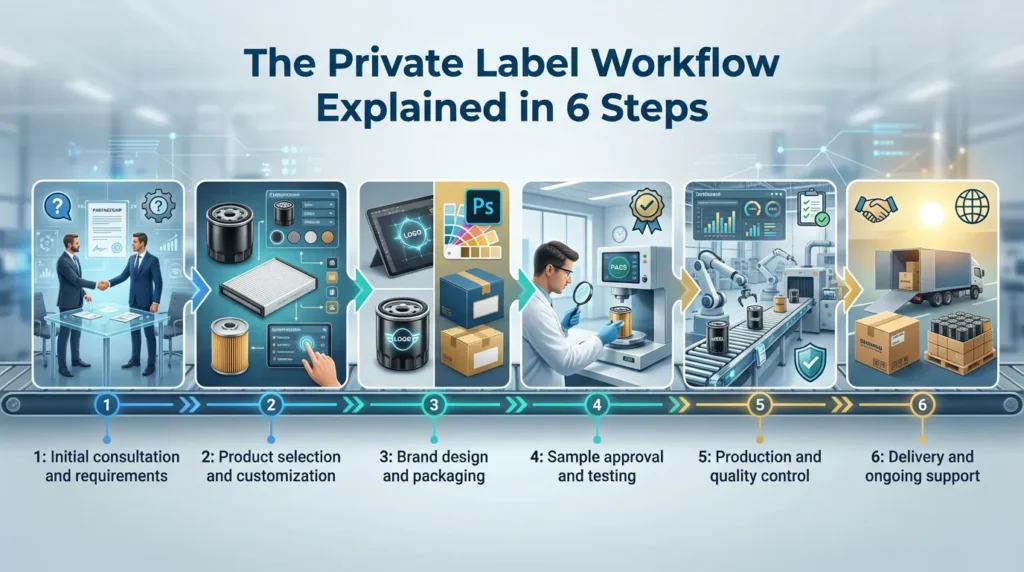
At Beling, we run a proven 6step private label workflow for automotive filters – guiding distributors and importers from the first idea to longterm brand growth. This article explains that workflow in detail, so you can see what to expect and how we support you at each stage.
Step 1 – Brand Positioning & Basic Requirements
Before touching any artwork or part numbers, we start with strategy. A private label brand can only be sustainable if its positioning is clear.
1.1 Define Your Market Segment
We first clarify where your brand will sit in your market:
- Economy / Budget
- Main focus: low price, stable basic quality
- Competes with aggressive lowcost imports
- Value / MidRange
- Balanced: good quality at reasonable price
- Ideal for most independent workshops and distributors
- Premium Independent Brand
- Higher specs, stronger technical story
- Positioned closer to OE or large international aftermarket brands
Your segment choice affects:
- Media and material specifications
- Test standards and warranty level
- Price targets and margins
1.2 Identify Your Target Customers
We then define who you are selling to:
- Regional or national wholesalers
- Retail shops, parts stores, ecommerce sellers
- Independent garages and service chains
- Fleets and large endusers
Each customer group has different expectations for:
- Pricing structure
- Warranty and support
- Brand communication (technical vs marketing driven)
Your private label concept must reflect your real customer mix, not a generic idea.
1.3 Clarify Quality Expectations and Key Selling Points
We discuss:
- Typical warranty periodyou want to offer
- Any key selling pointsyou want to emphasize, such as:
- “Reliable everyday quality”
- “Focus on local vehicle parc”
- “Better dust holding / long service intervals”
- “Fleetoriented performance vs price”
We then match these expectations with:
- Suitable media types and components
- Testing and validation level
- Internal process controls required
1.4 Define the Price Level and Competitive Position
Together, we analyze your main competitors:
- OE brands and OES suppliers
- Big independent global brands
- Other local private label programs
We then decide:
- Where your price level should sit in relation to them
- Which gaps in the market your brand can realistically fill
This avoids situations like:
- A brand that looks premiumbut is priced extremely low, which may confuse customers
- Or a brand that costs morebut cannot demonstrate why
1.5 Collect Basic Brand Requirements
At this stage, we also collect practical basics:
- Your logo(if already available)
- Main brand colorsand any existing brand guidelines
- Target launch date(e.g. for a trade show or season)
- Approximate initial SKU quantityyou plan to start with
Output of Step 1:
A clear brand positioning brief and project scope that guide every next step of the private label workflow.
Step 2 – Range Definition & Data Alignment
Once the strategy is clear, we move to the product range itself and align all technical and commercial data.
2.1 How We Define the First Launch Range
You can start from either direction:
- Option A – You have an existing list
- You send us your current part list (from another supplier or brand).
- We cross it with our range and suggest upgrades or consolidation.
- Option B – You are starting from zero
- You tell us your main vehicle parcand regions:
- Key brands (e.g. VW, Toyota, Hyundai, etc.)
- Common models and years
- We propose an initial rangethat covers:
- High rotation oil, air, fuel, and cabin filters
- A high percentage of the parc with a compact list
Typical firstphase range: around 80–200 SKUs, depending on your market size.
2.2 Mapping Part Numbers and Cross References
When the range concept is clear, we:
- Map your part numbers↔ our internal part codes
- Align:
- OE references
- Major competitor brand crosses
We make sure description, application, and reference data are consistent.
2.3 Structured Data Output
We provide a structured Excel file including:
- Your private label part number
- Our internal code
- Basic application data (vehicle, engine, year – where available)
- OE and competitor cross references
You can use this file to:
- Build your catalogue or ecatalogue
- Prepare your ERP system and inventory codes
- Align with your sales and purchasing team
Output of Step 2:
A confirmed SKU list for the first phase, with aligned data, ready for packaging and label planning.
Step 3 – Packaging & Label Design
With the range and data confirmed, we design how your brand will look on the shelf and in the warehouse.
3.1 How Design Cooperation Works
You can choose:
- You provide finished designs
- We adjust dimensions and technical parts to fit box sizes and printing requirements.
- We and/or your designer build from your logo + color direction
- We share guidelines from a factory and logistics perspective.
In both cases, the goal is a design that is both attractive and practical.
3.2 Box Design – Visual and Functional
We align:
- Box layout:
- Logo placement
- Color blocks and branding elements
- Technical icons (oil, air, fuel, cabin symbols, etc.)
- Language zones for text on international markets
- Information areas:
- Large, clear part numberdisplay
- Secondary area for OE or reference data (if required)
- Space for barcode, QR code, and internal codes
We also consider:
- Shelf visibility and scanability
- How boxes stack and resist damage in shipping
- Costefficient printing methods and materials
3.3 Master Carton Design
Master cartons must be:
- Strong enough for longdistance shipping
- Clearly marked for warehouse identification
We align:
- Shipping marks (customer name, brand, destination port if needed)
- Handling icons (this side up, fragile, etc.)
- Branding level (plain or with logo and colors)
3.4 Label Layout and Coding Decisions
Together, we define:
- Label layout:
- Brand logo
- Part number (in large, readable font)
- Barcode (EAN / GTIN / internal code128, etc.)
- Short description / OE / application if required by your market
- Legal or language requirements (e.g. country of origin, safety notes)
- Coding decisions:
- Part number structure (logical, scalable, and easy to learn)
- Barcoding system and number ranges
3.5 Artwork Approval
We then:
- Send you digital artwork files(PDF/AI format) for review
- If needed, produce printed samples / dummy boxesand share photos or physically send samples
You can check:
- Color shades vs. your brand guide
- Readability of part numbers
- Position of barcodes and texts
Output of Step 3:
Final approved artworks (boxes, master cartons, labels) and clear printing specifications integrated into our system.
Step 4 – Samples & Technical Confirmation
Before going into mass production, we make sure product + branding together reflect your brand promise.
4.1 Branded Sample Production
Depending on your requirements, we:
- Produce branded samplesfor selected SKUs, including:
- Box with your design
- Label with your part number and barcode
- Product marking (logo or code) where technically possible and meaningful
These samples allow you to:
- Show the concept internally to your management and sales team
- Present initial pieces to key customers or opinion leaders
- Validate the visual identity and packaging practicality
4.2 Technical Information and Test Data
For technical validation, we can provide:
- Product data sheets (media type, construction details, dimensions)
- Test reports (where applicable), such as:
- Filtration efficiency
- Pressure drop curves
- Burst or collapse resistance
- Information on:
- Media grade
- Gaskets and sealing materials
- Valves, bypass and ADBV (for oil filters)
4.3 Your Check and Final Technical Confirmation
You:
- Inspect the physical look & feelof the filters and packaging
- Confirm that the quality levelmatches your brand position (economy, value, premium)
- Request any fine tuning:
- Slight color adjustments
- Changes in wording, icon styles, or font size
- Label text or language details
Only after your confirmation do we proceed.
Output of Step 4:
Your formal goahead for mass production under your brand, with both visual and technical aspects approved.
Step 5 – Mass Production & Quality Control Under Your Brand
With specs and designs confirmed, we move into fullscale production and structured quality control.
5.1 Locking Your Brand Specifications Internally
Inside Beling, we:
- Lock your brand’s:
- Artwork versions (for each box and label size)
- Product specifications and reference samples
- Assign clear production instructionsfor each part number:
- Which box design and size to use
- Which label template and barcode to print
- Any customerspecific features:
- Product marking
- Leaflets or inserts
- Specific language combinations
5.2 InProcess Quality Control
During production, we apply:
- Standard inprocess QC:
- Dimensions and tolerances
- Correct media and components
- Functional checks where needed (e.g. valves in oil filters)
- Additional controls for your brand if required:
- Extra appearance checksfor premium lines
- Specific packaging or marking verification
5.3 PreShipment QC Focused on Your Brand
Before any shipment leaves our factory, we perform PreShipment QC with focus on:
- Correct brand and artwork version
- Correct part numbers and labels
- Packing quality:
- Box integrity
- Master carton condition
- Palletizing, wrapping, and protection
- Batch traceability marks:
- Production date or batch codes on cartons
- Matching information in packing lists
If requested, we:
- Send you photos or short videosof finished goods and loaded containers
- Provide additional reportsfor audits or key customers
Output of Step 5:
Your filters are produced, checked and packed under your brand rules, ready for shipment.
Step 6 – Shipment, Market Launch & Continuous Optimization
The final step is not just shipping. It is about launching, monitoring, and continuously improving your private label program.
6.1 Logistics and Documentation
We support you with:
- Combining SKUs to optimize container space
- Planning shipment schedules to meet your launch timing
- Providing:
- Detailed packing lists (by SKU and quantity)
- Commercial invoices
- HS codes and origin information per SKU
We ensure:
- Shipping marks match your warehouse system
- Documentation supports smooth customs clearanceand internal receiving
6.2 After Launch: Performance Tracking
Once goods arrive and your brand is on the market, we help you:
- Track performance of each SKU (based on your feedback and sales data)
- Identify:
- Missing fast movers that should be added next
- Very slow movers that can be reduced or moved to special order
We then:
- Adjust the range together
- Plan second and third phases of SKUs
- Add new vehicle coverage as your market moves
6.3 Claims, Feedback, and Brand Protection
We maintain a continuous feedback loop:
- If you receive any claim or technical question:
- We trace back to the production batch
- Analyze technically what may have happened
- Suggest solutions and help you communicate with your customers
This protects your brand reputation and builds your confidence when dealing with big accounts and fleets.
Output of Step 6:
A running private label filter program that we refine together over time – not a onetime project of “printing your logo on a box.”
Summary – The 6 Private Label Steps at a Glance
To make the whole workflow easy to remember:
Brand Positioning & Requirements
- Define who you want to be in the market
- Choose segment, customers, quality, price level
Range Definition & Data Alignment
- Choose the right SKUs for your vehicle parc
- Align part numbers, OE and competitor cross references
Packaging & Label Design
- Make the brand visible and attractive
- Ensure boxes, labels and master cartons are practical
Samples & Technical Confirmation
- Test product + design in real hands
- Confirm quality level and branding before scaling
Mass Production & QC Under Your Brand
- Stable manufacturing following your brand rules
- Inprocess QC and PreShipment QC aligned with your identity
Shipment, Launch & Continuous Optimization
- Ship, launch, monitor performance
- Adjust range and quality details as we grow together
If you want a private label filter program that is structured, transparent, and scalable – not just “put my logo on a box” – we can walk you through these 6 steps based on your specific market, vehicle parc and growth plan.
Beling – Save Your Time & Cost
Your valuable automotive filter partner since 2008.
Contact:
Bruce Gong – Key Account Manager, Beling Filters
Email: bruce.gong@belingparts.com
WhatsApp: +86 150 5776 4729
LinkedIn: www.linkedin.com/in/brucegong-beling
Let’s make sure your next shipment is not only technically correct –
but also perfectly labeled for customs, warehouses, and workshops worldwide.