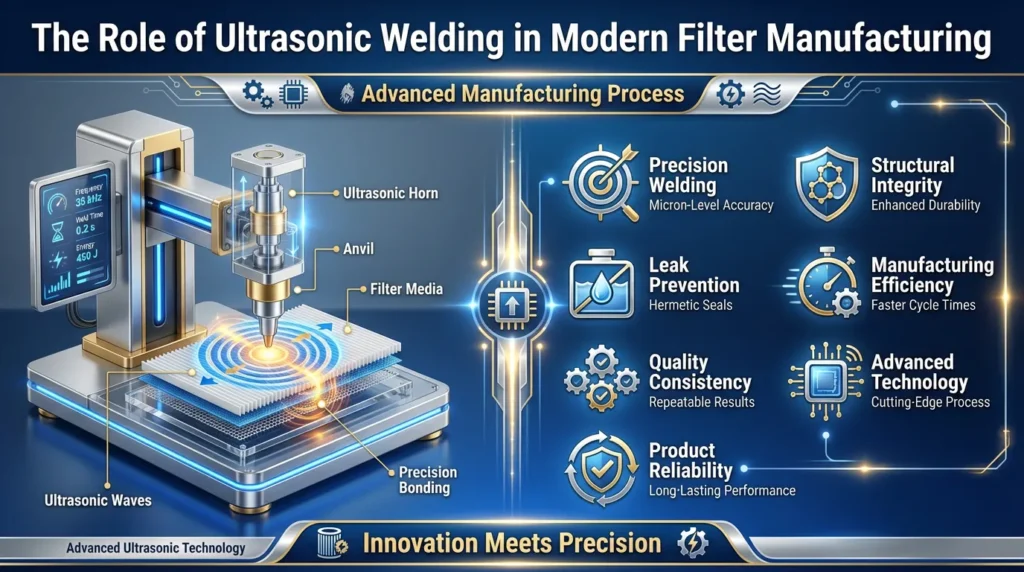
In modern automotive and industrial filter production, the question is no longer just:
“Is the media good enough?”
It is also:
“Are all joints and seals reliable enough for real‑world conditions?”
A filter with premium media but weak joints can still fail in the field through:
- Bypass leakage around the media
- Media detachment
- Frame deformation
- Cracked or leaking plastic components
This is where ultrasonic welding has become a key process step in high‑quality filter manufacturing.
At Beling, we apply ultrasonic welding on various filter components (especially air filters and cabin air filters, and selected plastic cartridge filters) because it directly affects:
- Seal reliability
- Dimensional stability
- Production consistency
- And ultimately – your complaint rate as an importer or brand owner
Below, we explain how ultrasonic welding works, where we use it, and why it matters for your filter program.
What Is Ultrasonic Welding in Filter Manufacturing?
Ultrasonic welding is a non‑contact, high‑frequency welding process used to join thermoplastic parts without screws, solvents, or traditional hot-melt glues.
1.1 Basic Principle of Ultrasonic Welding
In simple terms, ultrasonic welding uses:
- High‑frequency mechanical vibration (ultrasound, usually 20–40 kHz)
- Localized frictional heat at the interface of two plastic parts
- Controlled pressure and time
The process:
- The plastic parts are positioned together in a dedicated fixture.
- An ultrasonic horn applies pressure and vibration to a specific weld zone.
- The vibration generates heat at the interface, melting a thin layer of plastic.
- Vibration stops, pressure is maintained for a short time, and the molten layer solidifies into a weld.
No screws, no open flame, and usually no added glue – just clean, repeatable joints.
1.2 Typical Ultrasonic Welding Applications in Filters
In filter manufacturing, we mainly use ultrasonic welding to:
- Weld end caps to filter media
- Weld plastic frames / grids to non‑woven or cellulose media
- Join housing parts for certain cartridge and cabin filters
- Fix internal plastic components, such as center tubes and ribs
These are all joints where:
- A reliable seal is critical
- Traditional adhesive bonding can introduce variability or contamination
Why Ultrasonic Welding Is Ideal for Filters
Filters are sensitive components. The joining method must not compromise the function of the media or the sealing line.
2.1 Requirements for Joining Methods in Filter Production
A good joining process in filter manufacturing must:
- Avoid burning, deforming, or damaging the media
- Avoid introducing contaminants (e.g. excess glue entering the media)
- Maintain precise dimensions and flatness
- Provide strong, leak‑free, long‑term stable joints
Traditional manual gluing can struggle with:
- Excess glue flow
- Variable curing conditions
- Operator‑dependent differences
Ultrasonic welding helps us overcome these challenges.
2.2 Advantages of Ultrasonic Welding for Filters
1) Clean, Precise Joints
- Heat is generated only at the interface, not across the whole part
- The surrounding media and frame are not overheated
- There is no excess adhesive that can flow into the media and reduce effective filter area
This keeps the media open and effective, while still sealing the critical joint.
2) Strong and Consistent Seals
- Weld parameters (energy, pressure, time, amplitude) are controlled by the machine
- Once the process window is validated, each weld is highly repeatable
- This reduces variability compared with purely manual gluing, especially at higher production volumes
The result is a more homogeneous bond line with predictable strength.
3) Faster Cycle Time and Higher Efficiency
- Welds are completed in fractions of a second
- There is no adhesive curing time
- This supports higher line speeds and more stable takt time
For you as a buyer, stable cycle time and process control mean more reliable delivery and capacity planning.
4) More Environmentally Friendly
- No solvent evaporation
- Less chemical handling in the workshop
- Reduced risk of adhesive odor or contamination
This contributes to a cleaner production environment and easier compliance with environmental and safety regulations.
Where We Apply Ultrasonic Welding in Filters
The exact use of ultrasonic welding depends on the filter type and design. At Beling, we mainly apply it in the following areas.
3.1 Ultrasonic Welding in Air Filters
For automotive engine air filters, we use ultrasonic welding to:
- Join pleated media to plastic end caps
- Fix inner and outer plastic support frames
- Create clean sealing edges along the frame to prevent bypass leakage around the media
Benefits:
- The media stays accurately positioned within the frame
- Sealing lines are robust even under vibration
- The risk of dust bypass around the media is significantly reduced
Cabin filters often use non‑woven, melt‑blown, or multi‑layer media, sometimes with activated carbon.
We use ultrasonic welding to:
- Weld plastic frames around flat or pleated non‑woven media
- Attach side strips or positioning ribs to keep shape under airflow
- Add stiffening elements to maintain geometry in the HVAC housing
Benefits:
- The filter retains shape during installation and operation
- The media does not collapse or detach from the frame
- Bypass leakage around the edges is minimized, keeping dust and pollutants from entering the cabin around the filter.
3.3 Ultrasonic Welding in Plastic Cartridge Filters
For certain oil and fuel cartridges with plastic components, we use ultrasonic welding to:
- Weld internal center tubes to plastic end caps
- Join PP/PA housing parts where a leak‑free, high‑strength joint is required
Benefits:
- Better internal sealing and structural integrity
- Less risk of internal bypass between dirty and clean sides
- Stronger resistance to pressure pulses in the lubrication or fuel system
In all cases, the core purpose is the same:
Keep the media in the correct position and ensure the flow goes through the media, not around it.
How Ultrasonic Welding Improves Performance and Reduces Complaint Risk
For an overseas importer or private label brand owner, ultrasonic welding is not just a “nice technology.” It has direct impact on:
- Real‑world filtration performance
- Stability under vibration and temperature
- Consistency between batches
- Long‑term complaint rates
4.1 Better Filtration Efficiency in Real Use
Even if the media itself has excellent laboratory efficiency, poor joints can create bypass leakage.
Ultrasonic welding helps reduce:
- Gaps between media and cap/frame
- Risk of the media detaching under vibration, pulsation or installation forces
- Deformation of parts that could break the sealing line
Result:
- The filter performs much closer to its designed efficiency, not just in the lab, but in vehicles and equipment in your market.
4.2 Improved Long‑Term Stability Under Heat and Vibration
Filters in engine bays, underfloor areas, or HVAC systems are exposed to:
- Temperature fluctuations
- Constant vibration
- Pulsating air or fluid flows
Joints made with low‑control gluing or weak mechanical fixtures can:
- Crack over time
- Delaminate under stress
- Slowly open tiny leakage paths
Ultrasonic welds, when properly engineered, provide a continuous, homogeneous bond line that is much more resistant to:
- Thermal cycling
- Mechanical vibration
- Long‑term fatigue
This translates into fewer “in‑service” failures and fewer calls from angry workshops.
4.3 Reduced Variability Between Batches
Many complaints in the aftermarket come from inconsistent batches:
- One batch is perfect
- The next batch has more weak joints, warped frames, or detached media
Because ultrasonic welding machines control:
- Weld energy
- Time
- Pressure
- Tooling position and stroke
We can keep lot‑to‑lot variation significantly lower than with manual-only joining methods.
This reduces the “surprise factor” in your market and makes your brand image more stable and predictable.
Our Process Control for Ultrasonic Welding at Beling
At Beling, we don’t treat ultrasonic welding as simply “push a button and weld.” We manage it as a full, controlled process, similar to any other critical manufacturing operation.
5.1 Joint Design and Tooling Engineering
A reliable ultrasonic weld starts with correct design:
- Plastic parts are engineered with:
- Energy directors (small triangular ribs)
- Proper contact surfaces
- Correct wall thickness
- Tooling (fixtures and horns) is designed to:
- Support the media and frames without crushing
- Maintain correct alignment during welding
- Distribute force evenly across the weld area
This prevents damage to the media and ensures repeatable weld geometry.
5.2 Parameter Setting and Validation
For each new product, we define a qualified process window, including:
- Amplitude or power
- Weld time or target energy
- Pressure and hold time
We then:
- Run samples under different parameter combinations
- Test welds for:
- Strength (pull or peel tests)
- Visual quality
- Dimensional stability
Only after this validation do we release the ultrasonic welding settings for mass production.
5.3 On‑Line Monitoring and Control
During production:
- Weld cycles are monitored for key parameters:
- Actual energy
- Time
- Collapse/height (if applicable)
- If a weld is outside the set limits:
- The machine triggers an alarm
- Parts can be automatically flagged as NG (not good)
This helps catch:
- Under‑welded joints (weak bonds)
- Over‑welded joints (excess melting or part deformation)
5.4 Regular Tooling Maintenance
To keep ultrasonic welding consistent over time:
- Horns and fixtures are regularly cleaned
- Contact surfaces are checked for wear or damage
- Preventive maintenance schedules ensure stable ultrasonic performance
This is how we keep ultrasonic welding as a controlled, repeatable process – not an experiment.
What Ultrasonic Welding Means for You as an Importer or Brand Owner
When your filter supplier uses well‑controlled ultrasonic welding, you gain business advantages, not just manufacturing detail.
6.1 More Stable Product Performance
You benefit from:
- Less risk of media detaching from caps or frames
- Less risk of frames opening or deforming under real‑world conditions
- More consistent sealing and filtration efficiency
This directly reduces:
- Hidden performance problems
- Failures that show up months after installation
6.2 Better Positioning vs Low‑End Competitors
Many low‑cost producers still rely heavily on:
- Manual gluing with limited control
- Minimal investment in joining technology
When your filters use ultrasonic welding in critical joints, you can legitimately say:
“Our filters use modern welding technology to improve reliability and long‑term performance.”
This gives you:
- A stronger technical story for workshops and fleets
- Better justification for positioning your brand above purely “price only” competitors
6.3 Lower Long‑Term Claim Rate
Common complaint topics in the aftermarket include:
- “Media collapsed”
- “Filter distorted”
- “Dust bypassed into engine or cabin”
- “Frame opened after some time”
By reinforcing joints with ultrasonic welding, these types of complaints can be significantly reduced.
Fewer complaints mean:
- Less time spent on problem solving and negotiations
- More time for sales and business development
- Stronger customer loyalty
6.4 A Partner Who Invests in Process, Not Just Price
Ultrasonic welding equipment, tooling design, and process validation all require investment.
When a supplier chooses to invest in these areas, it reflects a mindset of:
- Process stability
- Long‑term cooperation
- Focus on risk control and brand protection, not just the lowest initial price
If you want to differentiate your air and cabin filter range with more stable, modern production methods, ultrasonic welding is a key part of that story.
We are ready to share:
- Specific examples of how we use ultrasonic welding on different references
- How the process can be aligned with your target market requirements and brand position
Beling – Save Your Time & Cost
Your valuable automotive filter partner since 2008.
Contact Our Team
Bruce Gong – Key Account Manager, Beling Filters
Email: bruce.gong@belingparts.com
WhatsApp: +86 150 5776 4729
LinkedIn: www.linkedin.com/in/brucegong-beling
Customs inspections may never disappear.
But with the right process, your shipments don’t have to be the ones that always get stopped.