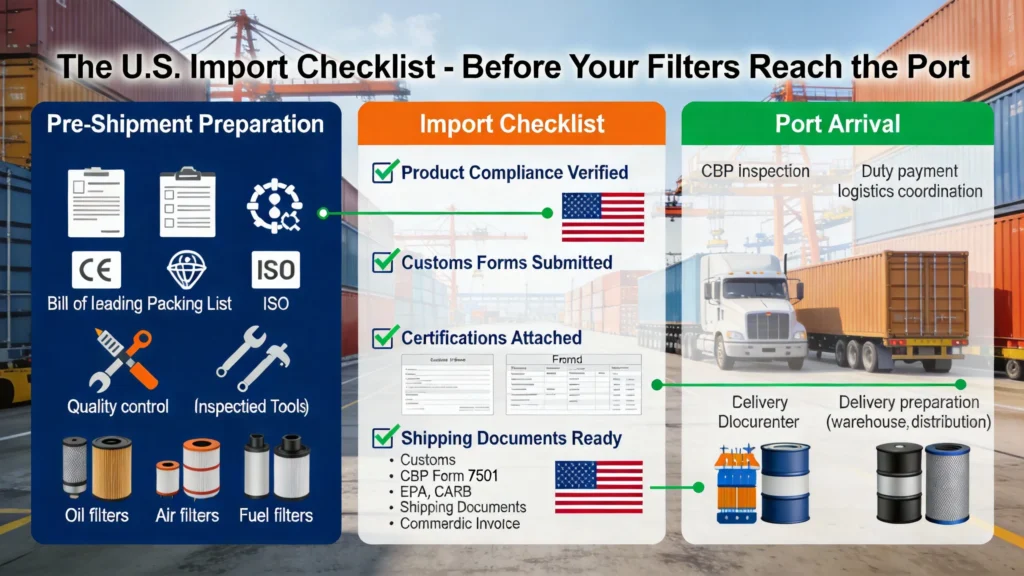
Winning in the U.S. automotive aftermarket is not only about price, quality, and brand.
It is also about making sure your shipments of automotive filters:
- Clear U.S. customs smoothly
- Avoid holds, exams, and costly delays
- Arrive at your distribution center in a way your team can process quickly
For private label and branded buyers alike, the port is often where margin is silently lost: through documentation errors, unclear responsibilities, and preventable customs issues.
This guide shares the practical U.S. import checklist we use with partners before filters are on the water — so containers don’t get stuck at the port and your warehouse can receive them without friction.
HS Classification & Country of Origin — Locked In Before Production
1.1 Why Correct HS Codes and Origin Matter in the U.S.
In the United States, U.S. Customs and Border Protection (CBP) pays close attention to:
Errors or inconsistencies here can lead to:
- Miscalculated duties and taxes
- Requests for information (RFI) and delays
- Potential penalties or reclassification
For aftermarket filters, classifications can differ by function and material. That is why alignment with your customs broker is critical.
1.2 Checklist: HS Classification & Origin
Before production starts, we recommend confirming:
- ✅ Correct HS/HTS code for each filter type
- Validated with your customs broker
- Aligned with your internal item master and ERP
- ✅ Country of origin is clear and consistent across all documents
- Invoice
- Packing list
- Labels
- Certificate of Origin (if required)
- ✅ Any preferential duty programs (if applicable) are understood
- Free trade agreements (if relevant)
- Any special tariff measures or exclusions
1.3 How Beling Supports HS and Origin Compliance
At Beling, we:
- Work with your broker’s preferred tariff classification
- We align to your HS codes if they are compliant
- We can share our typical codes as a starting point
- Keep HS codes and origin identical on:
- Commercial invoice
- Packing list
- Outer carton and pallet labels (where required)
- COO and any supporting documents
- Share factory/manufacturer details up front
- For your internal compliance files
- To support MID (Manufacturer Identification) or similar requirements
This minimizes classification disputes and origin confusion when your filters arrive in the U.S.
Complete & Correct Commercial Documents — Broker Ready
2.1 Why Document Accuracy Drives Clearance Speed
Before your customs broker can file the entry, they need clean, complete, and consistent commercial documents. Missing information can easily cause:
- Entry filing delays
- Additional backandforth right before vessel arrival
- Increased risk of customs holds and exams
2.2 Checklist: Commercial Invoice, Packing List & Supporting Docs
Before booking shipment, we ensure the document set is fully aligned:
✅ Commercial Invoice
Includes:
- Full consignee and “ship to” details
- Legal entity name
- Address
- Contact information if required
- Incoterms, currency and payment terms
- HS codes and country of origin per line, if requested
- Clear item description for each SKU
- Units, unit price, line totals and grand total
- Quantities in units that match your entry (pieces, sets, etc.)
✅ Packing List
Includes:
- Carton count and pallet count
- Net and gross weight, and dimensions if needed
- Clear SKU reference and quantity per carton
- Pallet breakdown if relevant for your warehouse
✅ Certificate of Origin (if requested)
- Chamberstamped or supplierissued, depending on your process
✅ Any additional statements your broker or compliance team requires
- For example: specific wording, manufacturer information, or regulatory statements
The goal: you should be able to forward the documents straight to your broker without editing.
2.3 How Beling Builds BrokerFriendly Documentation
We:
- Use structured, standard templatesfor invoices and packing lists
- Make sure names, addresses, weights and values matchacross all documents
- Integrate your PO numbersand internal references for easier reconciliation
That way, your broker can submit entries quickly and your operations team can match documents to deliveries without hassle.
Labels & Markings That Match Your Customs Entry
3.1 The Risk of Mismatch Between Labels and Entry
A common source of issues in U.S. imports is misalignment between what customs sees in the entry and what is physically on the packaging:
- Carton label describes something different than the invoice
- Country of origin on the box doesn’t match what’s in the entry
- Internal customer codes confuse receiving or auditors
CBP and your warehouse team both rely on visible labels; inconsistencies can raise questions at inspection and slow down receiving.
3.2 Checklist: Carton, Pallet & CustomerSpecific Labels
We align:
- ✅ Carton markings
- SKU / part number
- Product description (short, but clear)
- Quantity per carton
- Country of originclearly printed
- ✅ Pallet labels
- For warehouse receiving and scanning
- Pallet ID / license plate if needed
- Overall SKU and quantity per pallet
- ✅ Customerspecific label formats
- Barcodes (EAN, UPC, Code 128, etc.)
- Your internal item codes
- Any DC routing or zone information
3.3 How Beling Ensures Label–Entry Alignment
We make sure that everything visible on product and cartons matches:
- What appears on the invoice and packing list
- What your broker submits in the entry
- What your WMS expects to see on receipt
This reduces the risk of questions at customs and speeds up inbound handling in your U.S. warehouse.
Incoterms & Responsibility Split — No Grey Areas
4.1 Why Clear Responsibility Is Critical
Misunderstandings about who is responsible for freight, insurance, and customs clearance can lead to:
- Disputes when a problem occurs in transit
- Lack of clarity on who should contact the shipping line or broker
- Unexpected costs landing on the wrong side
That is why, before shipment, we always clearly define the Incoterms and responsibility split.
4.2 Checklist: Incoterms and Roles
Before shipment, clarify:
- ✅ Incoterms (FOB, CFR, CIF, FCA, etc.)
- ✅ Who books the ocean freight
- Your nominated forwarder
- Or Beling’s logistics partner (depending on agreement)
- ✅ Who arranges marine insurance
- Included in the Incoterms or arranged separately
- ✅ Who handles customs clearance and duties
- Normally the U.S. importer of record
- Ensure broker nomination is clear
4.3 How Beling Adapts to Your Preferred Setup
We adapt to your standard import model, but we always ensure both sides are clear on:
“Where does our responsibility end and yours begin?”
This avoids confusion when:
- A shipment is on the water and time is tight
- Something unexpected happens (schedule changes, port issues, weather)
With clear roles, problems are resolved faster and with less stress.
BrokerReady Shipment Data — Early and Consistent
5.1 Why Timing and Consistency Matter
Your customs broker needs final shipment data before vessel arrival to:
- File the entry on time
- Deal with any questions before the container is at the terminal gate
- Minimize the risk of holds, exams or storage charges
Late or inconsistent information compresses timelines and increases risk.
5.2 How We Prepare BrokerReady Data
We help by:
- Sending all final documents as soon as the container is loaded
- Commercial invoice
- Packing list
- COO (if applicable)
- Booking / B/L details when available
- Keeping weights, counts and values consistent across:
- Invoice
- Packing list
- Booking information
- Providing any additional info your broker asks for, such as:
- Manufacturer details for MID (Manufacturer Identification)
- Specific statements or codes your compliance team requires
5.3 Benefit for U.S. Importers
With clean, early data, your broker can:
- File entries in advance
- Resolve classification or valuation questions proactively
- Reduce the likelihood of:
- Lastminute scrambles
- Holds and inspections
- Storage and demurrage fees
Your filters spend less time waiting at the port and more time moving into your network.
Packaging & Palletization Optimized for U.S. Warehouses
6.1 Customs Clearance Is Only Step One
Even if customs goes smoothly, your warehouse operations can still suffer if:
- Pallets are built in a way your DC cannot handle efficiently
- Labels are placed where scanners cannot read them easily
- SKUs are mixed in cartons or on pallets without clear logic
This leads to:
- Longer receiving times
- Higher error rates
- Frustration for your operations team
6.2 Checklist: WarehouseFriendly Packaging and Pallets
Beyond customs, your warehouse team needs:
- ✅ Pallets configured to preferred sizes and heights
- Compliance with your pallet specs (e.g., 40×48 inches or equivalent)
- Height and weight within your racking and handling limits
- ✅ Clear SKU separation
- No mixed cartons, unless specifically agreed
- Clear unit counts per carton
- ✅ Label positions aligned with your receiving process
- Entryside label placement
- Barcode orientation compatible with your scanners
6.3 How Beling Aligns Packaging With Your WMS
We align our packaging plan with:
- Your WMS requirements(SKU, pallet and carton identification)
- Any crossdocking or directtocustomer flowsyou use
- Special needs for private label branding:
- Artwork and color boxes
- Neutral packaging where needed
This reduces time and errors in your DC once the container is cleared, and helps your team see Beling shipments as “easy to handle.”
PreShipment QA & Claims Procedure — Defined Up Front
7.1 Why PreAgreed QA and Claims Processes Matter
If something goes wrong and you don’t have a clear process, you end up:
- Debating basic rules in the middle of a crisis
- Collecting incomplete evidence
- Slowing down resolution and credit decisions
A predefined QA and claims procedure makes issue handling faster, fairer and more transparent.
7.2 Checklist: Quality, Specification and Claims
Before loading, we ensure:
- ✅ Agreed specification and packaging standard for each SKU
- Technical specification
- Branding and labeling
- Packaging configuration
- ✅ Visual checks and sampling
- According to your requirements or our standard AQL/inspection procedure
- ✅ Defined claim and complaint process
- Required photos and documentation
- Batch and production date identification
- Time limits for reporting transit damage vs. quality issues
7.3 How Beling Handles QA and Complaints
We define the claim process up front, so that if anything happens:
- You know exactly what to collect and send
- We can quickly trace the batch and root cause
- Both sides can agree a fair solution without long disputes
This protects both your brand and your relationship with us as a manufacturer.
Timeline Planning — Working Backward From U.S. Port ETA
8.1 Why Working Backward Avoids Surprises
For each shipment, we work backward from your desired port ETA:
- When does the container need to arrive at the U.S. port?
- When do you need the product available in your DC?
From there, we calculate the full operational timeline.
8.2 Elements of the Backward Plan
We jointly consider:
- Production lead time
- Based on confirmed POs and current capacity
- Internal QC and packing time
- Including preshipment inspections
- Booking cutoff and container stuffing
- Booking space with the shipping line or forwarder
- Stuffing schedule and port cutoff
- Ocean transit time and buffer
- Standard transit time for the chosen route
- Additional buffer for delays and peak seasons
8.3 Benefits for Your Planning and Customs
You get:
- Realistic shipment windows(not just optimistic ETDs)
- Enough time to prepare customs documents and broker instructions
- Fewer lastminute surprises on ETD/ETA
For your U.S. operations team, this means better planning of labor, promotions and replenishment.
How Beling Fits Into Your U.S. Import Routine
9.1 Our Goal: Beling Shipments Feel “Easy”
With our U.S. partners, our goal is that Beling shipments feel naturally integrated into the routines of:
- Your customs broker
- Your warehouse and operations team
- Your purchasing and planning
9.2 What We Standardize for U.S. Buyers
We achieve this by:
- Standardizing documents and labels
- Consistent formats
- Data your broker and WMS can rely on
- Aligning HS codes and origin with your compliance needs
- Working with your classification decisions
- Keeping origin visible and consistent across all surfaces
- Sharing all shipment data early and cleanly
- No surprises dayofarrival
- Easy communication with your internal teams
9.3 Customs as a Formality, Not a Risk Point
When these elements are in place, customs becomes:
- A routine step, not a major risk
- A predictable process, not a stress factor
So when your filters reach the U.S. port, the focus is where it should be:
- Serving your customers
- Growing your aftermarket business
- Building your private label brand
Beling – Save Your Time & Cost
Your valuable automotive filter partner since 2008.
Contact Our Team
Bruce Gong – Key Account Manager, Beling Filters
Email: bruce.gong@belingparts.com
WhatsApp: +86 150 5776 4729
LinkedIn: www.linkedin.com/in/brucegong-beling
We’re happy to share how we usually adjust pallets for EU vs Middle East vs Latin America markets, and help you fine tune palletization to your warehouse system.