
Ensuring the quality of your automotive filters before they leave China is essential to maintaining customer satisfaction and protecting your margins. A single batch of defective filters can lead to costly returns and damage your brand’s reputation in your local market.
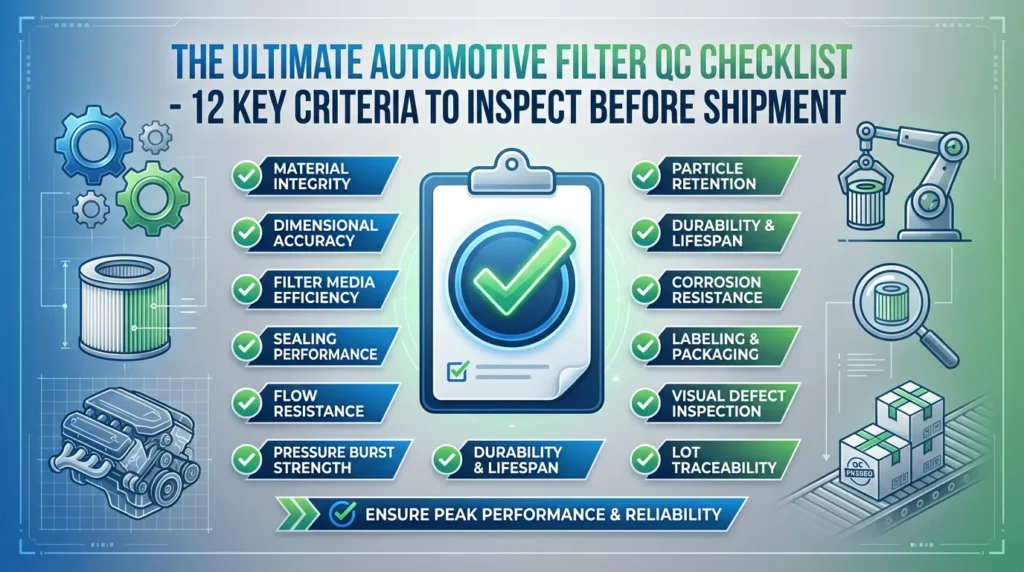
At Beling Filters, we implement rigorous inspections based on OE standards. This Automotive Filter QC Checklist outlines the 12 critical points every importer should verify to ensure zero defects.
What to Inspect: Look for cracks in the plastic frame, dents in the metal canister, or crushed pleats.
Why It Matters: Physical damage compromises structural integrity.
How to Check: Use a bright light source. Gently press the frame to detect hidden hairline cracks that might expand under engine vibration.
What to Inspect: Ensure the filter paper (cellulose or synthetic) is free from oil spots, dust, or foreign particles.
Why It Matters: Contaminated media reduces the lifespan of the filter before it is even installed.
How to Check: Visually inspect the surface. For cabin filters, check that the activated carbon layer (if applicable) is evenly distributed.
What to Inspect: Verify that pleats are straight, evenly spaced, and not bunched together.
Why It Matters: Air filter pleat alignment dictates airflow. Uneven spacing creates “blind spots” where air cannot pass, reducing the effective filtration area.
How to Check: Use a caliper to measure the distance between pleat tips. They should match the product drawing specifications.
What to Inspect: Check injection-molded frames for flash (excess plastic) or weak points.
Why It Matters: A weak frame can warp under the high heat of an engine bay, causing leaks.
How to Check: Apply moderate twisting pressure to the frame. It should be rigid and return to its original shape immediately.
What to Inspect: Inspect the gasket or PU seal for bubbles, gaps, or detachment.
Why It Matters: Filter seal integrity is the most critical factor for preventing “bypass”—where dirty air or oil flows around the filter instead of through it.
How to Check: Perform a compression test. The seal should be elastic and bounce back when pressed.
What to Inspect: Length, width, height, and thread size (for oil filters).
Why It Matters: If the dimensions are off by even 2mm, the filter may not fit the housing.
How to Check: Use a digital caliper. Compare the measurements against the OE sample or technical drawing.
What to Inspect: The glue line connecting the paper to the frame/end cap.
Why It Matters: If the glue fails, the media will detach under pressure, causing catastrophic engine failure.
How to Check: Apply light pressure to the media near the glue line. It should be immovable.
What to Inspect: For spin-on oil/fuel filters or cylindrical air filters, check the metal or plastic end caps.
Why It Matters: Loose end caps lead to leakage.
How to Check: Ensure the adhesive is cured and there is no excess glue blocking the flow holes.
What to Inspect: The pressure drop across the filter at a specific flow rate.
Why It Matters: High airflow resistance chokes the engine, reducing horsepower and increasing fuel consumption.
How to Check: This requires laboratory equipment. Ask your supplier for the airflow test report for that specific batch.
What to Inspect: The percentage of particles captured (e.g., 99% @ 20 microns).
Why It Matters: Filtration efficiency testing confirms that the paper grade used matches what you paid for.
How to Check: Review the ISO 5011 (air) or ISO 4548 (oil) test reports provided by the factory lab.
What to Inspect: The strength of the inner box and the master carton.
Why It Matters: Weak boxes crush during 40 days of ocean transit.
How to Check: Ensure filters are immobile inside the box. Use 5-layer corrugated master cartons for export.
What to Inspect: Part numbers, barcodes, “Made in China” markings, and brand logos.
Why It Matters: Incorrect private label filter packaging leads to customs seizures or warehouse scanning errors.
How to Check: Scan the barcode with a phone to ensure it reads correctly. Check spelling and logo placement against your artwork file.
Quality control is not an “extra step”—it is the foundation of your business. By enforcing this 12-point checklist, you ensure that every container leads to repeat orders, not complaints.
At Beling Filters, strict QC is part of our DNA. We welcome third-party inspections and provide detailed quality reports with every shipment.
Want to Upgrade Your Quality Standards? We can help you audit your current supply or provide samples for comparison.
Contact Bruce Gong (Key Account Manager)
Email: bruce.gong@belingparts.com
WhatsApp: +86 15057764729
LinkedIn: www.linkedin.com/in/brucegong-beling
Privacy Policy Powered by 2uncle