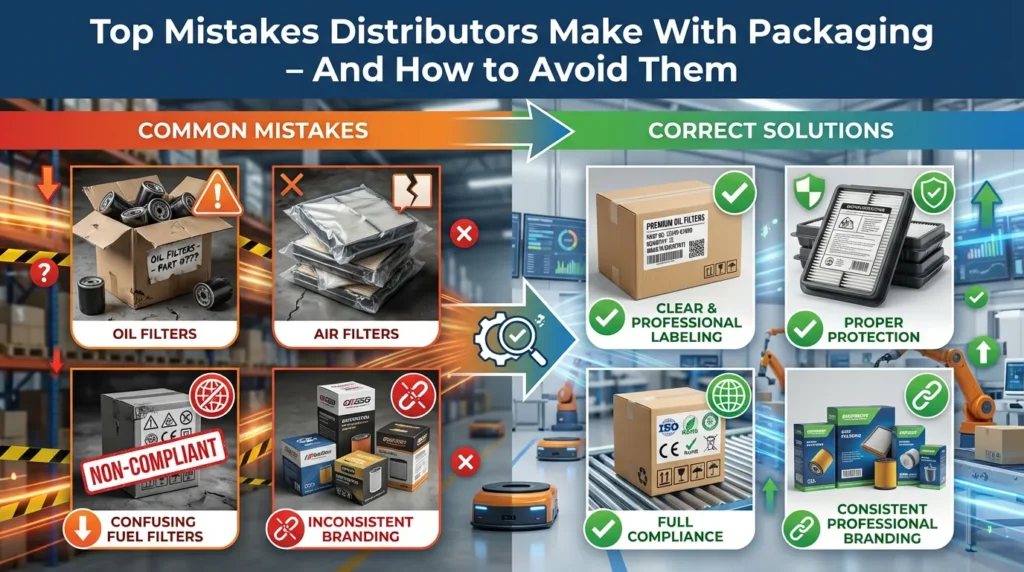
In private label automotive filters, you can have very good product quality… and still lose money, customers, and reputation because of packaging mistakes.
We see this repeatedly when we work with distributors in Europe, the Middle East, Latin America and Africa:
Extra costs in logistics and repacking
Warehouse chaos and picking errors
Angry workshops and returns
Slower sales because the brand feels “difficult”
This article goes through the most common packaging errors we see from distributors, and explains what we do differently at Beling when we build private label brands for 30+ markets.
1. Treating Packaging as “Just a Box” Instead of a Strategic Tool
1.1 The Mistake: LastMinute Box Decisions
Many distributors still see packaging as:
This leads to boxes that look good in a design file, but fail in real life.
1.2 What Happens in Reality
When packaging is treated as an afterthought, you end up with:
No space for labels or mandatory local stickers
Part numbers not visible when boxes are on the shelf
No room for barcodes in a standard position
Difficult or expensive adaptation when entering new countries
The result:
Warehouses add stickers wherever they find space → messy shelves
Workshops can’t easily find or read part numbers
Each new market requires new, improvised solutions
1.3 How to Avoid This Mistake
To avoid this, you should treat packaging as part of your product strategy, not just decoration.
Key steps:
Define packaging as a functional component:
Plan specific areas on each box for:
Develop a “core global” design that:
Represents your brand visually
Remains modular for different markets
Can be adapted with labels and language blocks without redesigning everything
1.4 How Beling Approaches This
At Beling, packaging is a dedicated project step, not an afterthought. We build:
A strong, professional box design
A clear layout for labels and mandatory info
A flexible structure that works across regions
So your packaging is ready to sell, not something that needs constant local fixing.
2. Inconsistent Design Across Product Groups
2.1 The Mistake: Different Look for Every Line
Another common error:
Each new product line (
oil,
air,
cabin,
fuel, heavy duty) gets its
own design logic.
For example:
This may seem creative, but in the aftermarket it usually causes more harm than good.
2.2 What Happens in the Warehouse and Workshop
When design is inconsistent:
Warehouse staff take longer to learn and recognize your range
Workshops don’t visually recognize your brand on the shelf
The range looks like a collection of random products instead of one strong brand
Mixed design styles give a “cheap” and unprofessional impression
This weakens your brand equity and slows down recognition in all markets.
2.3 How to Avoid This Mistake
The solution is to build one consistent design family for all filters:
consistent across all SKUs.
2.4 What Beling Does Differently
We design a unified packaging system with:
But the core brand look remains the same, so your range is easy to recognize in:
3. Weak or Overloaded Labels on Filter Boxes
3.1 The Mistake: Labels That Don’t Work in Real Life
There are two opposite but equally damaging label mistakes:
Both cause daily problems.
3.2 What Happens in Operation
With weak or overloaded labels:
Warehouse pickers make mistakes
Wrong parts reach the workshop counter
Reorders become harder because people say:
“I can’t read this code properly.”
3.3 How to Avoid This Mistake
Treat the label as a sales and logistics tool, not just a sticker.
Good practice:
3.4 How Beling Designs Labels
We design label templates that:
Work for warehouse operations
Are readable in workshop conditions
Are consistent across SKUs and product groups
This reduces picking errors, speeds up reorders, and reinforces brand recognition.
4. No Clear Plan for MultiLanguage & Local Regulations
4.1 The Mistake: Either Too Many Boxes or Too Little Compliance
Two typical extremes:
Both create problems.
4.2 What Happens When There Is No Plan
Consequences include:
High printing cost and complexity
Stock of “wrong” boxes when regulations or markets change
Local distributors forced to add ugly stickers everywhere:
Over time, this damages your brand image and increases costs.
4.3 How to Avoid This Mistake
The solution is a clear multilanguage and compliance strategy:
Group countries into language clusters, such as:
EN + DE + FR for parts of Europe
EN + AR for the Middle East
ES + PT for Latin America
Keep text short and supported by icons so:
More languages fit
Translations are easier
Layout remains clean
Reserve clean space for:
Use a compliance checklist before final artwork approval:
4.4 Beling’s Approach for 30+ Markets
Our packaging is structured to be ready to sell in several countries at once:
A limited number of multilanguage versions
Neutral, predefined areas for local additions
Compliance elements locked into the artwork
This keeps your packaging flexible and compliant, without chaos.
5. Ignoring Logistics, Palletization and Container Loading
5.1 The Mistake: Designing Only for Shelf Appearance
Some brands choose box sizes mainly for:
Shelf look
Graphic composition
without considering:
Container loading
Pallet patterns
Warehouse handling
5.2 What Happens in Transport and Storage
When logistics are ignored:
Empty space in containers → higher freight cost per unit
Unstable pallets → damage during transport and handling
Mixed box heights and footprints → slow and inefficient warehouse operations
Over time, this increases cost and risk.
5.3 How to Avoid This Mistake
Packaging design should balance shelf and logistics needs:
5.4 How Beling Designs for Logistics
We always check both:
This reduces freight cost per unit, minimizes damage, and makes warehouse life easier.
6. Using Cheap Board and Weak Protection to “Save” Cost
6.1 The Mistake: Choosing the Thinnest Cardboard
To reduce unit cost, some brands choose:
Very thin board
Lowstrength materials
believing this saves money. In reality, it often costs more.
6.2 What Happens in the Market
With weak packaging:
Boxes are crushed during transport or storage
Retailers and workshops complain about damaged presentation
Even if the filter inside is fine, people perceive low quality
Damage and return rates increase, especially in:
6.3 How to Avoid This Mistake
Board quality should match:
Ideally, you should test with real shipments:
Container
Truck
Courier / parcel
6.4 Beling’s Balance of Cost vs Protection
We help customers balance:
Packaging cost
Protection level
Brand perception
especially for export to hot, humid or longdistance markets, where weak boxes quickly become a serious problem.
7. No Version Control – Endless Small Changes
7.1 The Mistake: Constant Small Adjustments
Some brands:
Adjust design slightly for each new order, region or idea
Change colors, text or positions without a clear system
7.2 What Happens Over Time
This results in:
Multiple box versions in the same warehouse
Old and new designs mixed on shelves
Confused customers asking:
“Is this original or fake?”
7.3 How to Avoid This Mistake
Packaging should be treated as a longterm asset, with clear version control:
Freeze one approved design as Version 1
Change only when really needed:
New regulations
Major brand update
Strategic change
When you change, create Version 2 and communicate it:
Internally
To key distributors
Use internal codes to track which version is used for each order or shipment
7.4 Beling’s Version Control Practice
We:
Assign an internal version code to your packaging concept
Update it only with your agreement
Record which version is used for each production run
This keeps your brand stable and predictable, even as you grow into many markets.
8. Packaging Not Aligned With SKU & Barcode Logic
8.1 The Mistake: Design First, Codes Later
Another serious issue is designing packaging without considering:
Then later trying to “fit” codes and barcodes wherever there is space.
8.2 What Happens in Warehouse Systems
When packaging and SKU logic are not aligned:
Barcodes end up in different positions per SKU
Codes are truncated or printed too small
Warehouse scanners have trouble reading certain boxes
ERP systems get inconsistent data
Staff spend time guessing which code is the correct one
All of this slows down operations and increases error rates.
8.3 How to Avoid This Mistake
Packaging and SKU structure must be designed together:
8.4 Beling’s Integrated Approach
At Beling:
This significantly reduces headaches for distributors and makes your brand easier to work with.
9. How Beling Supports Distributors to Avoid These Packaging Mistakes
When we develop private label projects for automotive filters, we build packaging as a strategic system, not as a cosmetic accessory.
We help you avoid the mistakes listed above by:
Designing a global core box with modular areas:
Creating label templates optimized for:
Planning multimarket language and compliance from day one:
Aligning packaging with SKU, barcode and logistics strategy:
Standardized code and barcode positions
Palletization and container utilization
Master data and version control
Applying packaging version control so your brand stays consistent over time:
The result is packaging that doesn’t just look professional, but:
Reduces headaches for warehouses and distributors
Makes workshops more confident in your brand
Supports your growth into new markets
If you’re building or upgrading a private label filter range and want packaging that works in real life, not just in design files, we can guide you through each step of this process.
Beling – Save Your Time & Cost
Your valuable automotive filter partner since 2008.