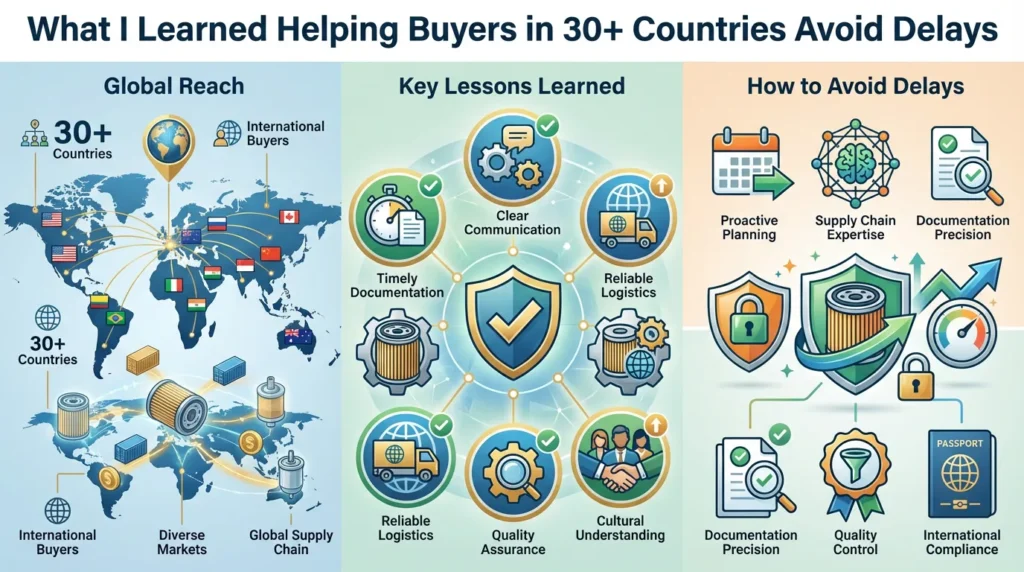
Since 2008, I’ve supported automotive filter buyers in 30+ countries – importers, distributors, and private label brands across very different markets.
After hundreds of containers and programs, one pattern is clear:
Most serious delays are not caused by production problems.
They’re caused by small, predictable issues that nobody fixed in advance.
The factory usually isn’t the bottleneck. The real delays happen in documentation, communication, labeling, and coordination.
This article summarizes the main lessons learned from those experiences, and how we’ve built them into our daily process at Beling to help buyers avoid delays, not just get a good price.
“Standard Documents” Don’t Exist in Automotive Filter Exports
1.1 Why Standard Export Documents Are a Myth
On paper, international trade looks simple: commercial invoice, packing list, bill of lading, certificate of origin.
In reality, every country, customs authority, broker, bank and buyer has a slightly different expectation for:
- Wording of descriptions
- HS code structure
- Origin format
- Additional information or certifications
Delays often start when suppliers assume:
- One invoice format works for all markets
- Minor wording preferences of local customs or banks are “not important”
- HS codes and descriptions can be copied and pastedfrom another market
These assumptions create document discrepancies that slow clearance and payment.
1.2 How Small Differences Trigger Big Delays
Examples of how “nonstandard” requirements cause delays:
- A customs authority that wants very detailed descriptions, not just “auto parts”
- A bank that will not accept abbreviations in the beneficiary name
- A broker that uses slightly different HS codesor wording than what the supplier copied from another client
Individually, these look like small issues. Added together, they can:
- Delay document approval
- Trigger document amendments
- Delay customs clearance and payment by days or weeks
1.3 What We Do Differently Now: BuyerSpecific Documentation Profiles
At Beling, we no longer treat documents as “one size fits all”. For every new buyer, we now:
- Prealign core elements:
- HS codes (checked with your broker when needed)
- Description style (short vs detailed, language, wording)
- Country of origin format
- Incoterms and delivery terms
- Adjust invoice and packing list format to:
- Your broker’s preferences
- Your bank or L/C wording requirements
- Your own internal processes
- Keep a file with your specific requirements so:
- Every shipment follows the same pattern
- New team members at our side don’t have to “relearn” your rules
By treating each buyer’s documentation setup as unique, we greatly reduce the risk of small, repeated mistakes that cause delays.
Draft Documents Save Weeks in Automotive Filter Shipments
2.1 The Old Way: Final Documents Sent After Loading
In the early years, our process looked like this:
- We loaded the container
- We issued the final invoice and packing list
- We sent documents to the buyer or bank
- The buyer or broker finally saw the documents and noticed:
- A wrong code
- A minor name mismatch
- A wording that didn’t match L/C or import license
Result:
- Documents had to be corrected and reissued
- Banks and customs needed updated files
- Clearance and payment were delayed – even when the goods were already at port
A small piece of text on paper delayed an entire container.
2.2 The New Habit: Always Use Draft Documentation
One simple habit changed this:
We now always send draft documentation before shipment.
Our current process:
- Before the container leaves, we send:
- Draft commercial invoice
- Draft packing list
- We invite the buyer and/or broker to:
- Check wording
- Verify codes, consignee, notify party
- Confirm that descriptions and origin match local expectations
- Only after the buyer confirms, we:
- Issue stamped originals
- Apply for necessary certificates (COO, etc.)
2.3 Result: Fewer Surprises With Customs and Banks
This small step has prevented many weeks of aggregate delays:
- Issues are caught beforethe cargo is on the water or at the border
- Banks receive documents that already match the L/C terms
- Customs sees consistent data across all paperwork
For automotive filter buyers, this means:
- More predictable arrivals
- Fewer “urgent correction” emails
- Faster cash cycle
Labels & Marks Are Part of “Customs Documents”
3.1 Customs Look at Paper and Packaging
A common blind spot: many people think customs only check documents on paper or in electronic systems.
In reality, customs officers also check what is:
- Printed on the boxes
- Printed on cartons and pallets
- Shown on labels and shipping marks
Typical causes of delays:
- “Made in …” missing on the product or box
- Origin shown differently on the label vs. invoice / COO
- Importer name or address missing where it is legally required
- Carton marks (carton number, PO, SKU) not matching the packing list
When labels and marks don’t align with documents, customs may:
- Request reinspection
- Block goods for clarification
Ask for written corrections or relabeling
3.2 How We Now Synchronize Labels, Marks and Documents
We now treat labels and shipping marks as part of the official documentation set:
- Make sure origin, brand, and importer info appear as required in your market
- Ensure carton marks match the packing list 1:1:
- Carton numbers
- Purchase order numbers
- References or part numbers
- Synchronize:
- Invoice data
- Packing list data
- Labels on unit boxes
- Shipping marks on outer cartons
By connecting what’s on the paper and what’s on the box, we reduce the gap that often causes customs questions.
OverCommunication Is Better Than Assumptions
4.1 How Assumptions Create Delays
Many of the worst delays we’ve seen were not caused by big failures but by simple assumptions such as:
- The buyer assumed FOB Shanghai; the supplier assumed FOB Ningbo
- The buyer believed average transit time was 25 days, but the actual sailing for that route was 35+ days
- The buyer urgently needed a partial shipment, but didn’t mention it early, so the full order was booked for one container
No one intended to cause a problem, but unspoken expectations turned into delay and frustration.
4.2 Our Current Practice: Confirm, Share, Ask
Now, we deliberately overcommunicate key points:
- Confirm Incoterms, port and shipping expectations in writing, not just verbally
- Share:
- Estimated production schedule
- Expected sailing windowsand typical transit times
- Ask early:
- “Do you have any fixed deadlinefor this shipment?”
- Seasonal demand
- Tender or contract start
- Promotion or marketing campaign
When deadlines are clear, we can:
- Plan production better
- Adjust sailing choices
- Discuss partial shipments if needed
4.3 Why OverCommunication Reduces Mistakes
Most mistakes happen under time pressure and unclear expectations.
By overcommunicating:
- Both sides know the real constraints
- There is time to fix small issues before they become big problems
- Buyers can plan their own downstream commitments more confidently
In international automotive filter trade, clear communication is as important as correct pricing.
One Responsible Contact Makes Everything Faster
5.1 The Problem With Too Many Voices
On the buyer’s side, multiple departments may be involved:
- Purchasing
- Logistics
- Finance and banking
- Customs broker
- Sometimes the end customer (fleet, chain, OEM)
If each person contacts the supplier separately, we often see:
- Different instructions from different stakeholders
- Conflicting versions of how documents should look
- Delays while waiting for internal alignment
This slows down:
- Document approvals
- Booking decisions
- Issue resolution
5.2 Our Approach: One Main Contact Per Order or Program
To speed things up, we now ask our buyers to:
- Appoint one main contact person for each order or longterm program
- Have that person collect internal feedback from:
- Logistics
- Broker
- Finance
- Send back clear, consolidated instructions to us
We then:
- Send all draft documents and key confirmationsto this main contact
- Treat their response as the single source of truth
5.3 Benefits for Automotive Filter Buyers
With one responsible contact:
- Questions are answered faster
- Decisions are clearer
- Document changes are fewer and more consistent
This reduces:
- Confusion
- Overlapping emails
- Missed details
…and speeds up every step from purchase order to cleared cargo.
Never Ignore “Small” Data Fields
6.1 The Small Details That Cause Big Delays
Looking back at delayed shipments, the culprits are often small data fields that people thought were “not critical”:
- Wrong or missing notify party
- Beneficiary name slightly inconsistent with the L/C
- Incomplete consignee addressor missing tax ID / importer code
- Incorrect or incomplete shipping markscompared with the packing list
Customs and banks treat these as compliance issues, not minor cosmetic errors.
6.2 Our Standard Checklists for Documentation Accuracy
To avoid these traps, we now use a standard checklist before:
- Booking shipments
- Issuing commercial documents
We verify:
- All names and addresses:
- Buyer, consignee, notify party
- Against your last approved shipment or L/C
- All key numbers:
- Tax IDs
- Importer codes
- Registration numbers
- All shipping marks the packing list:
- Carton numbers
- Order numbers
- Brand and origin text
We treat what used to be seen as “extra info” as critical fields.
6.3 Result: Fewer Bank and Customs Discrepancies
By respecting small data fields, we:
- Reduce the number of bank queriesand rechecks
- Lower the chance of customs questioning consignee or origin
- Simplify the work of your broker and logistics team
For you, this translates into smoother clearance and faster cash flow.
LongTerm Partners Deserve LongTerm Memory
7.1 The Value of Remembering Each Buyer’s Way of Working
One of the biggest efficiency gains comes from consistency over time.
Instead of treating each order as “new,” we build and maintain a buyer profile that includes:
- Preferred forwarder or Incoterm
- Specific documentation preferences:
- Wording
- Format
- Certificate details
- Label and packaging rules:
- Languages
- Origin marking
- Importer text
- Any recurring regulatory or brand requirements
7.2 Training Our Team to Use Buyer Profiles
Internally, we train our team to:
- Check the buyer profile before preparing documents and labels
- Follow the profile automatically, not reinventing the process each time
- Update the profile when something changes, so the new rule becomes the standard
This means:
- Fewer repeated questions
- Fewer repeated mistakes
- Faster onboarding of new orders
7.3 How This Helps Automotive Filter Buyers
For our longterm partners, each new shipment becomes smoother than the last:
- Less time spent explaining preferences again and again
- Fewer surprises in documentation or labeling
- More trust and predictability in your supply chain
This is how we aim to grow from “just another supplier” to a longterm export partner.
Beling – Save Your Time & Cost
From first order to longterm program, we use these lessons to help automotive filter buyers avoid delays – not just get a good price.
Your valuable automotive filter partner since 2008.
Contact Our Team
Bruce Gong – Key Account Manager, Beling Filters
Email: bruce.gong@belingparts.com
WhatsApp: +86 150 5776 4729
LinkedIn: www.linkedin.com/in/brucegong-beling
We’re happy to share how we usually adjust pallets for EU vs Middle East vs Latin America markets, and help you fine tune palletization to your warehouse system.