“OE level quality” is one of the most abused phrases in the automotive aftermarket.
It’s printed on boxes, websites, and catalogs everywhere.
But when you open the packaging and install the filter, the reality can be very different:
- The filter doesn’t fit the housing properly.
- The sealing is weak and allows bypass.
- The media looks generic, with no proven efficiency.
- Batch‑to‑batch quality is inconsistent.
In practice, true OE‑level quality is not a slogan.
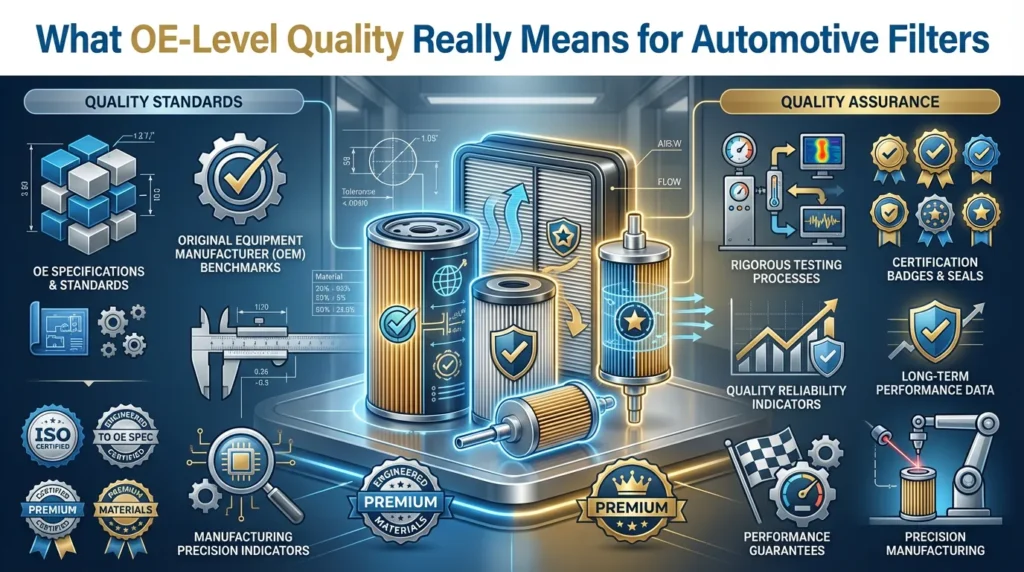
It is a system that combines engineering, materials, process control, testing, and documentation.
As a manufacturer and supplier of air filters, cabin filters, oil filters and fuel filters to global aftermarket brands, we work every day with customers who want to position their brand at genuine OE level. This article explains how we define and deliver OE‑level quality in practice — beyond marketing language.
OE-Level Design and Fitment: More Than “It Looks Similar”
OE‑level quality starts long before the box is printed. It starts at the design and fitment stage.
You can copy the shape of a filter from a sample and still end up with something that:
- Doesn’t sit correctly in the housing
- Requires force or “tricks” to install
- Leaves gaps that allow unfiltered air or oil to bypass
Critical Elements of OE-Level Design
For us, OE‑level design for automotive filters includes:
- Precise dimensions
Every filter must match the OE housing and brackets within tight tolerances. This includes overall length, width, height, diameters, and critical interface dimensions. - Correct sealing design
Sealing is not just “put a gasket somewhere.” We design sealing profiles and materials to:- Match OE geometry
- Maintain compression over the service life
- Avoid bypass or leakage, even under vibration and temperature changes
- Proper connector/interface design
For modern engines and HVAC systems, many filters interact with:- Sensors
- Clips and latches
- Specific mounting interfaces
OE‑level quality means these connectors and interfaces are engineered to match the original, not guessed or approximated.
- Consistent fitment across batches
It’s not enough that one sample fits well. Every batch and every piece must:- Drop into the OE housing without “fighting” the part
- Require no trimming, bending, or forcing by the installer
Why Fitment Is a Core Part of OE-Level Quality
If a filter does not fit like OE, it is not OE level — regardless of how nice the packaging looks or what is printed on it.
Poor fitment leads to:
- Installer frustration and longer installation time
- Risk of damage to housings or clips
- Improper sealing and potential engine or cabin protection issues
- Returns, complaints, and loss of trust in the brand
That’s why we treat OE‑spec design and fitment as the foundation of our automotive filter development.
Filtration Media: Not All “Paper” Is Equal
To many, the media inside a filter looks like simple paper.
In reality, the filtration media is the heart of the filter.
Two filters can look identical from the outside but perform completely differently because of the media quality and specification.
What OE-Level Filtration Media Requires
When we say OE‑level filtration media, we mean:
- Defined efficiency and dust holding capacity
Media is selected and specified based on OE performance targets. We look at:- Initial efficiency (how much contamination is captured from the start)
- Dust holding capacity (how much contamination can be held before restriction becomes excessive)
- Correct composition and grammage for each application
Not every filter can use the same media. OE‑level media selection considers:- Fiber type and blend
- Grammage (weight per square meter)
- Resin and treatment
- Specific application (engine air, cabin air, oil, fuel, etc.)
- Stable performance over the entire service interval
We develop media that:- Maintains efficiency over time
- Resists collapse or deformation under flow and pressure
- Handles the full service life expected by the OE or market
- Verification in laboratory tests
We do not rely on assumptions. OE‑level media performance is verified with tests such as:- Multi‑pass efficiency tests
- Dust loading tests
- Pressure drop measurements
- Efficiency curves over the life of the filter
Data, Not Just Claims
When we say our filters are “high efficiency” or “OE level,” we can support those claims with:
- Test reports
- Efficiency curves
- Dust holding capacity data
- Comparative testing vs OE parts
True OE‑level quality means we can show data, not just write slogans.
Process Control: Every Piece, Not Just One Good Sample
A single good sample can be made in almost any factory.
But OE‑level products require consistency, not luck.
That consistency comes from automotive‑grade process control.
Quality Systems Behind OE-Level Filters
We follow production systems based on:
- IATF 16949 and ISO standards
- Documented procedures for every stage of production
- Continuous improvement and corrective action processes
This framework ensures that what we design is actually what we produce — batch after batch.
Key Process Control Elements for Automotive Filters
In practice, our process control includes:
- Incoming inspection of key materials
We check critical components such as:- Filtration media (specs, grammage, appearance)
- Rubber and sealing materials
- Plastics and metal components
- Adhesives and resins
- In‑process checks
During production, we monitor:- Dimensions (length, width, height, diameters)
- Pleat count and spacing (to ensure correct surface area and flow)
- Glue lines and sealing (no gaps, correct amount, proper curing)
- Torque or assembly force where applicable
- Orientation and assembly completeness
- Final inspection
Finished filters are checked for:- Leakage and sealing performance
- Pressure resistance (where applicable)
- Visual quality and appearance (no defects, clean assembly)
Traceability and Batch Control
True OE‑level quality also means:
- Every batch can be traced back to material lots and production records.
- If an issue is ever detected, we can:
- Identify affected batches
- Analyze root causes
- Implement corrective actions
OE‑level quality is not just about one good part for testing. It’s about every part leaving the factory meeting the same high standard.
Durability and Real-World Testing
Passing a lab test on day one is important, but it is not enough.
An automotive filter must protect the engine, fuel system, or cabin throughout the entire service life under real conditions.
Durability Requirements for OE-Level Filters
To achieve OE‑level durability, we run:
- Endurance tests
Simulating the full service interval:- Continuous or cyclic flow
- Dust loading or contamination scenarios
- Monitoring pressure drop and integrity over time
- Temperature and pressure cycling
For certain applications (especially oil filters and fuel filters), we test:- Repeated temperature changes (hot–cold cycles)
- Pressure fluctuations and spikes
- Structural integrity and sealing after stress cycles
- Environmental condition testing
We consider different markets and real operating environments:- Dusty regions (high particulate load)
- Humid climates (risk of moisture effects on media)
- Cold climates (viscosity changes for oil, materials contraction)
Field Feedback and Continuous Improvement
Lab tests are crucial, but field feedback is equally important.
We work with customers and installers worldwide to collect:
- Feedback on fitment and installation
- Performance feedback from different markets
- Warranty data and complaint analysis
This information feeds into continuous improvement, allowing us to refine designs, materials, or processes when needed.
OE‑level quality means the filter performs consistently from the first kilometer to the last, not just in a controlled test bench environment.
Documentation and Traceability: Quality You Can Prove
For serious aftermarket brands, distributors, and importers, quality is not only what happens at the factory. It’s also what you can document and prove.
Technical Documentation
Our OE‑level approach includes providing:
- Technical specifications for each filter
- Test reports (efficiency, pressure drop, endurance, etc.)
- Material and design data where relevant for audits or certifications
This helps brand owners:
- Support their own marketing claims (“OE‑level performance,” “meets or exceeds OE specifications”)
- Answer technical questions from installers or fleet customers
- Pass audits from large customers or distributors
Batch Codes and Traceability Information
Each production batch is marked with:
- Batch codes / date codes
- Factory/location identifiers (where applicable)
This allows:
- Traceability from the field back to production
- Targeted investigation if a specific issue is reported
Clear Labeling and Usage Information
Documentation is not only for internal use; it also appears on the product and packaging:
- Application information (which vehicles / engines / models)
- Service interval recommendations (where required by the brand)
- Installation direction (airflow arrows, “top/bottom” markings, etc.)
OE‑level quality includes giving installers and distributors clear, accurate information so the product is used correctly.
What OE-Level Quality Means for Distributors and Brand Owners
If you are a distributor, brand owner, or importer building an automotive filter program, the difference between true OE‑level quality and “slogan quality” shows up directly in your business.
Practical Benefits of Genuine OE-Level Quality
When your filters are engineered, produced, and controlled to OE‑level standards, you can expect:
- Fewer returns and complaints
Good fitment, reliable sealing, and consistent performance reduce field problems and warranty claims. - Stronger brand reputation
Installers and workshops learn they can trust your filters:- They fit properly the first time.
- They perform well over the service interval.
- They don’t cause comebacks.
- Higher installer confidence and loyalty
Technicians tend to stick with brands that make their work easier and reduce risk. OE‑level quality supports that trust. - More stable, long‑term business
When end users and installers are happy, distributors experience:- More repeat orders
- Better word‑of‑mouth
- Stronger positioning in competitive markets
Positioning Your Brand at Genuine OE Level
If you want to position your brand as OE level — not just on paper — you need a supplier that:
- Designs filters based on OE specifications, not reverse‑engineering shortcuts
- Uses proven filtration media and verifies performance with real test data
- Operates under automotive‑grade quality systems and process control
- Supports you with documentation, traceability, and technical communication
That is exactly the system we’ve built for our air, cabin, oil, and fuel filters.
How Our OE-Level System Supports Your Brand
At Beling Filters, OE‑level quality is not a one‑time promise. It is an integrated system that supports your brand every day.
We help aftermarket brands and importers by:
- Engineering filters to OE dimensions, sealing, and interfaces
- Selecting and validating filtration media specific to each application
- Producing under IATF/ISO‑based quality control, with full traceability
- Testing products in the lab and learning from real‑world usage
- Providing documentation and technical support when you need to defend or promote your brand
If you’re building or expanding your automotive filter brand and want to position it at genuine OE level, we’re ready to:
- Share how we design and validate our filters behind the scenes
- Provide example test reports and specifications (where commercially appropriate)
- Work with you on product ranges, private label packaging, and technical positioning
OE‑level quality is not a sticker on the box.
It’s the combination of design, media, process, testing, and documentation that protects your customers — and your reputation.