In the automotive filter business, most buyers are trained to evaluate samples.
You receive a few air, cabin, oil or fuel filters:
- Fitment is good
- Media looks fine
- Packaging is clean
You approve the supplier based on these samples, place a container order, and then discover:
- First shipment is good
- Second shipment has fitment issues
- Third shipment has more returns and complaints
- Fourth shipment looks different again
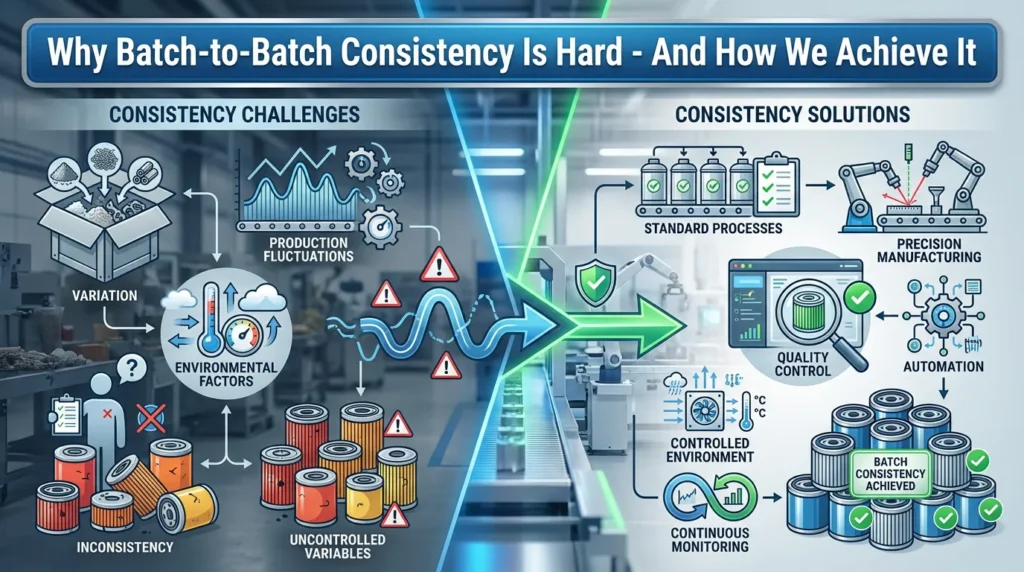
The real challenge in automotive filters is not getting one good sample.
The real challenge is batch-to-batch consistency.
Keeping every shipment at the same level – same fitment, same performance, same appearance – is where most suppliers struggle.
In this article, we’ll break down:
- Why batch-to-batch consistency is so difficult in automotive filter manufacturing
- The typical technical and process reasons quality “moves” from shipment to shipment
- The concrete systems we use to achieve consistency for our air, cabin, oil and fuel filters
- What this means for importers, distributors and brand owners building serious filter programs
Why Batch-to-Batch Consistency Is Difficult in Automotive Filter Production
Many factories can produce an excellent sample when everyone is watching.
Very few can keep that level across months and years of production.
Here are the main reasons why consistency is hard.
1.1 Different Raw Material Lots
Automotive filters use a combination of:
- Filter media (cellulose, synthetic, blends)
- Rubber gaskets and seals
- Plastics (end caps, frames, connectors)
- Metal parts (caps, shells, centers, covers)
These materials come from:
- Different lots
- Sometimes different suppliers
- Different production conditions
Even small variations can significantly affect performance:
- Media grammage (weight per square meter)
- Resin content
- Fiber blend and structure
- Rubber hardness and elasticity
If there is no strict material control, each batch might be built from a slightly different recipe, leading to different:
- Filtration efficiency
- Dust holding capacity
- Sealing behavior
- Durability
1.2 Human-Dependent Operations
Many steps in filter production still involve people:
- Pleating
- Gluing and applying adhesive
- Assembly and positioning components
- Visual checks and packing
Without standardization, each operator may have a “slightly different way” of doing things:
- One uses slightly more glue, another slightly less
- One aligns parts perfectly, another tolerates minor misalignment
- One is very careful with pleat uniformity, another speeds up
Over time and across shifts, these small differences add up to visible and performance differences between batches.
1.3 Machine Setting Drift Over Time
Machines do not stay perfectly calibrated forever.
Factors such as:
- Tool wear
- Temperature and humidity changes
- Different operators
- Maintenance quality
…can cause gradual drift in:
- Dimensions
- Pleat height and density
- Glue position and quantity
- Cutting length
If there is no defined machine setting control and monitoring, a part that was “perfect last month” may slowly drift out of tolerance.
1.4 Weak In-Process Control
In many factories, quality control focuses only on the final product:
- A quick visual check
- Occasional dimension check at the end
The problem with this approach:
- If something goes wrong early in production and no one is checking in the middle, the issue is only found after thousands of pieces are already made.
- At that point, you have:
- A large quantity of non-conforming filters
- A difficult decision: scrap them (costly) or ship them (risky)
Without in-process control, variation is discovered too late to be efficient or safe.
1.5 Poor Traceability
If you cannot trace:
- Which materials were used
- Which machine produced the batch
- Which operators and parameters were involved
…it becomes almost impossible to:
- Understand why differences occurred
- Prevent the same issue in future batches
- Separate good batches from potentially affected ones
Poor traceability means problems get “solved” only on the surface, with no structural improvement.
Why “Good Samples, Unstable Batches” Is So Common
Putting all these factors together explains a common pattern in automotive filter sourcing:
- Supplier makes extra effort on samples
- Approved materials are used for initial development
- Best operators and machines are used, with extra checks
- Buyer approves sample quality
But then:
- Raw material selection changes under cost pressure
- Operators change or are not properly trained
- Machine parameters are not fixed for each part number
- In-process checks are minimal or inconsistent
Result:
- Good first shipments, then quality drifts
- Importers see batch-to-batch differences in:
- Fitment
- Color/appearance
- Media stiffness
- Sealing quality
This is not “bad luck”; it is a system problem.
To avoid this, you need system-based consistency, not sample-based promises.
How We Achieve Batch-to-Batch Consistency for Automotive Filters
To keep every batch as close as possible to the approved sample, we focus on systems, standards and traceability, not luck or one-time efforts.
Here is how we manage batch-to-batch consistency for our air, cabin, oil and fuel filters.
Standardized BOM and Approved Samples
Consistency starts with a fixed recipe.
4.1 Fixed Bill of Materials (BOM) for Each Part Number
For every filter, we define a Bill of Materials that specifies:
- Exact media specification (type, grammage, treatment)
- Rubber compound and hardness range
- Plastic material type and grade
- Metal thickness and coating type
This BOM is locked as the standard for that part number.
4.2 Golden Sample and Drawing
For each reference, we keep:
- A golden sample – the physically approved product that represents the target:
- A technical drawing showing:
- Critical dimensions
- Tolerances
- Key interfaces
4.3 Change Management
If any change is needed (material substitution, design adjustment, supplier change), it must be:
- Evaluated
- Tested
- Approved
- Documented
No silent changes.
Result: Each batch is built on the same recipe, not random substitutions or unapproved shortcuts.
Strict Incoming Material Control
Even with a fixed BOM, material lots must be checked before they enter production.
5.1 What We Check on Incoming Materials
For every lot, we:
- Measure media grammage, thickness, and resin content against standards
- Test rubber/plastic hardness and check appearance
- Verify metal thickness and coating
Each lot is:
- Accepted if it meets criteria
- Rejected or quarantined if it does not
5.2 Impact on Consistency
This step reduces performance variation caused by:
- Slightly denser or lighter media
- Softer or harder rubber gaskets
- Thinner or inconsistent metal
By controlling incoming material quality, we keep performance and fitment stable from batch to batch.
Controlled Machine Settings and First Piece Approval
To avoid “good last time, different this time” issues, we control the machine side carefully.
6.1 Defined Machine Parameters
For each part number, we define:
- Pleat height and distance
- Cutting lengths
- Glue application position and quantity
- Speed and temperature settings (where relevant)
These parameters are recorded and used whenever that part runs.
6.2 First Piece Inspection for Every Batch
At the start of every batch:
- Machine is set according to defined parameters
- A small quantity is produced
- The first pieces are inspected for:
- Dimensions
- Fitment
- Critical features and appearance
Only after first piece approval can mass production start.
This prevents an entire batch being produced on incorrect settings.
In-Process Quality Checks – Not Only Final QC
Instead of waiting until the end, we perform regular checks during production.
7.1 What We Check In-Process
During production, we periodically check:
- Dimensions and critical interfaces
- Pleat count and uniformity
- Glue line position and curing quality
- Sealing surfaces and assembly alignment
If any measurement shows drift or deviation, we:
- Stop the line
- Adjust settings
- Recheck before continuing
7.2 Why This Matters
In-process checks allow us to:
- Catch issues early
- Correct them before thousands of filters are affected
- Reduce scrap and prevent non-conforming batches from reaching packing
This is a key difference between “sample quality” suppliers and serious, automotive-standard manufacturers.
SPC and Control Plans for Key Characteristics
For important products and high-volume references, we apply Statistical Process Control (SPC) and structured control plans.
8.1 SPC on Key Dimensions
We use SPC to monitor:
- Critical dimensions (height, diameter, gasket position, etc.)
- Trends over time rather than just pass/fail checks
By analyzing data, we can see:
- Gradual drift before parts are out of tolerance
- When a process needs adjustment or maintenance
8.2 Control Plans Based on Automotive Standards
We use control plans inspired by IATF 16949 / automotive quality standards, defining:
- What to check
- How often
- With which tools
- Acceptance criteria
8.3 Benefit of SPC and Control Plans
This approach allows us to:
- Detect and correct problems before they create non-conforming parts
- Maintain tight control on high-volume or critical items
- Prove to customers that consistency is measured and managed, not just promised
Clear Traceability for Every Batch
Traceability is essential for both consistency and problem solving.
9.1 Batch Coding System
Each batch is labeled with:
- Batch code
- Production date
- Production line or machine
- Linked material lots
These codes appear on:
- Inner packaging (where appropriate)
- Outer cartons
- Production records
9.2 Why Traceability Matters
If there is ever an issue, we can:
- Quickly identify which exact batch is affected
- Trace back to specific materials, machines and settings
- Perform targeted corrective actions
This protects:
- Other batches that are not affected
- Your brand from broad, uncontrolled risk
Traceability is the backbone of long-term consistency and continuous improvement.
What Batch-to-Batch Consistency Means for Importers and Brand Owners
For our overseas partners, achieving batch-to-batch consistency is not just a production goal. It directly affects your business.
10.1 Stable Quality – Fewer Surprises
With controlled materials, machines, processes and traceability, you get:
- The same quality level shipment after shipment
- Filters that fit and perform consistently, not just sometimes
- Less time spent solving unexpected quality swings
10.2 Lower Claims and Return Rates
Installers quickly notice:
- Parts that always fit the same way
- Predictable performance
- Fewer comebacks
This leads to:
- Fewer returns and complaints
- Lower hidden costs (handling, communication, reputation damage)
10.3 Easier Market Approval and Scaling
Once your market tests and approves our filters:
- You can scale volume with confidence
- You don’t need to “re-test” every new shipment
- Distributors and workshops build trust in your brand
10.4 Stronger Brand Reputation and Long-Term Business
Consistency is what keeps customers coming back:
- One good sample may win a trial order
- Ten consistent shipments build a strong brand
By controlling batch-to-batch consistency, we support your:
- Brand positioning (OE-level, professional, reliable)
- Long-term relationships with distributors and workshops
- Growth in competitive markets
If you’re tired of “good samples, unstable batches,” it’s not just about finding a new supplier — it’s about choosing a supplier with systems for consistency.
We’re ready to show you:
- How our BOM, incoming control, machine settings, in-process checks, SPC and traceability work in practice
- Example records and control plans for your key references
- How this system can support your long-term filter business globally
Contact Our Team
Bruce Gong – Key Account Manager, Beling Filters
Email: bruce.gong@belingparts.com
WhatsApp: +86 150 5776 4729
LinkedIn: www.linkedin.com/in/brucegong-beling
We’re happy to walk you through how we integrate container loading photos into our export process and how you can use similar practices with all your suppliers.