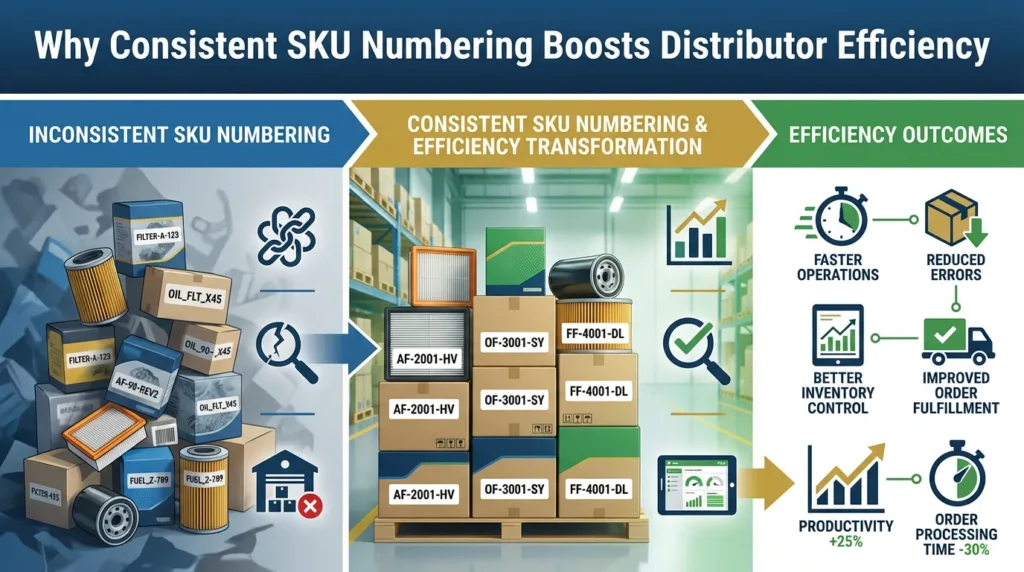
Many private label automotive filter brands invest heavily in:
- Logo and brand identity
- Box and packaging design
- Catalogue layout and photos
All of these are important. But the thing your team, distributors and workshops use every single day is much simpler:
Your SKU / part number system.
Every time someone:
- Picks a filter in the warehouse
- Enters a sales order
- Scans a barcode
- Searches in an ERP or ecommerce system
they are working with your SKU structure.
When the numbering is simple and consistent, distributors:
- Pick faster
- Make fewer mistakes
- Integrate you more easily into their ERP and ecommerce
- Are more willing to grow and stock more of your line
This article explains how a good, wellplanned SKU numbering system directly improves efficiency and sales for private label automotive filters.
One Clear Master Code for Each Filter: Fewer Errors, Less Confusion
A very common problem in private label or rebranded ranges is code confusion.
Typical mistakes include:
- Different codes on box vs. invoice
- Old codes still appearing in some catalogues or Excel files
- Long, complicated strings with mixed letters and numbers
- Internal codes used in some places, external codes in others
When this happens, your warehouse and customers regularly ask:
“Which code is the real one?”
This leads to:
- Extra emails and calls just to clarify codes
- Picking the wrong part from the shelf
- Returns, credit notes and lost confidence
1.1 Why “One Master Part Number” Is Essential
To avoid these problems, we always define one master part number per SKU and make sure it is:
- The same on:
- Individual box and label
- Outer carton (if used)
- Invoice and packing list
- Proforma invoice and export documents
- Catalogue (PDF/printed)
- Excel / CSV data lists
- Printed large and clear on at least two sides of the box
- Used consistently in all digital and physical materials
This singlecode rule means:
- Everyone inside your company speaks the same “language”
- Distributors always know what to use in their ERP and stock systems
- Workshops know exactly what to quote when they reorder
A clear master code is the foundation of errorfree logistics.
Logical SKU Structure for Filters: Faster Training & Picking
A smart part number can “tell a story” and make your range much easier to understand.
Instead of random codes, a structured system lets people decode some basic information just by looking at the SKU.
2.1 Example of Logical Structure for Automotive Filters
For example, you might define:
This is just one example. The exact logic depends on your range, but the principle is:
The code should have internal meaning and not be 100% random.
2.2 Operational Benefits of Logical SKU Structure
When there is clear logic:
- New warehouse staff learn the range faster
- Pickers can “feel” if a code looks wrong or belongs to a different group
- Sales teams navigate the catalogue more easily
- Product managers and buyers see gaps in the range faster
In other words, the SKU itself becomes a navigation tool.
2.3 How Beling Helps Design SKU Structures
We help customers design numbering systems that:
- Fit their existing systemif they already have one and want to improve it
- Or create a new, clean coding logicfor a fresh private label brand
We consider:
- Product groups you have now (oil, air, fuel, cabin, heavy duty, etc.)
- Where you want to expand in the next 3–5 years
- How distributors typically structure their own internal codes
The goal is a system that is:
- Logica
- Easy to remember
- Scalable in the future
Avoiding Duplicate and “LookAlike” Codes
In a big aftermarket range, it’s easy to accidentally create:
- Codes that look almost the same (e.g. A1234 and A1243)
- Duplicated codes used for different items
- Internal codes that clash with major OE or wellknown competitor codes
These issues can be very expensive.
3.1 Risks of Duplicate or Similar SKU Numbers
When codes are too similar or duplicated:
- Wrong parts get shipped regularly
- Customer systems become confused when they import your data
- Warehouse staff constantly doublecheck and lose time
- Your team spends hours every month correcting mistakes
In some cases, a simple digit swap can cause:
- The wrong oil filter to be installed
- Complaints from workshops
- Claims and damage to your brand reputation
3.2 How We Prevent Duplicate & Confusing Codes
Our process includes:
- Checking for duplicate and very similar codes before final approval
- Avoiding risky patterns such as:
- Simple digit reversals (1234 vs 1243)
- Letters that look similar (O vs 0, I vs 1, etc.)
- Keeping a master list of codes that is:
- Locked once launched
- Controlled under clear change rules
This keeps your code base clean and avoids the typical chaos that happens when codes are created “on the fly” over many years.
ERP & ECommerce Friendly SKU Numbering From Day One
Modern distributors rely heavily on ERP systems, ecommerce platforms and online catalogues.
Sooner or later, they will ask:
“Can you send the full SKU list in Excel with codes, barcodes and cross references?”
If your numbering system is clean and fixed, this becomes a simple export.
If not, it becomes a long project with manual corrections.
4.1 Why ERPFriendly Codes Matter
With a clean, wellstructured SKU system:
- Import into distributor ERPs is quick and reliable
- Ecommerce listing (webshop, marketplace, B2B portal) is much simpler
- Crossreference mapping (to OE or other brands) is easier to manage and update
This makes you a “lowfriction” supplier – the kind distributors prefer to grow with.
4.2 Beling’s Support for Data & Integration
We support this by:
- Maintaining structured part lists with your final codes, updated when new SKUs are added
- Aligning barcode numberswith SKU numbers where possible (or following your GTIN logic precisely)
- Keeping the same code across all pack types:
- Individual box
- Inner pack (if any)
- Master carton / outer carton
This avoids having to manage different codes for the same product depending on packaging level – a common cause of confusion in ERPs.
FutureProof SKU Numbering: Space to Grow Your Filter Range
If you start with random codes or shortterm thinking, you very quickly hit problems when you try to grow your line.
Typical growth challenges include:
- Adding new product groups (e.g. expanding from light vehicle to heavyduty)
- Creating new sizes or variants (e.g. updated design, different sealing type)
- Launching a premiumline next to your existing economy line
Without a plan, you run out of “space” in your code structure and end up with:
- Inconsistent new codes
- Entirely new systems layered on top of old ones
- Confusion between old and new lines
5.1 Key Principles of FutureProof SKU Design
A wellplanned system:
- Reserves number rangesfor future product groups and lines
- Separates passenger car / LCV / heavy dutyclearly, where relevant
- Makes it easy to see where new SKUs should be inserted
For example, you can:
- Reserve certain letters or number ranges for heavyduty
- Reserve codes for a future “Plus” or “Premium” series
- Keep enough free codes in each segment so you don’t need to break your structure later
5.2 Thinking 3–5 Years Ahead
When we create codes with private label clients, we always ask:
“What happens when you have 2–3 times more SKUs in 3–5 years?”
We then:
- Build a structure that can comfortably growwith your range
- Avoid shortterm shortcuts that will cause major recoding later
- Document the rules so new SKUs can be added consistently
This saves you from painful renumbering projects in the future.
Consistency Across Packaging, Labels & Documents
Nothing slows down a warehouse or creates more confusion than inconsistent information about the same product.
Typical issues:
- One code printed on outer carton
- A slightly different code on the individual box
- Another variation (or old code) appearing on invoice, packing list or export documents
6.1 Operational Risks of Inconsistent Codes
This leads to:
- Receiving mistakes (warehouse thinks it’s a different item)
- Stock mismatches between physical stock and ERP
- Long investigations to find “where the mistake started”
- Customs and inspection issues when documents and packaging don’t match
In multicountry shipments, any inconsistency quickly becomes a major headache.
6.2 How Beling Ensures Code Consistency
We ensure that:
- The same code is used in:
- Packaging artwork and label templates
- Master cartons and pallet markings
- Packing lists and invoices
- Proforma invoices and certificates
- Export documents such as CO, PL, BL (as applicable)
- There is clear change control if a code must ever be updated:
- Change is documented
- Old and new codes are mapped
- Distributors are informed with proper “old code → new code” tables
This approach keeps your entire supply chain synchronized and reduces friction at every step.
Strong Brand Memory: When Codes Become Part of Your Identity
Workshops and buyers often don’t remember the full technical application list. Instead, they remember:
“Send me more of BA1234”
Your part numbers can become part of your brand identity.
7.1 How Good Codes Help Brand Recall
When your codes are:
- Short (but logical)
- Easy to pronounce on the phone
- Consistently printed in the same place and style
they are:
- Easier for workshops to remember
- Easier for parts sellers to recommend
- Easier for distributors to search and suggest
This makes reorders faster and keeps your brand “top of mind” when a mechanic is choosing between multiple similar boxes.
7.2 What We Pay Attention to in Code Design
We deliberately avoid:
- Very long, complex codes that are hard to speak and remember
- Strange combinations of letters and digits that cause spelling mistakes
- Codes that look unclear when printed small on labels
Instead, we focus on:
- Clear, visually clean codes on labels and catalogues
- A structure that keeps the same logic as your range expands
- Visual clarity in printing (contrast, font choice, size) so codes are readable in real workshop conditions
How We Help Private Label Clients Build Strong SKU Systems
For new or refreshed private label brands, we provide endtoend support in SKU strategy and implementation.
8.1 Step 1 – Audit & Planning
We start with an audit:
- Review any existing codesyou have
- Check for conflicts with major competitor patterns (where relevant)
- Identify issues: duplicates, confusing patterns, missing logic
Then we:
- Define a clear structure per product group (oil, air, fuel, cabin, heavy duty…)
- Discuss future expansion plans so the system is futureproof
- Document the basic coding rules so they are easy to understand internally
8.2 Step 2 – Code Creation & Master List
Next, we:
- Assign codes to each SKU in the initial range
- Build an Excel master list that includes:
- Final part numbers
- Basic descriptions
- OE numbers and cross references (if available)
- Barcode numbers (if already defined)
- Align this with your barcode strategy:
- Onetoone mapping between SKU and barcode
- Or integration with your existing GTIN logic
This master list becomes the single source of truth for your brand.
8.3 Step 3 – Implementation in Packaging & Documents
Finally, we implement:
- Integrate final codes into all artwork and label templates
- Use the same codes in:
- Packing lists
- Invoices
- Export documentation
- Keep version control for future updates:
- If codes or structure ever change, we track when and how
- Avoid mixing old and new systems without clear mapping
The result is a private label filter range that is:
- Easy to stock
- Easy to pick
- Easy to integrate into distributor systems
- Easy to grow over time
And most importantly, easy for your partners to do business with.
A strong, consistent SKU numbering system will never be the loudest part of your marketing. But in daily operation, it is one of the most powerful tools you can give to your distributors and workshops.
Beling – Save Your Time & Cost
Your valuable automotive filter partner since 2008.
Contact Our Team
Bruce Gong – Key Account Manager, Beling Filters
Email: bruce.gong@belingparts.com
WhatsApp: +86 150 5776 4729
LinkedIn: www.linkedin.com/in/brucegong-beling
We’re happy to walk through your current shipping pattern and see where moving from LCL to FCL (or structuring a mix of both) can protect your margin and your reputation.