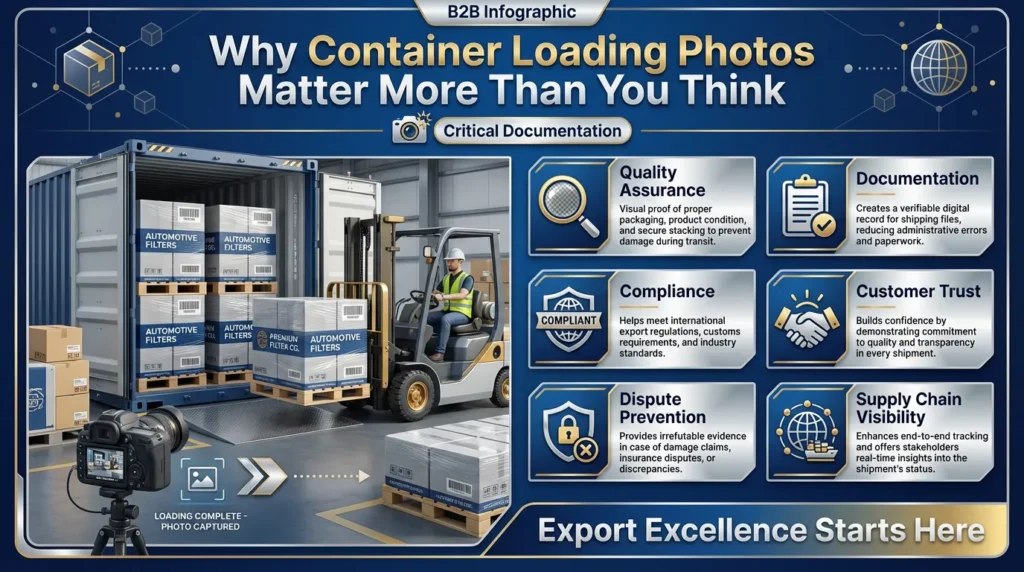
Many suppliers send container loading photos as a “nice update” on shipment day.
For us, container loading photos are part of quality control. 📸🚢
Not only for us as the factory.
Also for our distributors, importers and logistics teams.
Done properly, loading photos are:
- QC evidence
- A risk management tool
- A trust builder between factory and importer
In this article, we’ll explain why container loading photos matter more than most people think, and how we use them to:
- Provide proof of correct product and quantity
- Show evidence of packing quality at origin
- Visually check space utilisation and stability
- Support customs, insurance and internal audits
- Build transparency and trust with your team
- Drive continuous improvement together with partners
If your current suppliers only send 1–2 random photos (or none at all), you might be missing important signals and protections in your supply chain.
Proof of Correct Product and Quantity in Container Loading Photos ✅
(Seeing What Was Really Loaded Before the Doors Close)
Before the container doors are closed, we treat loading photos as a final visual verification.
Instead of just snapping one blurry picture of a half-loaded container, we systematically capture:
- Clear photos of labels on pallets and cartons
- Showing part numbers
- Brand
- Quantity
- PO or lot numbers where relevant
- Visible identification for key SKUs
- We zoom in on main items so part numbers and branding are readable.
- Overall view of how many pallets and loose cartons were loaded
- Full container overview from different angles.
1.1 Catching Issues Before the Vessel Sails
Why is this important?
Because if something looks wrong at the loading stage, it’s still possible to stop and correct it:
- Wrong SKU on the pallet
- Missing pallet
- Incorrect labelling or branding
- Mixed goods that should be separated
Finding out at destination is expensive and slow.
Finding out from a photo at origin is much cheaper and faster.
1.2 Evidence for Distributors: Right Goods, Right Labels
For you as a distributor or importer, these loading photos are evidence that:
- The right SKUs were prepared
- Branding and labels match your requirements
- What is being shipped matches the packing list and PO
When your purchasing or logistics team sees:
- Clear, readable labels
- Logical pallet layout
- Full overview of loaded quantity
they know that goods were physically prepared and loaded according to plan, not just “promised” on paper.
Evidence of Packing Quality at Origin in Loading Photos 📦
(Baseline for Damage, Moisture and Handling Claims)
When a box arrives crushed or wet, the usual comment is:
“It must have happened on the way.”
But without evidence of how the goods looked at origin, it’s hard to know:
- Did the damage start in the factory?
- In the warehouse?
- During stuffing at port?
- During transit or at destination?
2.1 What We Document About Packing Quality
Our container loading photos give a baseline of packing quality at origin. We record:
- Condition of cartons at origin
- Are they clean, dry, not deformed?
- Any visible damage before loading?
- Stretch film and wrapping
- How tightly pallets are wrapped
- Whether wrapping goes high enough and covers the load properly
- Corner protectors and pallet protection
- Whether corner boards or edge protectors are used
- How the bottom and top layers are protected
- Pallet height and stability
- Are pallets within agreed height limits?
- Does the load look stable or leaning?
- Use of moisture proof covers or not
- Plastic top cover, liners, desiccants where applicable
2.2 How This Supports Root Cause Analysis
If a claim is needed later, loading photos help determine:
- If cartons were already weak or poorly wrapped at origin
- If height or stacking was excessive
- If moisture protection measures were taken
- Whether damage likely started in the factory, at the port, or at destination
This matters when you need to:
- Talk to your insurance company
- Discuss with freight forwarders or carriers
- Review with your own team what went wrong
Photos give a clear baseline to compare against the condition at arrival.
Visual Check of Space Utilisation and Stability Inside the Container 🧱
(Reducing Movement, Void Spaces and Crushing Risk)
A container is more than just a metal box.
How you use the space inside has a big impact on damage risk.
That’s why we always document:
- How pallets are arranged in the container
- Whether there are large gaps or void spaces
- How loose cartons are blocked and braced
3.1 What We Look For in Space Utilisation
In our loading photos, we look at:
- Pallet arrangement
- Are pallets aligned properly?
- Are they stable and evenly placed?
- Gaps between pallets and container walls
- Large empty spaces can allow pallets to move during transport.
- Blocking and bracing
- Use of wooden blocks, airbags, or extra carton to fill gaps where needed.
- Loose cartons
- How they are stacked and secured if used to fill remaining space.
3.2 Why Container Layout Matters
Poor loading patterns can cause:
- Movement during sailing
- Leading to leaning stacks, crushed corners, or collapsed cartons.
- Over-stacking
- Heavy weight on bottom layers, causing deformation and product damage.
- Unstable loads
- Risky when doors are opened at destination or during inspection.
By reviewing our own loading photos, we can:
- Improve blocking and bracing for each product mix
- Adjust pallet patterns for different carton sizes
- Reduce empty spaces and dangerous “overhanging” areas
Over time, each lane and product combination gets a more optimised loading pattern, based on visual evidence and feedback.
Container Loading Photos as Support for Customs, Insurance and Internal Audits 📑
(When Something Goes Wrong, Memories Are Not Enough)
When something goes wrong in international trade, everyone asks for evidence:
- Customs may investigate
- Insurance may request proof
- Internal audit may review export processes
In these moments, memories are not enough.
You need objective records.
4.1 How Loading Photos Help With Insurance and Claims
Loading photos can support:
- Insurance claims for transit damage
- Showing condition and packing at origin
- Demonstrating that goods were properly secured and protected.
- Discussions with freight forwarders or carriers
- If there is evidence of rough handling, container falling, or other major incidents, photos help define responsibility more clearly.
- Disputes over short shipment or missing pallets
- “Were 18 pallets really loaded or only 16?”
- Full-container photos with pallet counts create an audit trail.
4.2 Photo Archive for Internal Quality and Compliance
For some partners, we maintain a photo archive linked to each shipment, including:
- PO number
- Container number
- Loading date
- Relevant loading photos
This makes tracing much easier months later when:
- A specific shipment is questioned
- An audit checks export control procedures
- A customer complaint is being investigated
Internally, these photos are also valuable for:
- Quality audits on export packing and loading procedures
- Training new staff in logistics and QC
- Consistent implementation of best practices across different shipments
Transparency That Builds Trust With Your Purchasing and Logistics Team 🤝
(Showing Reality Instead of Only Sharing Words or Spreadsheets)
For your purchasing and logistics colleagues, container loading photos are a simple but strong signal.
They show:
- The shipment is really ready, not just promised.
- Goods are physically loaded into a container.
- The supplier is not hiding the real situation.
5.1 Why Loading Photos Reduce Anxiety
During sensitive situations like:
- Peak season (Q4 and Chinese New Year)
- New cooperation with a supplier
- First orders after a complaint or quality issue
anxiety levels are naturally higher.
Your internal stakeholders may think:
- “Is the order really ready?”
- “Will they ship on time?”
- “Did they listen to our packaging feedback?”
When we provide detailed loading photos, your team can see for themselves:
- Pallets with your labels and branding
- Cartons packed and wrapped correctly
- Container doors sealed after loading
Sometimes a few good photos are worth more than a long email full of words.
5.2 Creating a Culture of Openness
Regular loading photos help build a culture of openness and transparency between factory and importer:
- No mystery about what was shipped
- Clear view of efforts on packaging and loading
- Visual confirmation that standards are being followed
Over time, this increases trust, which allows both sides to:
- Move faster on new projects
- Spend less time arguing about basic facts
- Focus on improvement rather than suspicion
Continuous Improvement Together With Partners Using Loading Photos 🔁
(Making Each Container Look a Bit Better Than the Previous One)
We don’t just send loading photos and forget them. 😅
We use them to improve.
With key distributors, we often:
- Review loading photos on early shipments
- Receive feedback on what looks risky from their perspective
- Adjust our procedures based on real-life outcomes
6.1 How We Use Loading Photos for Joint Improvement
Together with partners, we may:
- Adjust pallet height
- If they see repeated compression or issues in their warehouse, we lower or reconfigure pallets.
- Modify pallet layout
- Change the number of cartons per layer, or how layers are arranged.
- Improve dunnage and blocking
- Add more blocking where movement is observed.
- Add extra protection where they see risk
- Extra corner protection, top boards, or plastic covers.
We treat loading photos as a shared tool:
- You bring your field experience from destination
- We bring our experience from origin and other routes
- Together we define better standards for your shipments
6.2 The Goal: Continuous Incremental Improvement
Our philosophy is simple:
The next container should always look a bit better than the previous one.
By documenting each shipment with photos and reviewing them over time, we:
- Reduce repeat mistakes
- Standardise best practices
- Adapt to new routes or new product mixes
This is how container loading photos become more than “marketing material”. They become part of a continuous improvement system in export logistics.
Container Loading Photos as a Strategic Tool in Your Supply Chain 🎯
To summarise, container loading photos are not just a “nice to have” update for social media.
When used properly, they are:
- QC evidence
- Proof of correct product, quantity and packaging at origin.
- Risk management tool
- Baseline for claims, root cause analysis and insurance discussions.
- Trust builder
- A clear window into what is really happening at the factory and warehouse.
If your current suppliers only send:
- 1–2 random photos taken from far away
- Or no photos at all
you might be missing:
- Early detection of packing or loading issues
- Useful documentation for claims and audits
- A powerful way to align internal teams on what was actually shipped
We believe that systematic, structured loading photos are an essential part of modern export quality control, especially for long distance shipments of automotive filters and other sensitive products.
Want a Simple Checklist of What We Always Capture in Our Loading Photos?
With partners, we use a simple container loading photo checklist to ensure consistency from shipment to shipment. It covers:
- Labels and identification on pallets and cartons
- Overview of total pallets / loose cartons
- Condition of cartons and wrapping at origin
- Blocking, bracing and space utilisation inside the container
- Door sealing and container number
If you’d like a copy of this checklist, we can share it and help your team:
- Standardise how you request loading photos from your suppliers
- Evaluate the quality of packing and loading more systematically
- Build your own internal archive for logistics risk management
Contact Our Team
Bruce Gong – Key Account Manager, Beling Filters
Email: bruce.gong@belingparts.com
WhatsApp: +86 150 5776 4729
LinkedIn: www.linkedin.com/in/brucegong-beling
We’re happy to walk you through how we integrate container loading photos into our export process and how you can use similar practices with all your suppliers.