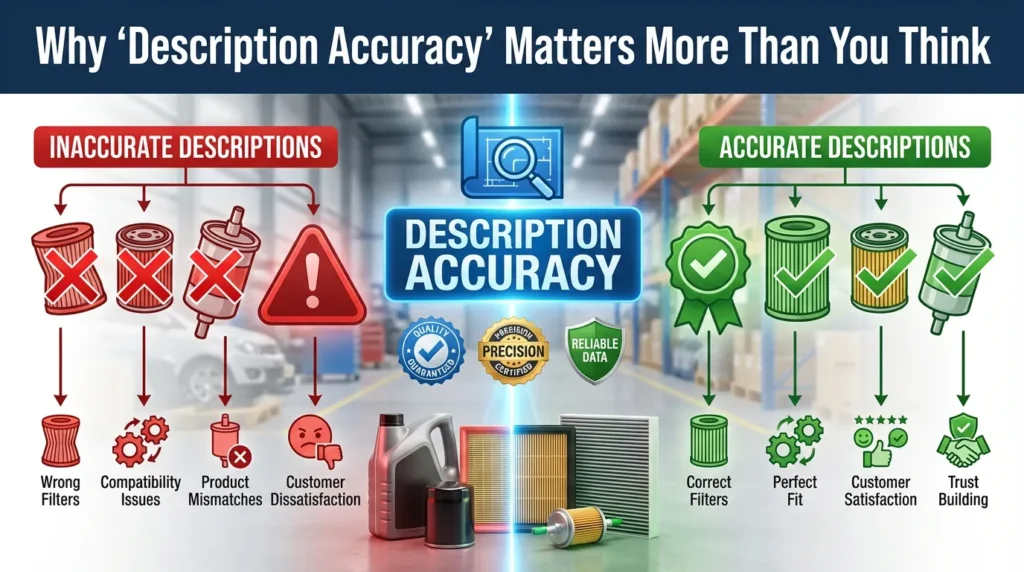
Many shipment problems don’t start with price.
They start with words.
More specifically, with how your product is described across:
- Commercial documents
- Shipping labels
- Warehouse systems
- Catalogs and data sheets
In global trade, words move before containers.
Customs, banks, warehouses, mechanics and end users all meet your product first through description.
If the description is vague, misleading or inconsistent, everything after is at risk:
- Customs checks and delays
- Misclassification and duty issues
- Warehouse confusion and wrong picking
- Wrong parts sold to end customers
- Claims, returns and brand damage
At Beling Filters, after exporting automotive filters to 30+ markets, we treat description accuracy with the same seriousness as:
- HS codes
- Packing details
- Certificates and CO
- Compliance declarations
This article explains:
- Why description accuracy for customs clearance reduces risk
- How product description consistency for importers and warehouses prevents headaches
- Why catalog and data quality for automotive filters protects end customer trust
- Our simple internal test: “would a stranger understand this description?”
- How we create standardised product descriptions for filter exports
- A practical checklist for product and shipment descriptions in global trade
Description Accuracy for Customs Clearance: Clarity = Less Suspicion 🛃
(How Good Descriptions Support HS Code and Smooth Clearance)
Customs doesn’t know your business.
They don’t know your quality.
They don’t know your reputation.
They only see:Your commercial invoice
- Your packing list
- Your Certificate of Origin
- Your HS codes and product descriptions
If your product description is:
- Too general
- Too short
- Too marketing-style
- Or inconsistent with the HS code
customs becomes suspicious.
1.1 Typical Risks of Poor Descriptions for Customs
When descriptions on documents are vague or confusing, customs may:
- Question the HS code
- Example: HS code for automotive parts, but description just says “spare parts” with no detail.
- Order extra inspections
- Physical checking of cartons, opening boxes, testing samples.
- Perform duty reassessment
- Reclassify your goods into a different HS code with higher duty.
- In some cases, demand back-duties for past shipments.
Each of these means:
- Delays in clearance
- Extra costs
- A “red flag” feeling about your shipments
1.2 How We Describe Automotive Filters for Customs
For our filter exports, we describe products in a way customs can understand, not just in a way that sounds nice to marketing.
We focus on:
- Product type
- Main use / application
- e.g., for passenger cars, for trucks, for engine intake system, for cabin air
- Material when relevant
- e.g., non-woven synthetic media, paper media, metal housing
- Correct HS background
- The description supports and matches the HS code classification logic.
Example style (simplified):
✅ “Automotive air filter, for passenger cars, non-woven synthetic media, for engine intake system.”
Not just:
❌ “Auto parts”
❌ “Filter”
The more your description looks like “I’m hiding something”, the more attention you attract from customs.
The more your description looks clear and technical, the easier it is for customs to classify and release.
Product Description Consistency for Importers and Warehouses 📦
(One Product, One Identity Across Documents, Labels & Systems)
Description accuracy is not only a customs issue.
It is also a daily operational issue for importers and distributors.
When documents and labels are not aligned, importers pay the price.
2.1 What Happens When Descriptions and Codes Don’t Match
Common problems when descriptions, codes and labels are inconsistent:
- Warehouse cannot identify items quickly
- Carton labels show one code, invoice shows another, ERP has a third name.
- ERP or barcode system doesn’t match reality
- System description doesn’t match what is printed on the box.
- Staff are unsure if they are scanning the right item.
- More claims and returns
- Wrong product shipped because of internal confusion.
- Customers receive items that don’t match their PO description.
- Time wasted reconciling “which code is which?”
- Operations and customer service teams spend hours matching Excel lists, photos and labels.
All of this creates hidden cost and hidden stress in the importer’s daily work.
2.2 Our “One Product, One Identity” Approach
To reduce these headaches for our partners, we keep naming and codes consistent across all touchpoints:
- PI / proforma invoice
- Commercial invoice / packing list
- CO / certificates and test reports
- Carton labels and product labels
- Catalogs and Excel price lists
The goal is simple:
Your team sees one product, with one clear identity.
- Same name
- Same internal code
- Same cross reference
- Same description logic
This consistency sounds basic, but it removes a lot of daily friction for importers:
- Faster receiving and put-away in the warehouse
- Fewer questions from accounting and purchasing
- Easier integration with ERP or WMS systems
- Less time spent on “description translation” between supplier and importer
Catalog and Data Quality for Automotive Filters 🧰🚗
(How Description Accuracy Affects End Customer Trust)
Description accuracy is not just for customs and warehouses.
It reaches all the way to the mechanic in the workshop and the end driver.
When catalog or label descriptions are wrong or vague, this is what happens on the ground:
- ❌ Wrong part being sold at the counter
- ❌ Mechanics losing time trying to install the wrong filter
- ❌ End users losing trust when the part “doesn’t fit” or fails early
This is expensive, not only in:
- Return shipping
- Credit notes
- Replacement costs
but also in reputation:
- Mechanics may stop recommending your brand.
- Distributors may shift more orders to a competitor with more reliable data.
- Online reviews may reflect frustration with “wrong parts in catalog”.
3.1 How We Structure Catalog and Data Sheet Descriptions
In our filter catalogs and data sheets, we focus on practical clarity:
- ✅ Clear cross reference
- OEM numbers and competitor references mapped accurately to our filter codes.
- ✅ Correct vehicle application
- Model, engine, year, and application clearly listed to avoid confusion.
- ✅ Honest technical details
- Filter type, media, dimensions, and performance information described realistically.
When mistakes are found, we:
- Update the digital catalog / data sheet
- Communicate with partners about corrections
- Avoid leaving old, wrong information online
Because in technical trade:
Every wrong description creates doubt in every right one.
Protecting data quality is protecting brand trust.
Our Internal Habit: “Would a Stranger Understand This Description?” 🧠✍️
(A Simple Test Before We Finalise Product and Shipment Descriptions)
To keep our descriptions clear and useful, we use a very simple internal test:
“Would a stranger understand it?”
Before we finalise a product or shipment description, we ask:
- If someone outside filters read this, could they understand what it is?
- If customs saw only this line, could they classify it without guessing?
If the answer is “maybe not”, we rewrite.
4.1 What This Habit Changed in Our Writing
This habit has changed how we write:
- ➡️ Less jargon
- We reduce internal technical slang that only our factory understands.
- ➡️ More clarity
- We include the basic elements customs, warehouses and buyers need.
- ➡️ Fewer misunderstandings
- Fewer questions from buyers asking “what exactly is this part?”
- Fewer corrections requested by customs or brokers.
In global trade, description lines are often the first contact between your product and:
- Customs officers
- Warehouse receivers
- Mechanics and parts staff
- End users reading labels or online listings
If the words are wrong, everything after is at risk.
We prefer to fix the description before the container moves, not after the problem appears.
Standardised Product Descriptions for Filter Exports 📋
(A Practical, Repeatable Structure for Documents, Labels & Catalogs)
Over time, we’ve built a standard structure for describing our filters across the whole export chain.
5.1 Product Description Structure (Technical & Customs-Friendly)
For each filter code, we keep a structured description that can be reused across:
- Invoice and packing list
- CO and certificates
- Labels and tags
- Catalogs and Excel lists
Typical elements:
- Product type
- Vehicle / system application
- e.g., “for passenger cars”, “for light commercial vehicles”, “for engine intake system”, “for cabin ventilation”
- Key material features (when relevant for understanding)
- e.g., “non-woven synthetic media”, “cellulose paper media”, “metal housing”, “plastic end caps”
- Optional technical or compliance note
- e.g., “for aftermarket use”, “non-OEM branded”, “for internal combustion engines”
This allows us to create descriptions that are:
- Detailed enough for customs and warehouses
- Clear enough for non-technical staff
- Stable enough to be used across systems without constant rewriting
5.2 Description Consistency Across All Export Documents
We then make sure that one core description is reflected consistently:
- In PI and commercial invoice
- On the packing list (especially if buyers use it as receiving reference)
- In the Certificate of Origin and other certificates
- On carton and product labels
- In catalog and data sheets
- In Excel lists shared with importers for ERP upload
This reduces:
- Typing errors
- Translation differences between departments
- Confusion when comparing documents during customs clearance
Checklist for Product and Shipment Descriptions in Global Trade ✅
(What to Review Before You Confirm Documents, Labels & Catalogs)
To make description accuracy actionable, we use a simple internal checklist for product and shipment descriptions in global trade. Before confirming a description in PI, labels, or catalogs, we ask:
- Does the description match the HS code logic?
- Would a customs officer see a clear link between description and HS classification?
- Is this description identical (or compatible) across documents?
- PI, invoice, packing list, CO, labels and catalog: same core wording and code?
- Can warehouse staff identify the product using this description?
- If they only saw the label and packing list, can they pick the right item?
- Would a mechanic or parts person sell the correct part using this description?
- Does it clearly indicate application, vehicle type, and key dimensions/features?
- Is there any vague or marketing-only wording that could confuse customs or systems?
- If yes, we replace it with technical but readable wording.
- Is this description future-proof?
- Can it be used in ERP, e-commerce, catalogs and compliance documents without constant rewriting?
By running each description through this checklist, we reduce:
- Customs delays
- Internal confusion
- Customer complaints
- Costly rework on documentation and data
Turn Description Accuracy Into Your Advantage
Most companies focus on:
- Price
- Lead time
- Packaging design
Fewer companies invest in description accuracy and consistency.
But for serious importers and distributors, the way a supplier handles descriptions can be a real differentiator:
- Faster, smoother customs clearance
- Less operational noise in the warehouse and ERP
- Lower risk of wrong deliveries and returns
- Higher confidence from mechanics and end users
At Beling Filters, we see description accuracy as part of our market access and risk management service, not just a cosmetic detail.
If you’ve ever had issues because of unclear descriptions in documents or catalogs, we’re happy to share how we standardise descriptions for our filter exports and adapt them to your systems.
Contact Our Team
Bruce Gong – Key Account Manager, Beling Filters
Email: bruce.gong@belingparts.com
WhatsApp: +86 150 5776 4729
LinkedIn: www.linkedin.com/in/brucegong-beling
In global trade, words move before containers.
Let’s make sure your words are working for you, not against you.