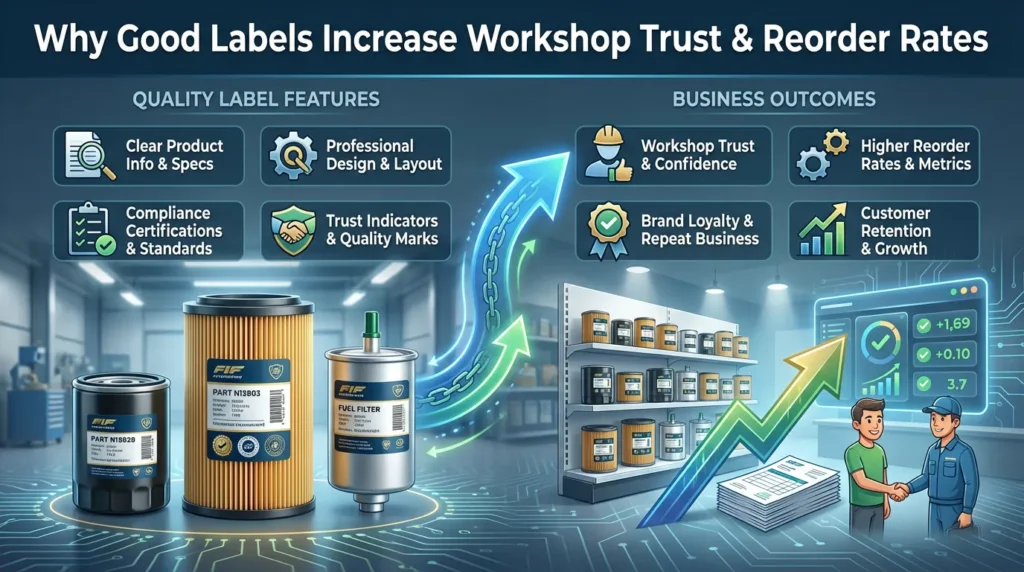
Many distributors invest heavily in box design – colors, graphics, premium finishes – but underestimate one simple component:
The label is what mechanics actually read, scan, and remember
on the shelf, at the counter, and during reordering.
In daily workshop reality, the label is often more important than the box artwork. It is the touchpoint that connects:
- The physical filter on the shelf
- The mechanic’s workflow during service
- The distributor’s ERP and reordering process
From what we see in Europe and Middle East markets, good labels directly affect:
- Workshop trust in the brand
- How fast and accurately they can reorder
- How often they choose your brand vs. a competitor
This article explains why label quality is not “cosmetic”, but a commercially critical part of your automotive filter packaging – especially for private label brands.
Fast Identification on the Shelf: Less Frustration, More Loyalty
Workshops are busy environments. Mechanics and parts advisors don’t have time to fight with confusing packaging or tiny codes.
A good filter label makes it immediately clear:
1.1 Why Fast Identification Matters
In real life, a mechanic:
- Opens a shelf or drawer filled with different brands and part numbers
- Quickly scans for the correct part
- Needs to pick the right box on the first try
If your label is:
- Clear
- Large
- Easy to read at a distance
they can:
- Find the correct part faster
- Make fewer picking mistakes
- Feel that your brand is “easy to work with”
This positive experience has a direct impact:
When mechanics feel less friction working with your brand, they are more likely to ask for it again.
1.2 What We See in Europe & Middle East Workshops
In both regions, mechanics often complain about:
- Very small, lowcontrast part numbers
- Labels placed only on one side of the box – often the wrong side for their shelf layout
- Too much text and not enough clear hierarchyof information
Workshops solve this themselves by:
- Writing the part number by hand on blank spaces
- Adding their own stickers
- Avoiding brands that are “hard to read”
1.3 How Beling Designs Labels for Fast Identification
We design labels to support real daily usage:
- Large, highcontrast part numbers
- Logical placement:
- Visible on the shelf side
- Plus on the topfor boxes stacked flat
- Simple, clear naming in relevant language(s)
- Short descriptions instead of long, complex wording
This might look like a small detail, but across thousands of boxes and years of use, it directly impacts how mechanics feel about your brand.
Professional Label Look = Higher Trust in Filter Quality
You can have excellent filters inside the box – but if the label looks bad, the workshop gets a different message.
Common label issues that hurt brand perception:
- Faded or uneven printing
- Misaligned barcodes or logos
- Spelling errors in product or brand names
- Messy, overloaded layouts
Mechanics see this daily and think:
“If they don’t care about the label, did they really care about the filter?”
2.1 How Label Quality Signals Brand Quality
A clean, precise, consistent label communicates:
- This brand is organized and serious
- They likely have good quality controlbehind the product
- If something goes wrong, it will be traceable and handled professionally
Price and margin still matter, but visual professionalism influences:
- Which box the mechanic reaches for first
- Whether they trust your brand for more critical applications
- Whether they feel comfortable recommending your filters to customers or fleet managers
2.2 Matching Label Style to Brand Position
Label style should match your private label’s positioning:
- Economy line
- Simple, clean layout
- No unnecessary complexity
- But still neat and correctly printed
- Midrange / value line
- Balanced design with clear branding
- Professional look without expensive effects
- Good readability and structure
- Premium line
- Very precise printing and alignment
- Finer typography and spacing
- Possibly extra details (icons, structured layout, multilingual clarity)
2.3 How Beling Supports Professional Label Design
For private label projects, we help you:
- Use consistent fonts, spacing and alignmentacross all SKUs
- Avoid “overloaded” labels full of small text, random codes, or decorative elements that look cheap
- Align label style with your chosen economy / mid / premiumpositioning
This way, your labels visually support the story your sales team tells about the brand.
Clear Part Numbers & Barcodes: Making Reordering Easy
In the real aftermarket world, reordering often starts from a used box on the workshop bench.
Typical workflow:
- The mechanic finishes the job, keeps the empty box.
- They read or scan the part number from the label.
- They call, message, or submit an order to the distributor: “Send me this one again.”
If the label is:
- Hard to read
- Missing key information
- Or confusing (multiple similar codes, no clear “main” part number)
then:
- The workshop may switch to another brand that is simpler to reorder
- Your sales or customer service team spends extra time clarifying and correcting orders
3.1 How Good Labels Help Reordering
Good labels support smooth reordering by:
- Having one clear primary part number– prominently displayed
- Using standard barcodes(EAN/GTIN or agreed internal codes)
- Leaving space for customer’s own labelsif the distributor wants to add:
- Their internal codes
- Pricing or stock location info
3.2 Integrating with Wholesaler Systems
Wholesalers in Europe and increasingly in the Middle East:
- Use warehouse scanners
- Integrate supplier barcodes into their ERP systems
- Rely on quick scans to:
- Receive goods
- Adjust stock
- Pick and pack orders
If your labels are not scannerfriendly – wrong size, low contrast, bad positioning – this creates friction and errors.
3.3 How Beling Designs for Reorder & System Integration
We typically:
- Define part numbering logic together with the customer:
- Simple, logical structure
- Room for future expansion
- Standardize barcode position and size:
- Same place on every label
- Within scannerfriendly dimensions
- Make labels compatible with warehouse scanners and ERP systems:
- Proper contrast and background
- No overlapping graphic elements behind the barcode
This makes it easier for both workshops and distributors to keep choosing and stocking your brand long term.
Traceability on Labels: Building Confidence When Problems Occur
In the automotive aftermarket, problems can happen with any brand – the real difference is how they are handled.
Without proper label information, even a small issue becomes a big headache.
With the right information on the label:
- Batch or production date code
- Factory or internal production reference
- Clear part number and brand
you can:
- Quickly trace back the production batch
- Check related test data and production conditions
- Provide the workshop with a serious, technical answer
4.1 How Traceability Improves Workshop Confidence
Consider two scenarios:
- Brand A: “We don’t know, just send info to the importer, maybe they will check.”
- Brand B: “We checked your box’s batch code in our system, identified the lot, retested reference samples, and here’s what we found.”
Mechanics and distributors notice this difference.
They think:
“This brand clearly knows what they’re doing. I feel safer using them again.”
Even if there was a problem, transparent, professional handling can increase longterm trust.
4.2 How Beling Integrates Traceability into Labels
We build traceability into labels by:
- Integrating batch codes and internal IDsinto the label or box print
- Linking those codes to our production and quality records
- Ensuring codes are printed clearly and consistently, not hidden or illegible
This is critical for:
- Serious private label brands
- Customers dealing with fleets and large accounts
- Markets where warranty and claims are closely monitored
- MultiLanguage Labels & Icons: Less Misuse, More Confidence
In Europe and the Middle East, many workshops are multilanguage environments:
- Mechanics and staff from different countries and language backgrounds
- Labels written only in one language can be partially understood or misinterpreted
5.1 How Icons and Short Text Help
A label that uses:
- Simple, universal icons(oil, air, fuel, cabin)
- Short, translated descriptions (where space allows)
- Clear arrows or markers for:
- Flow direction
- Installation orientation or position (when relevant)
helps avoid:
- Misinstallation (using the wrong filter type by mistake)
- Misunderstanding of the product’s purpose
When mechanics feel they fully understand what they are installing, they:
- Trust the brand more
- Are more comfortable recommending it to vehicle owners or fleet managers
5.2 Balancing Information and Clarity
The challenge is to:
- Provide enough information for correct usage
- Avoid overloaded labels that are crowded and hard to read
This balance is particularly important for:
- Cabin filters with directional airflow
- Diesel fuel filters with water separation features
- Heavyduty applications where wrong use can be costly
5.3 How Beling Designs MultiLanguage Labels
We help by:
- Choosing a small, consistent set of icons that are truly universal
- Preparing label templates with optional language fields:
- English + local language
- Or English + multiple European or Middle Eastern languages, depending on your market
- Keeping text:
- Short and direct
- With clear hierarchy: what the mechanic really needs to see first
This improves daytoday usability and reduces misuse and installation errors.
Label Consistency Across All SKUs: Stronger Brand Memory
A common problem in many private label or multisupplier ranges:
- Different label styles on similar products
- Moving positions of part numbers and barcodes
- Inconsistent logo sizes or colors
This confuses:
- Workshop staff
- Warehouse teams
- Even your own salespeople
6.1 Why Consistency Matters
Workshops and warehouses remember:
- The colorof the label or box
- The typical layoutand where key information sits
- The part number patternyour brand uses
When every label follows the same logic, your brand becomes:
- Easier to recognize on shelves full of competitors
- Easier to stock and find quickly
- Easier to recommend (“We like this brand, it’s always easy to work with.”)
6.2 How Beling Standardizes Label Families
We work with private label clients to:
- Create a label family that works across all product types:
- Oil
- Air
- Fuel
- Cabin
- Possibly heavyduty vs light vehicle
- Define fixed areas for:
- Logo
- Primary part number
- Barcode
- Secondary text / cross references
- Allow variations only where truly necessary:
- Special lines (e.g. heavyduty or premium)
- Additional regulatory info for certain markets
This consistency makes your brand feel strong and reliable, not like a mix of different random suppliers.
From “Sticker” to Sales Tool: Labels as a Commercial Asset
When you look at all these factors together, a label is clearly not just a sticker.
A good automotive filter label is:
- A navigation toolfor the workshop
- A data pointfor ERP and ecommerce systems
- A trust signalfor your brand’s quality and professionalism
7.1 Commercial Benefits of Good Label Design
When done right, good labels:
- Reduce picking errors and incorrect installations
- Decrease returns and claims caused by confusion
- Make reordering simpler and fasterfor workshops and distributors
- Strengthen workshop confidence to keep choosing your brand over competitors
In competitive markets like Europe and the Middle East, these factors can make the difference between being:
- Just another “cheap box”, or
- A preferred working brandfor mechanics
7.2 How Beling Integrates Labels into the Private Label Workflow
At Beling, when we develop private label projects, label design is always a dedicated step, not an afterthought.
We align labels with:
- Your target markets(Europe / Middle East and their language needs)
- Your warehouse systems(barcodes, batch codes, part numbering)
- Your brand positioning(economy / mid / premium)
The goal is that every filter you sell is:
- Easy to find
- Easy to trust
- Easy to reorder
If you are building or upgrading your own filter brand and want to turn labels from “just a sticker” into a real sales tool, we can walk through the label concept and structure with you step by step.
Beling – Save Your Time & Cost
Your valuable automotive filter partner since 2008.
Contact Our Team
Bruce Gong – Key Account Manager, Beling Filters
Email: bruce.gong@belingparts.com
WhatsApp: +86 150 5776 4729
LinkedIn: www.linkedin.com/in/brucegong-beling
We’re happy to walk through your current shipping pattern and see where moving from LCL to FCL (or structuring a mix of both) can protect your margin and your reputation.