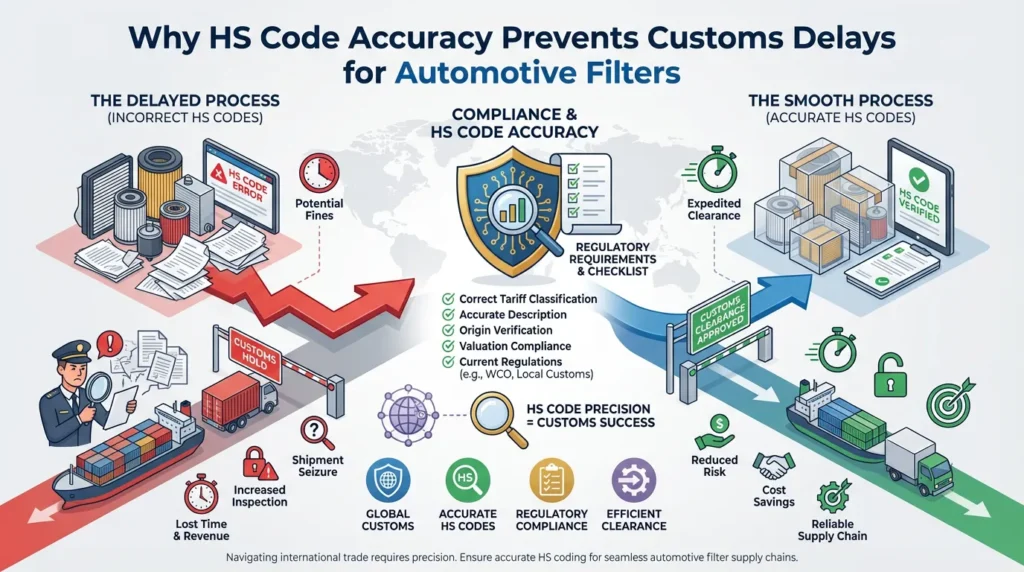
Most people see HS codes as “just paperwork”.
Customs authorities see them as a risk filter.
For automotive filters, wrong HS classification can instantly create problems:
- Delays at port while customs “takes a closer look”
- Extra inspections and document requests
- Unexpected duties and tax adjustments
- In serious cases: fines, re-classification, and damaged compliance history
At the same time, automotive filters are not always as simple as “one HS code fits all”.
Different product types can fall under different subheadings, and some markets interpret them in their own way.
Each of these can be classified differently depending on material, function, and local customs practice.
At Beling Filters, we treat HS codes as part of supply chain planning, not a last-minute box to tick.
Below is how we structure our HS code process for automotive filters across 30+ export markets.
HS Code Accuracy and Automotive Filter Customs Risk
Many importers only realise how important HS code accuracy is after they face:
- Containers held at port for “clarification”
- Goods re-classified into a higher duty category
- Retroactive duty payments and penalties
For automotive filters, this risk is higher because:
- Different filter types (air, cabin, oil, fuel) are not always treated the same
- Some markets apply more detailed national subheadings
- Customs officers pay special attention to automotive parts due to frequent misdeclarations
By handling HS codes systematically, we help partners:
- Reduce the chance of delays and re-checks
- Keep their duty planning predictable
- Build a good compliance track record with local customs
Starting HS Classification for Automotive Filters from the Destination Market
Instead of starting from “what we used before in China”, we start from the destination country and the importer’s existing practice.
This is the foundation of our approach to automotive filter HS code planning.
When a new customer starts a project, we first ask:
- Which country/region are you importing into?
- Have you used any HS codes previously on your side?
- Did you ever receive customs notes or objections about HS codes?
This gives us:
- Visibility of their current classification practice
- A sense of how local customs interprets automotive filter codes
- Early warning if there were previous problems we should avoid repeating
If they already have an HS structure approved by their customs or tax advisor, we do not blindly force “our standard”. We analyse and discuss it.
One of the biggest mistakes is to assume that all automotive filters use the same HS code in every market.
In reality, HS classification for filters can be more nuanced.
For each project, we separate filter types:
And then we:
- Check typical HS codes used by major import markets
- Compare those with the importer’s own HS coding, if they have one
- Identify where there is alignment and where there are differences
If our standard experience and the customer’s existing code differ, we do not simply say “our way is correct”. Instead, we:
- Explain the options
- Outline potential risks of each classification
- Encourage customers to confirm with their local customs broker or tax advisor
Our role is to bring:
- Our practical export experience for automotive filters
- The patterns we see across 30+ markets
- Transparency about the potential impact of each HS choice
Using Packing List and Invoice to Support Automotive Filter HS Code Logic
Correct HS codes are only part of the story.
If the documentation does not support the logic, customs can still question it.
We ensure invoice and packing list are aligned with the HS code documentation for filters.
4.1 Clear Product Description for Filters
We make sure that:
- The product description matches the HS code logic
- Example: distinguishing “automotive air filter” from “general industrial filter” if relevant
- Filters are grouped clearly by type (air/cabin/oil/fuel) in the documentation
- HS codes are not randomly mixed in one line that covers multiple product types
This approach:
- Makes your shipment look transparent and well-structured
- Helps customs officers understand quickly what is in the container
- Reduces the chance of “please explain” queries from customs
Learning from Customs HS Code Feedback Across 30+ Markets
We do not treat every shipment as an isolated event.
We actively collect and learn from customs HS code feedback.
Over time, we build a practical, real-world database that includes:
- Cases where customs requested re-classification of automotive filters
- Markets where certain HS codes tend to trigger more inspections
- Partners’ actual experience with duty rates and applied practice in their country
Instead of relying only on theoretical interpretation or one-country experience, we use:
- Actual clearance outcomes
- Comments from brokers, importers, and customs letters (where customers share them)
This helps us:
- Adjust our recommendations for sensitive markets
- Flag “higher risk” HS options for certain countries
- Improve our classification approach shipment after shipment
We do not give legal or tax advice; that stays with your local professionals.
But we bring pattern recognition and export context that is difficult to see from just one market.
Clear HS Code Communication with Importers Before Shipment
No importer likes surprises at the port.
To avoid this, we focus heavily on HS code communication before loading.
Before shipment, we always:
- Confirm the HS codes we plan to use on the documents
- Clarify how they will appear on the commercial invoice and packing list
- Ask if there are any special notes the customer wants us to add for customs
For example:
- Some importers prefer a very detailed description to match their internal classification file
- Some need particular wording requested by their broker or customs authority
- Some want HS codes separated by product group in a specific way
By aligning in advance, we reduce:
- Misunderstandings at customs
- Last-minute document amendments
- Clearance delays caused by confusion over classification
Less surprise at port = faster clearance.
HS Code Risk Management as Part of Automotive Filter Supply Chain Planning
For us, HS codes are not a side detail.
They are part of supply chain risk management.
When we plan a project with a distributor or brand owner, we consider:
- The main destination markets
- The filter mix (air / cabin / oil / fuel)
- The duty impact of different classification scenarios
- Past customs comments, if any
This allows us to:
- Highlight where HS codes might be contentious
- Suggest where it could be useful to pre-align with local customs or a broker
- Prepare documentation that supports your chosen HS logic from day one
With 30+ markets served, we have seen:
- Which document structures lead to smoother clearance
- Which HS decisions create repeated questions and holds
- How to present automotive filters in a way that looks clear, honest, and consistent
We are not trying to minimise duties at any cost.
We are trying to help you build a sustainable, compliant import structure that customs can accept repeatedly.
Work With a Filter Manufacturer That Understands HS Codes and Customs Practice
If you are importing automotive filters and have ever faced:
- Random customs delays over HS codes
- Requests for re-classification
- Confusion between air, cabin, oil, and fuel filter codes
- Inconsistent HS usage across suppliers and shipments
we can help you set up a more structured HS code logic for your filter program.
At Beling Filters, our export team:
- Works daily with air, cabin, oil, and fuel filter documentation
- Coordinates with partners across Europe, the Middle East, Latin America, Southeast Asia, and more
- Treats HS codes, descriptions, and packing lists as an integrated system
If you’d like, we can share a short HS code overview for filters that shows how we usually structure HS logic by filter type and region (for discussion with your local broker or advisor).
Contact Our Team
Bruce Gong – Key Account Manager, Beling Filters
Email: bruce.gong@belingparts.com
WhatsApp: +86 150 5776 4729
LinkedIn: www.linkedin.com/in/brucegong-beling
Let’s make your next container of filters easier to clear and more predictable to cost.