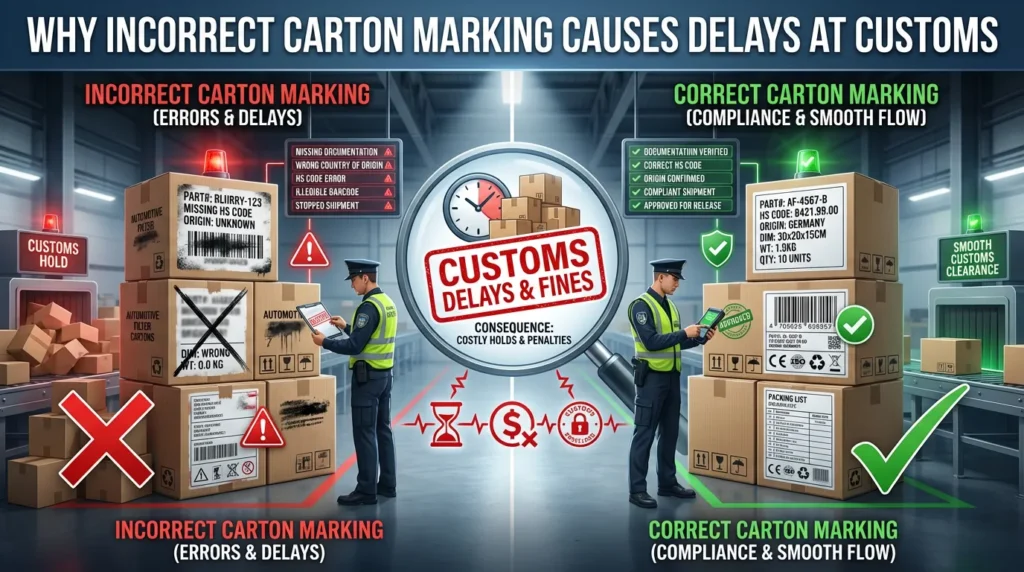
Many importers think customs mainly cares about:
- HS code
- Product value
- Country of origin
So carton marking looks like a minor detail.
Until a shipment is held because of it.
We repeatedly see the same carton marking problems:
- Carton marks not matching invoice / packing list
- Wrong or missing country of origin
- Mixed languages that confuse customs
- Old customer name or brand still printed on the box
- Shipping marks too vague or incomplete
For customs and warehouses, your cartons are the first touch point.
If what is printed on the box doesn’t match what is written in the documents, someone will ask questions.
Questions = time.
Time = delay.
In this article, we’ll cover:
- Document and carton inconsistencies at customs
- Origin marking requirements on filter cartons
- Shipping mark standards for filter shipments
- Our internal carton marking checklist for export filters
- How we help importers simplify and standardise carton markings
Document and Carton Inconsistencies at Customs 📦
(When Documents Say One Thing and Cartons Say Another)
A very typical delay scenario looks like this:
- Invoice: “Oil Filter – Brand X – Made in China”
- Carton: “Automotive Parts – Brand Y – No origin shown”
From a customs officer’s point of view, logical questions appear:
- Is it the same product described in the invoice?
- Which brand is the correct one – Brand X or Brand Y?
- If the box has no origin, can we trust the “Made in China” in the documents?
Even if nothing illegal is happening, the inconsistency itself is a risk.
1.1 How Customs Reacts to Mismatched Carton and Document Data
When customs sees a mismatch between:
- Carton marking
- Invoice description
- Packing list details
- Certificate of Origin
they may:
- Hold the shipment for clarification
- Request additional documents or explanations
- Decide to inspect cartons physically
- In tougher cases, question the declared origin or classification
All of this causes:
- Time lost at port
- Extra cost for storage or demurrage
- Frustration for importers and end customers
1.2 Aligning Carton Marks With Invoice and Packing List
To avoid these issues on our filter shipments, we:
- Align shipping marks with invoice and packing list
- The brand, product description, and origin visible on cartons correspond to what is written on the commercial documents.
- Use the same brand name and country of origin on all sides
- No mixing of old and new brand names.
- No different origin markings on different panels of the carton.
- Remove old designs when a brand changes
- When our buyer changes brand strategy, we update the artwork and make sure old-branded cartons are not re-used.
This makes the shipment look:
- Consistent
- Transparent
- Easier for customs and warehouse teams to verify
The more everything matches, the fewer reasons customs has to stop the cargo.
Origin Marking Requirements on Filter Cartons 🌍
(Origin Marking Is Not Optional)
Many markets are very sensitive about country of origin.
For automotive filters, this often means:
- “Made in …” must be visible on the carton
- Not only on documents – customs sometimes checks the physical box.
- Origin marking on the box must match CO and invoice
- If the Certificate of Origin says “China” but the carton says “Germany”, there is a serious problem.
- No double messages that confuse origin
- For example, creative phrases like “Designed in XX / Made in YY” used in a way that misleads or confuses customs.
2.1 Why Wrong Origin Marking Delays Filter Shipments
Incorrect or unclear origin markings can trigger:
- Origin verification
- Customs may ask for extra proof (production records, supplier declarations).
- Re-labeling requirements
- Importer has to fix origin marking at the port, which is slow and costly.
- Duty or preference issues
- If origin affects tariff treatment (e.g., FTA preferences), any doubt about origin can cause delays.
Even when the product is correctly made in a certain country, poor labeling can make customs unsure.
2.2 How We Handle Origin Marking on Cartons and Boxes
Our rule for filter packaging is simple:
- Confirm correct origin text with the buyer
- For example: “Made in China” vs “Manufactured in China” – we use wording that matches local practice and documentation.
- Print origin clearly on product box and master carton
- The same origin appears on the individual box and on the outer carton.
- Avoid creative wording that confuses customs
- We do not mix marketing phrases with origin in a way that could be misinterpreted.
This ensures that:
- Invoice, CO and packing list origin
- Product box origin
- Master carton origin
all tell the same story, reducing customs doubts.
Shipping Mark Standards for Filter Shipments 🚢
(Why Vague or Messy Shipping Marks Cause Problems)
Shipping marks like:
“Auto Parts – 1/500”
are easy to write, but they are not helpful when someone needs to:
- Count cartons
- Verify packing lists
- Check consistency for customs
For our automotive filter exports, we use structured shipping marks that help both customs and warehouses.
3.1 Problems With Vague or Messy Shipping Marks
When shipping marks are vague, customs and warehouse teams may struggle to:
- Quickly match carton numbers to the packing list
- Understand which customer or PO the shipment belongs to
- Verify whether all cartons are present and correct
This can lead to:
- Manual recount and re-check
- Longer handling time at port or warehouse
- Higher chance of misdelivery or missing cartons
3.2 What We Include in Carton Shipping Marks for Filters
For our filter shipments, we typically include:
- Customer code or PO number
- So warehouse and customs can see the link to the order.
- Brand and part number range
- Carton number
- Clearly printed: “Carton 1/250, 2/250, … 250/250”.
- Country of origin
- Consistent with all documents.
This helps:
- Customs to count and check faster
- Warehouse to receive, scan, and store faster
- Everyone to see that cartons match the packing list and invoice
Good shipping marks don’t cost much, but they save a lot of time and confusion.
Our Internal Carton Marking Checklist for Export Filters ✅
(What We Check Before Printing Cartons)
To avoid basic, avoidable mistakes, we use an internal carton marking checklist before we approve any design or new shipment markings.
4.1 Carton Marking Checklist for Filter Shipments
Before we release any carton design or confirm the shipping marks for a batch, we check:
- Does brand name = contract and invoice?
- The brand printed on the carton is the same brand on the PI, contract and invoice.
- Does origin = actual production and CO?
- The origin printed on the carton is the real manufacturing country and matches the Certificate of Origin.
- Do shipping marks = packing list data?
- Carton numbers, customer code, and descriptions line up with the packing list details.
- Any special language requirement (EU, Middle East, LATAM, SEA)?
- For example, Arabic in the Middle East, Spanish/Portuguese in LATAM, or specific label elements in EU and Southeast Asia.
If one answer is “not sure”, we:
- Stop
- Re-confirm with the customer
- Adjust the artwork or text before printing
4.2 Why This Checklist Matters
Incorrect carton marking doesn’t always block a shipment.
But when customs is already suspicious (because of HS, value, or other risk signals), bad marking can become the final reason to stop it.
Our checklist helps us and our buyers:
- Catch problems before printing and packing
- Avoid rework at port or at the warehouse
- Present a consistent, professional image to customs and customers
Correct markings cost almost nothing.
Wrong markings can cost days or weeks.
Simplifying and Standardising Carton Marks With Importers 🤝
(Using Templates to Reduce Everyday Mistakes)
Many carton marking issues come from lack of a clear standard between exporter and importer.
That’s why, with long-term partners, we use a carton marking template for filter shipments.
5.1 What Our Carton Marking Template Covers
A typical template will define:
- Standard position of brand, part range and logo
- Exact wording of origin (e.g. “Made in China”)
- Customer reference (PO number or internal code)
- Carton numbering format (e.g. “Carton 1/200”)
- Any language or regulatory text based on the destination region
Once agreed, this template is used:
- Consistently across repeat orders
- Updated only when brand, origin or regulatory requirements change
5.2 How This Helps Your Next Filter Shipment
If you have had delays because carton marks didn’t match your documents, we can:
- Review your current carton designs and shipping marks
- Compare them to your invoices, packing lists and CO samples
- Suggest a simplified, standard marking layout that fits your markets
We can also share the carton marking template we use with long-term partners and customise it to:
- Your brand
- Your destination markets (EU, Middle East, LATAM, SEA, etc.)
- Your internal codes and warehouse needs
This way, every new shipment starts from a proven, compliant marking standard instead of reinventing the format each time.
Need Help Fixing Carton Marking Issues on Your Filter Imports?
If your filter shipments have been:
- Delayed because cartons didn’t match the documents
- Flagged for unclear or wrong origin marking
- Slowed down by vague shipping marks and extra counting
we can walk through your next shipment together and:
- Check your current markings vs. documents
- Propose a clear carton marking standard
- Share a ready-to-use carton marking template that has worked for other importers
Contact Our Team
Bruce Gong – Key Account Manager, Beling Filters
Email: bruce.gong@belingparts.com
WhatsApp: +86 150 5776 4729
LinkedIn: www.linkedin.com/in/brucegong-beling
Customs will always check some shipments more closely than others.
But your cartons don’t have to be the reason they keep stopping yours.