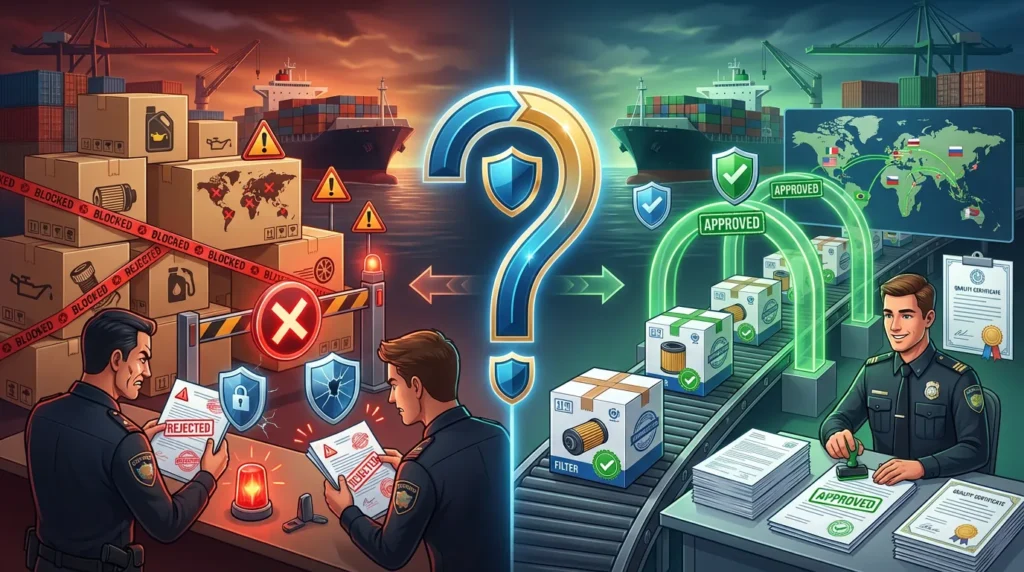
A rejected shipment is every importer’s nightmare.
You lose:
- Time
- Money
- Sometimes even the customer relationship
And in most cases, the problem is not the product itself.
It’s the details around the product:
- Wrong or vague HS code
- Missing or incorrect certificates
- Labeling that doesn’t follow local rules
- Invoices that don’t match the reality of the goods
- “Surprises” customs doesn’t like (undisclosed items, unclear descriptions, inconsistent values)
After years of exporting automotive filters to 30+ markets, we have seen the patterns behind shipment rejection and severe delays.
We used these lessons to build a disciplined process that helps our partners reduce the risk of containers being held, questioned, or rejected.
Below is how we approach this in a practical way.
Start From Destination Import Rules, Not Factory Habits
One major reason shipments get blocked is that exporters copy the same document style for every country.
But each market has its own:
- Customs sensitivities
- Required documents
- Labeling and packaging expectations
Our first principle is simple:
Start from destination rules, not from factory habits.
1.1 Key Questions Before the First Shipment
Before we ship filters to a new destination, we always ask the buyer:
- Which country and port will receive the goods?
- Different ports in the same country can have slightly different “ways of working”.
- Any previous issues with customs for similar products in that country?
- Holds, reclassification, extra inspections, or rejections.
- Specific documents your broker or customer requested?
- Sometimes the end customer (OEM, retail chain, or distributor) has their own documentation requirements.
This gives us a starting map of what customs and your partners expect.
1.2 Adjusting to Destination Requirements
Once we understand the destination, we:
- Adapt the document set (certificates, declarations, origin, etc.)
- Adjust invoice and packing structure to match local practice
- Clarify any additional papers needed (e.g., special declarations, product statements)
We avoid a “copy & paste” approach from another market, because what works for one country can cause serious trouble in another.
Document Consistency Is Non‑Negotiable
Customs officers do not know your company personally.
They only know what they see on paper and in the system.
If the story is confusing or inconsistent, the chances of:
- Extra questions
- Holds
- Reclassification
- Or rejection
go up immediately.
Our second principle:
Document consistency is non‑negotiable.
2.1 Aligning HS Code With Product Type
For automotive filters (air, cabin, oil, fuel), we ensure:
- The HS code corresponds to the actual product type
- The product description matches the logic of the HS classification
- If we know a particular HS code is sensitive in a country, we discuss options with the buyer (and their broker) before shipping
We do not “randomly pick” HS codes to save duties.
Short‑term savings can lead to long‑term problems with customs.
2.2 Making All Documents Tell the Same Story
We systematically align:
- Commercial invoice
- Packing list
- Certificate of Origin (CO)
- Quality / compliance certificates
Key points:
- Quantities match across all documents
- Descriptions are consistent (no “filter” on one document and “auto spare parts” on another)
- Incoterms and delivery terms are aligned everywhere
- Values and currency are clear and logical
If something looks confusing on paper, customs officers are more likely to say:
“Stop. We need to check this.”
A clean, consistent document pack makes your shipment look transparent and low‑risk.
Respect Local Labeling and Packaging Rules for Automotive Filters
Even when documents are correct, shipments can still be blocked or delayed for labeling and packaging issues.
Some countries pay particular attention to:
- Country of origin printed on the box & outer carton
- Language requirements on labels or manuals
- Barcodes, batch numbers, production dates, or expiry dates
Ignoring these details can cause:
- Goods being rejected at the border
- Goods being stopped at the destination warehouse
- Re‑labeling or re‑packing costs at destination
3.1 Country of Origin and Language Requirements
For automotive filters, we clarify:
- Whether “Made in China” or “Country of Origin: China” must be:
- On individual boxes
- On outer cartons
- On labels only
- Whether local language is required for:
- Application information
- Warnings or usage notes
- Technical details
Some markets are flexible; others are very strict. We check before mass packing, not when the container is already at the port.
3.2 Barcodes, Batches, and Traceability
For structured distribution and retail, we support:
- Barcodes (EAN/UPC/internal codes) in the format customers require
- Batch numbers or production codes to support traceability
- Production / packing dates where this is expected or required
This reduces stress at the destination warehouse and supports:
- Product recalls if ever needed
- Warranty and quality claims
- Stock management
By respecting labeling and packaging rules upfront, we help partners avoid costly rework and delays.
Proactive Compliance: REACH, RoHS and Quality Certificates
In regulated markets like the EU (and also in the UK and some others), compliance is not only about customs. It is also about chemical, safety, and quality regulations.
Shipments can be delayed or blocked when authorities or customers ask for proof of compliance and the importer cannot provide it.
Our fourth principle: Proactive compliance, not reactive excuses.
4.1 REACH and RoHS Declarations for Filters
For automotive filters going into the EU and similar markets, we support buyers with:
- REACH declarations
- Confirming that restricted substances are controlled or absent as required
- RoHS declarations (if relevant for the product scope)
- Showing that restricted substances are below the required thresholds
These declarations are based on:
- Our controlled material lists
- Supplier declarations and material safety data
- Lab test data where applicable
4.2 Quality Certificates and Lab Tests
To further support risk management, we provide:
- Quality certificates (e.g., ISO, IATF scope)
- Basic test reports or performance data where required
- Third‑party lab tests when requested by buyers or their customers
Handling this proactively means that when customs or a major customer asks:
“Can you prove that these filters comply with our rules?”
you are ready with clear documentation, not scrambling for last‑minute explanations.
Learning From Inspections, Delays and “Near Rejection” Cases
Even with a strong process, global trade always carries some level of risk. No exporter can honestly promise “zero issues forever”.
But you can choose:
- To treat issues as random bad luck, or
- To learn from every case and continuously improve
Our fifth principle: Learn from every close call.
Whenever a partner faces:
- Extra inspections
- Unusual delays
- A “near rejection” situation (where the shipment was at risk but finally released)
we don’t just say “it’s over” and forget it.
5.1 Building an Experience Database Across 30+ Markets
We record:
- What exactly happened
- Which document or detail triggered the problem
- How the customs officer, broker, or authority explained their reasoning
- What we changed to solve or prevent the issue
Over time, this becomes a practical experience database, not only theory.
For example:
- We learn which HS codes trigger more questions in certain markets
- We see which phrases in descriptions cause confusion
- We understand which certificates are more trusted by specific authorities
Then we adjust our process so the same issue is less likely to repeat:
- For that buyer
- For that destination
- Or in similar markets where rules are aligned
This is how we move from reactive problem-solving to proactive risk reduction.
A Structured Pre‑Shipment Process to Reduce Rejection Risk
Bringing everything together, we use a pre‑shipment structure that helps reduce rejection risk for our automotive filter exports.
- Destination Requirements
- Country and port confirmed
- Customer / broker specific document requirements reviewed
- HS Code and Description
- HS code aligned with filter type (air / cabin / oil / fuel)
- Descriptions clear, not vague or misleading
- Document Consistency
- Invoice, packing list, CO and certificates aligned
- Quantities, values, Incoterms and origin consistent
- Labeling and Packaging
- Country of origin on box/carton confirmed
- Language, barcode, batch/date requirements clarified and implemented
- Compliance Documents (if needed)
- REACH/RoHS declarations, quality certificates prepared
- Lab tests done if requested for that project or customer
- Final Review
- All files checked for logic and clarity
- Digital copies stored and easy to retrieve
6.2 Benefits for Importers
By following this structure, our partners enjoy:
- Fewer “surprise” questions from customs
- Lower risk of partial or full rejection
- Faster response when their customers ask for documents
No one can promise that customs will never inspect or question a shipment.
But a disciplined process can dramatically reduce the chances of:
- Cargo being rejected
- Costs escalating
- Relationships being damaged
Work With an Exporter That Treats Risk Reduction as a Process
If you’ve experienced:
- Shipments delayed without clear reasons
- Customs questioning your documents or HS codes
- Goods being held because of labeling or missing certificates
then you already know how painful and expensive these situations can be.
At Beling Filters, after exporting automotive filters to 30+ markets, we’ve built a systematic way to:
- Understand destination rules
- Keep documents consistent
- Respect local labeling requirements
- Support compliance proactively
- Learn from each “close call” and get better over time
If you’d like, we can share a short “pre‑shipment checklist” we use internally to avoid the most common rejection reasons.
Contact Our Team
Bruce Gong – Key Account Manager, Beling Filters
Email: bruce.gong@belingparts.com
WhatsApp: +86 150 5776 4729
LinkedIn: www.linkedin.com/in/brucegong-beling
Let’s make your next container of filters safer to ship and easier to clear.