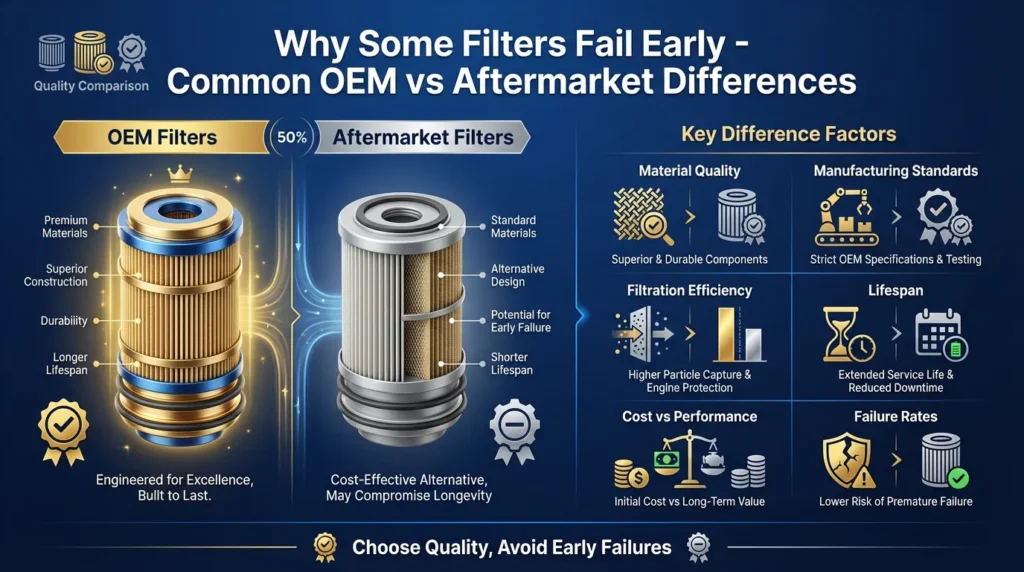
When an automotive filter fails early, it is rarely “bad luck.”
In most cases, the problem starts months before installation – in the design choices, material selection and quality control inside the factory.
For buyers who are:
- Building a private brand
- Sourcing aftermarket filters for distribution
- Expanding a filter program into new markets
understanding the real differences between OEM-level and low-end aftermarket filters is critical to avoid:
- Early failures
- Customer complaints
- Warranty costs
- Damage to your brand reputation
Beling has focused on automotive filters since 2008, supplying to:
- Europe
- Middle East
- Southeast Asia
and now expanding to the Americas, with:
- 32 million annual capacity
- IATF 16949 certification
This article explains how we look at early failure modes, where they come from, and how OEM vs aftermarket thinking leads to very different real-world performance.
Common Early Filter Failure Modes Seen in the Field
When filters fail early, it usually shows up at the workshop many months after production – but the root causes are in design and manufacturing.
Here are the most common failure modes we see.
1.1 Bypass Valve Opening Too Often or Too Early (Oil Filters)
What happens:
- The bypass valve opens at the wrong time or too frequently
- Oil circulates unfiltered for long periods
Root causes:
- Incorrect bypass opening pressure setting
- Poor spring material or design
- Weak valve components or sealing
Impact:
- Increased engine wear
- Microscopic damage over time
- Customers experience “engine wear” without clearly knowing why
In OEM designs, bypass valve behavior is carefully tuned to the engine and oil system. In low-end copies, it is often guessed or poorly controlled.
1.2 Media Collapse or Tear
What happens:
- Filter media collapses under pressure
- Media tears or cracks inside the element
Root causes:
- Media too weak for the application
- Poor resin impregnation and bonding
- Wrong pleat support (too large spacing, weak support core)
- Incorrect media choice for a long service interval
Impact:
- Contaminants bypass the media
- Direct engine wear or injector damage
- Early clogging and bypass valve activation
You rarely see this until a teardown or lab analysis, but it silently kills engine protection.
1.3 Seal or Housing Leakage
What happens:
- Oil or air leaks at the seal or housing
- Warning lights appear
- Pressure loss or unfiltered air bypass
Root causes:
- Poor rubber quality (gasket, seal, O-ring)
- Wrong hardness (too soft / too hard)
- Dimensional mismatch between filter and mounting base
- Bad crimping, potting or ultrasonic welding
Impact:
- Sudden failures (visible leaks)
- Micro leakage that leads to long-term contamination or pressure issues
Even if media is good, a weak seal or housing can turn the filter into no filter.
1.4 Excessive Restriction Early in Life
What happens:
- Filter shows high restriction soon after installation
- Vehicle performance drops
- Fuel consumption increases
- Driver feels the engine is “heavy” or “weak”
Root causes:
- Overly dense media without proper design
- Low effective filtration area (too few pleats, wrong pleat height)
- Wrong pleat geometry and spacing
- Media chosen only for cost, not flow performance
Impact:
- Poor driving experience
- Fuel penalties
- More frequent filter changes than expected
OEM designs balance efficiency + restriction; low-end designs often ignore the flow side.
1.5 Wrong Fit / Dimensions Out of Tolerance
What happens:
- Filter is difficult to install
- Gaps appear between gasket and mounting surface
- Vibration, noise, or micro-bypass occurs
Root causes:
- Poor or worn tooling
- Lack of dimensional control in production
- No testing on real vehicles, only rough size copying
Impact:
- Workshops struggle during installation
- Micro-bypass paths allow unfiltered air/oil/fuel to pass
- Long-term reliability issues
All these issues appear at the workshop, but they are created in the design, validation, and manufacturing stages.
OEM Design Philosophy vs Low-End Aftermarket – What’s Really Different?
OEM and serious aftermarket manufacturers do not think the same way as low-end “copy” producers.
Understanding this difference helps you evaluate suppliers more realistically.
2.1 Design Margin vs Minimum Cost
OEM parts:
- Designed with safety margins above the minimum requirement
- Validated for the full service interval under worst-case conditions
- Consider the whole system:
- Pump performance
- Engine type and clearances
- Temperature extremes
- Fuel and oil quality in target markets
Low-end aftermarket:
- Often reverse engineered from appearance only
- Focused on minimum cost:
- Thinner media
- Cheaper rubber
- Weaker springs and end caps
- Minimal or no full-life performance testing
For you as a buyer:
If a filter is “very cheap,” the key question is:
What has been removed or reduced to make it that cheap?
(Media basis weight? Rubber quality? Valve materials? Process controls?)
Cheap products usually mean reduced margins of safety, which becomes early failure risk in the field.
2.2 Media Selection and Service Interval Matching
OEM approach:
- Media is selected to match:
- Recommended service interval
- Engine requirements
- Operating environment
- For long oil change intervals, OEMs often use:
- Synthetic or composite media
- Higher dust holding and strength
Weak aftermarket approach:
- May use standard cellulose media even in long-interval applications
- Lower basis weight and fewer checks:
- Media loads up too fast
- Media breaks under pressure
- Efficiency drops quickly
Result:
- Filter clogs sooner → bypass valve opens → engine runs partially unfiltered long before the next service
- Or media suffers mechanical damage and starts letting particles pass through
At Beling, we match media type and basis weight to the:
- Vehicle type
- Intended service interval
- Market conditions
We do not use “one cheap solution for all” if it creates high failure risk for your brand.
2.3 Component Quality and Consistency
A filter is more than just media. Small differences in minor components can cause big differences in reliability.
OEM:
- Tight tolerances for:
- Bypass valves
- Anti-drainback valves
- End caps
- Seals and gaskets
- Strict material specifications for:
- Springs
- Rubber compounds
- Plastics and metals
- Stability tested under:
- High temperature
- Aggressive oil or fuel
Poor aftermarket:
- Cheaper springs:
- Wrong bypass opening pressure
- Inconsistent behavior across batches
- Inferior rubber:
- Hardening
- Shrinkage
- Swelling in contact with oil or fuel
- Weak end caps (e.g., low-strength plastic, cheap cardboard):
- Separation under pressure
- Leakage paths
This is why a filter that “looks similar” in photos or on a shelf can behave totally differently in the engine.
Where Early Filter Failures Are Really Created in the Supply Chain
Most early failures are not random; they come from gaps in validation and process control.
3.1 No Real Validation on the Car or Engine
Many copy-type aftermarket filters are checked only for:
- Overall dimensions (height, outer diameter, inner diameter)
- Thread compatibility
- Basic appearance
What is often missing:
- Real engine tests under:
- Correct pressure
- Correct flow rates
- Real operating temperature
- Durability testing for full service interval
Beling’s approach:
- Test fitment and installation on representative engines for critical references
- Validate:
- Pressure behavior
- Flow characteristics
- Temperature resistance
- Use feedback from European and Asian distributors and installers to:
- Improve weak points
- Adjust design where necessary
This OEM-style validation mindset sharply reduces hidden early failure risks.
3.2 Weak Process Control in Production
Even with a “good design on paper,” poor process control can still lead to failures.
Typical process-related issues include:
- Inconsistent pleat depth and spacing
- Incorrect curing of adhesives or potting compounds
- Unstable media quality from suppliers
- Poor crimping or welding:
- Loose end caps
- Leaky seams
At Beling, we manage this with:
- ERP/MRP integration for planning and traceability
- Material inspection team to check incoming media and components
- Defined QC checkpoints during production
- Trend analysis to catch defect patterns early
Our goal is to prevent:
- “Good sample, weak mass production” problems
- Customers discovering issues only after thousands of pieces are already in the market
OEM vs Aftermarket: Practical Checkpoints for Buyers
When you evaluate a supplier, you don’t need to be an engineer, but you should ask targeted questions to see how serious they are.
4.1 Design and Validation Questions
Ask:
- “How do you set bypass valve opening pressure – do you test it?”
- “Do you validate this part number for the full service interval on a real or simulated engine?”
You are looking for answers that mention:
- Specific test procedures
- Test benches or engine rigs
- Service interval simulation
Vague answers mean there is likely no structured validation.
4.2 Media and Service Interval Questions
Ask:
- “Is this media designed for the same service interval as the OEM part?”
- “Do you change media type for long-drain applications?”
A serious supplier should:
- Use upgraded media for long intervals
- Explain their media strategy for demanding applications
If they use one type of low-cost paper for everything, risk is high.
4.3 Dimensions and Fitment Questions
Ask:
- “What dimensional tolerances do you control (height, OD, ID, gasket position)?”
- “Have you done real installation testing on the main vehicle applications?”
You want:
- Defined tolerances (e.g., ±0.2 mm, ±0.3 mm, etc.)
- Evidence of fitment checks beyond just “it seems similar”
This is especially important for canister filters, insert filters and cabin filters with complex housings.
4.4 Quality System and Traceability Questions
Ask:
- “Are you IATF 16949 certified?”
- “Can you trace material batches used in each production lot?”
IATF 16949:
- Indicates automotive-level process control
- Requires traceability, defect analysis, and continual improvement
Traceability means:
- If an issue occurs, you can identify specific batches
- You don’t need to recall everything blindly
Suppliers who cannot trace material batches are more likely to face repeated, unexplained quality problems.
How Beling Positions Between OEM and Aftermarket
Beling is an aftermarket-focused manufacturer, but our mindset and systems aim to be close to OEM practice, while still offering competitive pricing and flexibility.
5.1 Quality and Engineering Foundation
We operate with:
- IATF 16949:2016 certified quality management
- ISO 9001 and ISO 14001 systems
- A dedicated material inspection team and office to ensure stable incoming quality
- R&D team to:
- Design OE-equivalent structures
- Select appropriate media for service interval and engine type
- Optimize pleat geometry, valve settings, and sealing structures
We also maintain:
- Order management & ERP/MRP systems for:
- Stable planning
- Consistent output
- Traceability
- 95%+ global vehicle coverage, with continuous data improvement
- Europe
- Middle East
- Southeast Asia
- Expanding to the Americas
5.2 Aftermarket-Friendly Pricing and Flexibility
At the same time, we understand aftermarket realities. We offer:
- Moderate pricing with controlled risk, not “race to the bottom” cheap
- Small MOQs:
- Trial orders welcomed, so you can:
- Test performance
- Validate claims
- Compare against your current suppliers before scaling
- Flexible, “no stubborn policy”:
- We discuss issues openly
- Analyze root causes
- Adjust designs or processes when needed
The goal is not just to sell more filters, but to protect your brand and customer trust.
5.3 Our Long-Term Value Proposition
Our value is not to be the cheapest filter in the market.
Our value is to:
- Reduce your early failure risk
- Lower your complaint and return rate
- Strengthen your local brand reputation
- Support you with technical data, coverage and media strategies
In other words:
Beling – Save Your Time & Cost
Your valuable automotive filter partner since 2008.
If you’re building or upgrading your filter program and want aftermarket pricing without “early failure” headaches, we can help you design a range that balances OEM-style reliability with competitive cost.
Contact Our Team
Bruce Gong – Key Account Manager, Beling Filters
Email: bruce.gong@belingparts.com
WhatsApp: +86 150 5776 4729
LinkedIn: www.linkedin.com/in/brucegong-beling
Audits will never completely disappear.
But with audit ready documentation, they become manageable instead of stressful.