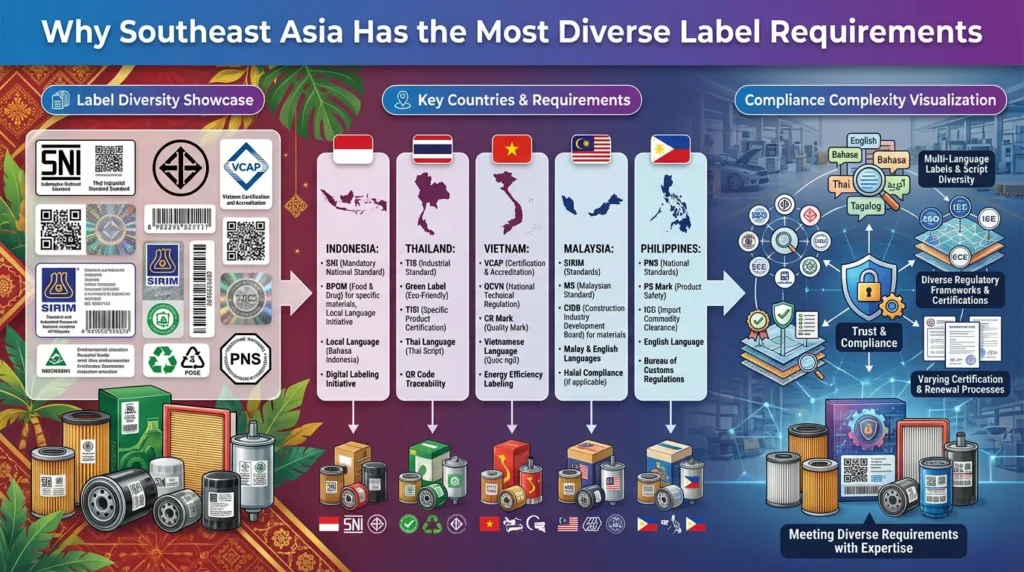
If you sell automotive filters across Southeast Asia, you quickly learn one thing:
You cannot use one label for all countries.
From language rules to “Made in…” placement and local importer information, Southeast Asia is one of the most diverse regions in the world for labeling and packaging requirements.
For brand owners and private label buyers, this has major implications:
- A box that works perfectly in Thailand might cause questions in Indonesia
- Labels accepted in Singapore might not be enough in Vietnam
- Trying to push a single “global” packaging into all SEA markets usually creates hidden costs and delays
This guide explains why Southeast Asia has such diverse label requirements and how we structure labeling for automotive filters in regional programs.
One Region, Many Label Rules in Southeast Asia
1.1 Southeast Asia Is Not One Homogeneous Market
When people say “Southeast Asia,” they often think of it as a single region. In reality, for labeling and packaging, you are dealing with:
- Different languages
- Thai
- Bahasa Indonesia
- Bahasa Malaysia
- Vietnamese
- Khmer
- Tagalog and others
- Different label expectations
- Some markets are relatively flexible
- Others have strict rules on language, origin marking, and importer details
- Different levels of enforcement
- Capital city ports vs. secondary ports
- Airports vs. seaports
- Some authorities check everything; others focus on specific areas
For the same filter, your label setup for Thailand may not work for Indonesia or Vietnam, and your Singapore packaging may look completely different from what you use in Myanmar or Philippines.
1.2 What This Means for Automotive Filter Brands
If you are planning a regional program, you must:
- Accept that “one label for all countries” is rarely realistic
- Build a flexible labeling and packaging system
- Involve local distributors and compliance teams in label design
Our role as manufacturer is to provide a stable base design and countryspecific customization options, so you can adapt without redesigning everything for each market.
Language Rules: Full Local, Partial Local, or English Only?
2.1 Typical Language Patterns Across Southeast Asia
From our experience with automotive filter programs, we see three main patterns:
Countries That Strongly Prefer Local Language
Examples often include:
These markets typically want at least product description and key information in local language, such as:
- Product name / type
- Basic usage or application
- Safety or handling instructions (if applicable)
Local language on the packaging is not only a regulatory expectation, but also:
- Helps mechanics and drivers understand the product
- Supports your brand’s professional image in the market
Countries More Flexible With English
Examples often include:
- Singapore
- In some cases, Philippinesand Malaysia
In these markets:
- English labeling is usually accepted
- Local language is still a plus for retail and workshop communication
- For B2B or pure workshop sales, Englishonly packs may be sufficient
Mixed or Hybrid Expectations
In several markets, a hybrid solution is common:
- English content on the main box design
- Local language and importer details added via labels or stickers
- Sometimes, local authorities accept local stickers as long as they are:
- Correct
- Durable
- Clearly readable
2.2 Our Label Language Strategy for Southeast Asia
Our practical solution:
- Base packaging design in English
- Clear, professional layout
- Internationally understandable technical terms
- Reserve space for countryspecific stickers
- Local language text (product description, key info)
- Regulatory statements if required
- Importer name and contact details
- Provide you and your partners with a clean template
- So local distributors can easily add what the authority requires
- Without covering critical branding or technical information
This gives you:
- A common visual identity across the region
- Enough flexibility to satisfy different language and regulatory expectations
Country of Origin & “Made in” Marking in Southeast Asia
3.1 Why Origin Marking Is Sensitive
Across Southeast Asia, customs officers and some local authorities look carefully at:
- Clear “Made in [Country]”marking
- Whether the origin on the box matches origin on the documents
- The visibilityof the marking:
- Not hidden
- Not printed in an extremely small font
- Preferably in a standard, easytofind location
Origins can influence:
- Duties and taxes
- Local perception of quality
- Applicability of any trade agreements or special measures
3.2 How We Handle Origin for Automotive Filters
We treat origin marking as a core compliance element, not a cosmetic detail.
We:
- Print country of origin clearly on:
- Each unit box
- Outer cartons
- Keep origin identical and consistent on:
- Labels
- Commercial invoices
- Packing lists
- Certificates of Origin
- Any additional certificates or declarations
- Adjust location and style per your local market preference, for example:
- Near the brand logo
- Close to the product description
- On a dedicated text area
3.3 Risk Reduction Through Clear Origin Marking
This approach reduces the risk of:
- Relabeling at destinationbecause origin is unclear or in the wrong place
- Fines or delaysdue to missing or confusing origin markings
- Questions from customs officers when:
- Documents say one origin
- Boxes appear to say something else or nothing at all
For Southeast Asian regional programs, getting origin marking right and consistent is one of the simplest ways to avoid unnecessary friction.
Importer / Distributor Details on the Label
4.1 Why Importer Information Matters
Some Southeast Asian markets require that the local importer or distributor name and address appear on the packaging. Authorities want to know:
- Which local companyis responsible for the product on their market
- Who they can contact in case of:
- Consumer complaints
- Safety or regulatory issues
Even where it is not strictly mandatory, local buyer and retail expectations often push for visible importer or distributor information.
4.2 Common Importer Label Setups
We typically see two practical setups:
- Printed directly into the packaging design
- Best for large, stable volumes
- Suitable when the importer relationship is longterm
- Each country gets its own variant with integrated importer data
- Added via importer sticker
- More flexible if distributors can change over time
- The base design remains generic
- Local importer applies a sticker with:
- Company name
- Address
- Contact information
4.3 How Beling Supports Importer Details
In our packaging design, we usually:
- Keep a “blank zone” on the back or side panel for importer info
- Coordinate with you on label size and layout
- So your local team can apply stickers efficiently
- Without covering critical branding or technical information
- Ensure there is no conflict between brand owner and importer names
- Clear hierarchy of brand vs. “imported by” or “distributed by”
- Avoiding confusion for customs, retailers, and consumers
This makes it easier for your local partners to comply without redesigning packaging from scratch.
Retail vs Wholesale Label Needs in Southeast Asia
5.1 Different Channel Visibility Requirements
Label expectations in Southeast Asia also depend heavily on how filters are sold:
Retail Shelves and Workshop Sales
When filters are visible to endcustomers, fleets or workshop mechanics:
- Brand and application information must be very easy to understand
- Local language content helps:
- Mechanics identify correct parts quickly
- Drivers or fleet managers interpret basic product information
- Marketing messages may be localized:
- Fuel saving claims
- Protection and longevity
- Local warranty messages
Pure Wholesale / B2B Distribution
In more B2Bdriven channels:
- Simpler, more technical packaging can be sufficient
- Main focus is on:
- Clear part number
- Application references
- Country of origin
- Quantity per box
- Packaging may be more standardized across multiple markets
5.2 How We Adapt Labeling to Your Channel Mix
We consider your gotomarket model country by country, and adapt:
- For retaildriven markets:
- More localized and branded boxes
- Stronger focus on visual design and local language content
- For pure wholesale programs:
- More standardized packaging
- Still aligned with basic local rules and origin requirements
This way, you avoid overinvesting in retailstyle boxes for purely wholesale markets, and underserving retail markets with packaging that looks “generic” or incomplete.
Why “One Global Box” Usually Fails in Southeast Asia
6.1 The Attractive but Risky Idea of One Global Packaging
From a cost and design perspective, the idea of one global packaging for all countries can look very attractive:
- One design
- One set of printing plates
- One inventory of cartons
However, in Southeast Asia, this approach usually causes more issues than it solves.
6.2 Typical Problems With One Global Box in SEA
When brands try to force one box into all markets, they often face:
- Customs questioning
- Labels that don’t match local language or origin expectations
- Doubts about compliance when importer information is missing
- Extra work and cost for restickering in each country
- Local partners need to add multiple stickers on top of global design
- Boxes become visually cluttered
- Higher labor cost and risk of error at destination
- Confusion for mechanics and retailers
- If language and application data aren’t clear
- If multiple markets’ information is mixed on the same box
6.3 Our Alternative: Regional Base + CountrySpecific Layers
Our approach for Southeast Asia:
- Use a common regional base design
- Consistent brand identity across all SEA markets
- Shared core visual elements and English technical data
- Add countryspecific label or sticker layers for:
- Local language
- Regulatory text
- Importer details
- Any special requirements (e.g., local standards references, hotline numbers)
- Maintain internal documentation that clearly describes:
- Which label version is used for which country
- Which SKUs go to which destinations with which packaging variant
This gives you:
- Efficiencyin design and production
- Complianceand clarity in each country
- The ability to scale your regional program without losing control of labeling versions
How We Work With Southeast Asia Distributors on Labeling
7.1 Mapping Country Requirements
For Southeast Asia programs, we typically start by:
- Mapping your target countries and their main label needs:
- Language
- Origin marking style
- Importer info requirements
- Retail vs. wholesale emphasis
- Discussing your channel structure:
- Workshop vs. retail vs. pure B2B
- Types of customers (independent workshops, fleets, dealers)
This gives us a clear picture of the label architecture we need.
7.2 Designing Flexible Packaging
Based on that mapping, we:
- Design a regional base packaging:
- English core content
- Stable brand look
- Add flexible zones for:
- Local language stickers
- Importer details
- Regulatory text or icons
- Align “Made in…” wording and model descriptions with:
- Your customs documents
- Certificates of Origin
- Local compliance expectations
We also keep a database of which SKU uses which label version for each country, including:
- Base box style
- Sticker design and content
- Destination mapping
7.3 Result for Local Distributors and Importers
The result is that your local partners can:
- Focus on selling filters and building the brand
- Trust that each shipment is labeled in a way that:
- Customs officers understand
- Workshop mechanics understand
- Local regulations are respected
Instead of fighting with rework, relabeling and inconsistent packaging, they receive readytouse, marketappropriate filters.
Beling – Save Your Time & Cost
Your valuable automotive filter partner since 2008.
Contact Our Team
Bruce Gong – Key Account Manager, Beling Filters
Email: bruce.gong@belingparts.com
WhatsApp: +86 150 5776 4729
LinkedIn: www.linkedin.com/in/brucegong-beling
We’re happy to share how we usually adjust pallets for EU vs Middle East vs Latin America markets, and help you fine tune palletization to your warehouse system.