Many distributors believe most risk is on their side: demand uncertainty, competition, currency, local politics.
In reality, a huge part of the risk sits upstream in the supply chain – at the level of:
- Filter paper and nonwovens
- Steel components
- Plastics and rubbers
- Adhesives and PU
- Packaging materials
One supplier delay, quality issue or local disruption at this level can block your entire private label program.
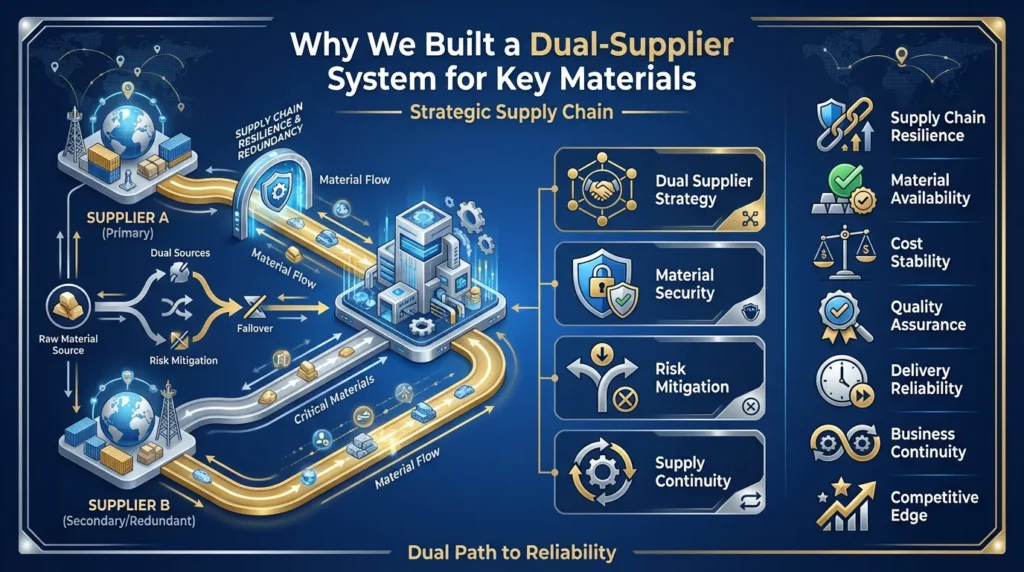
That’s why, at Beling, we deliberately built a dual supplier system for key materials.
Not to “play factories against each other”, but to protect continuity for our distributors and keep programs running even when things upstream get difficult.
The Problem With SingleSource Materials in Automotive Filters
1.1 How Single Sourcing Creates Hidden Risk
When a factory relies on one supplier for a critical component, the risk is quietly transferred to you, the distributor.
A singlesource setup is vulnerable to:
- Capacity limits
- “We’re fully booked this month”
- Prioritization of other customers or industries
- Price shocks
- Raw material costs jump
- Supplier passes increases suddenly, leaving you with no alternative
- Force majeure events
- Energy restrictions
- Port congestion
- Local lockdowns
- Natural disasters
- Quality problems
- Deviations that force stopping production
- Long investigations before release
1.2 What You See as a Distributor
From the outside, you only see the symptoms:
- “Lead time extended.”
- “Shipment delayed.”
- “We cannot supply these references right now.”
- “Raw materials are not available.”
Your brand reputation suffers, but the root cause is upstream fragility.
We decided we didn’t want our customers to carry that risk alone.
Identifying the “NoFail” Materials in Filter Production
2.1 Mapping Components by Criticality
We started by mapping all the components in our automotive filter production and asking a simple question:
“If this material fails or is delayed, can we still ship finished filters?”
For some components, there are temporary workarounds. For others, there are no substitutes without redesign or performance loss.
2.2 Our “NoFail” Material List
The answer was clearly “no” for the following categories:
- Filter media
- Oil filter paper
- Fuel filter media
- Air filter paper and nonwovens
- Cabin filter media (with or without carbon)
- Steel components
- Cans and outer shells
- Center tubes
- End caps, base plates
- Plastics and rubbers
- Plastic end caps
- Gaskets and seals
- Valves and support elements
- Adhesives and PU systems
- Bonding media to end caps
- Sealing elements
- Core packaging materials
- Inner boxes
- Outer boxes
- Master cartons and key inserts
These became our priority list for dual sourcing, because failure in any of them can stop an entire product group.
Qualifying Second Sources – More Than Just Two Names
3.1 Dual Sourcing Is Not Just a Spreadsheet Exercise
A “dual supplier system” does not mean:
- Two names in a spreadsheet
- Buying occasionally from each without full validation
To be real, dual sourcing must allow us to switch between Supplier A and Supplier B without affecting product performance.
3.2 Our Second Source Qualification Process
For each key material, we follow a structured validation process:
Supplier Selection
- Choose a second supplier with compatible technical capabilities
- Evaluate their quality systems and stability
- Sample and Lab Testing
- Test filtration performance (efficiency, dust holding, etc.)
- Check burst resistance and mechanical properties
- Run aging and chemical resistance tests where needed
- Trial Production
- Use the new material in real production lines
- Monitor process behavior (curing, bonding, forming)
- Field Performance Monitoring
- Where relevant, track field behavior in defined pilot markets
- Formal Approval Into BOMs and Standards
- Update our BOMs (Bills of Materials)
- Include the second source in our internal specifications and standard documents
Only after this full validation can we:
- Shift production between Supplier A and Supplier B
- Maintain the same performance and customer experience
Standardizing Specifications So We Can Switch Smoothly
4.1 Why Common Specs Matter
If each supplier has totally different specifications, switching source becomes a new project every time:
- New drawings
- New test plans
- New approvals
That defeats the purpose of dual sourcing.
4.2 BelingLevel Specifications
To avoid this, we:
- Define Belinglevel specifications for key materials
- Not just “whatever Supplier X usually provides”
- Clear requirements on:
- Basis weight
- Permeability
- Burst strength
- Resin content
- Color and appearance (where relevant)
- Align both suppliers to our spec, not the other way around
- Use internal codes that are materialagnostic, for example:
- “Media Type X01” instead of “Brand Y 85 g/m²”
4.3 Benefits of Standardized Specs
This standardization allows us to:
- Move from Supplier A to B under the same product code
- Maintain stable quality, performance and appearance
- Keep documentation and approvals consistent:
- Technical data sheets
- Validation reports
- Customerspecific approvals
For you as a distributor, this means supply flexibility without quality surprises.
Balancing Cost vs Supply Security in Dual Sourcing
5.1 Dual Sourcing Is an Investment
A true dual supplier system:
- Requires more work and engineering time
- Involves more supplier audits, tests and documentation
- Is often not the absolute lowest cost per kilogram or per piece
We made a strategic choice to accept:
- Slightly higher complexity
- Sometimes slightly higher direct material cost
In exchange for much stronger supply security for our partners.
5.2 The Real Cost of SingleSource Failure
For distributors, the cost of a singlesource failure is usually much higher than a small price difference in raw materials:
- Emergency airfreight
- Lost sales in peak season
- Damaged brand credibility with dealers and workshops
- Broken commitments in tenders or fleet contracts
By spreading our sourcing and having validated alternatives, we:
- Reduce that risk significantly
- Provide a more stable and predictable programover time
5.3 Benefits for Distributors
Our dual sourcing strategy gives you:
- Less risk of emergency shipmentscaused by upstream shortages
- Fewer “sorry, raw materials are not available” emails
- More stable pricing and reduced exposure to sudden supplier shocks
How Dual Sourcing Supports Our Stable 40Day Lead Time
6.1 Material Availability as the Base of Lead Time
Our 40 workday lead time (FOB) depends heavily on material availability.
Even the best production planning fails if:
- Filter media doesn’t arrive
- Steel parts are late
- Packaging is stuck at a supplier
6.2 Using Two Qualified Sources to Protect Lead Time
Because we have two qualified suppliers for key materials, we can:
- Switch demandbetween them when one is tight or overloaded
- Maintain safety stock of critical componentsusing both sources
- Negotiate better lead times, because we are not locked into one partner
This flexibility is a major reason why our 40day lead time is stable, not a rough guess that changes every season.
6.3 Connect to Your Forecast and Orders
When distributors share rolling forecasts with us:
- We coordinate raw material plans across both suppliers
- We reserve capacity accordingly
- We ensure that materials are available when your orders enter the system
Dual sourcing plus joint planning gives distributors a much more reliable supply chain from forecast to shipment.
Risk Diversification Across Regions and Geographies
7.1 Avoiding Geographic Concentration
Another dimension of risk is geographical concentration.
If all key suppliers are in one region, you are exposed to:
- Local energy policies
- Regional port congestion
- Countryspecific regulations or lockdowns
- Currency and political issues
7.2 Regional Diversification Strategy
Where it is reasonable and technically feasible, we:
- Spread key sourcing across different regions
- Avoid overdependence on a single country or port
- Balance local strengths (cost, knowhow) with global resilience
7.3 What This Means for Your Market
This way, a regional problem doesn’t automatically become your problem:
- A port issue in one country
- A temporary restriction on one chemical component
- A local political or energy crisis
Because we can pivot to a second source in another region, we can keep your program running while others may face disruptions.
Transparent Change Control When Switching Sources
8.1 Change Without Losing Control
Even with dual sources, we keep strict change control to protect quality and traceability.
Switching a key material source is not something we do casually or silently.
8.2 Our Change Control Practices
When we shift a key material from Supplier A to Supplier B, we:
- Ensure spec equivalence:
- Sometimes even stricter than OEMstyle requirements
- Confirmed through internal tests and, where needed, external labs
- Maintain full internal traceability:
- We know exactly which batches used which supplier
- This is documented in our production and quality records
- For sensitive markets (OElike programs, certified ranges):
- We can coordinate advance notice and documentation
- Provide updated test results or certificates if required
8.3 Benefit for Distributors
You get:
- The benefit of supply securityfrom dual sourcing
- Without unpleasant surprises in:
- Performance
- Appearance
- Documentation and approvals
If needed, we can support you with the information you require for your own quality and compliance processes.
What Our Dual Supplier System Means for Distributors
9.1 More Than a Technical Detail
Our dual supplier system is not just a technical detail of our factory. It directly impacts your:
- Stock availability
- Lead time stability
- Pricing and negotiation power
- Ability to win and maintain customers
When you choose a private label partner, you are not just choosing a factory – you are choosing their supply chain architecture.
9.2 Concrete Benefits for Your Private Label Program
With our dual sourcing approach, you get:
- Lower risk of stockoutscaused by upstream material issues
- More reliable lead timeand delivery commitments
- Better price stabilityand less exposure to sudden supplier shocks
- Stronger resilienceduring:
- Peak seasons
- Market disruptions
- Regional crises
This type of supply chain design is what keeps your program running when things upstream become difficult.
If your current partner often blames “raw material problems” for delays, it may be time to look at how their sourcing model is built.
At Beling, we consciously built a dual supplier system to save your time and cost, and to keep your private label filter program stable over the long term.
Beling – Save Your Time & Cost
Your valuable automotive filter partner since 2008.
Contact Our Team
Bruce Gong – Key Account Manager, Beling Filters
Email: bruce.gong@belingparts.com
WhatsApp: +86 150 5776 4729
LinkedIn: www.linkedin.com/in/brucegong-beling
We’re happy to share how we usually adjust pallets for EU vs Middle East vs Latin America markets, and help you fine tune palletization to your warehouse system.