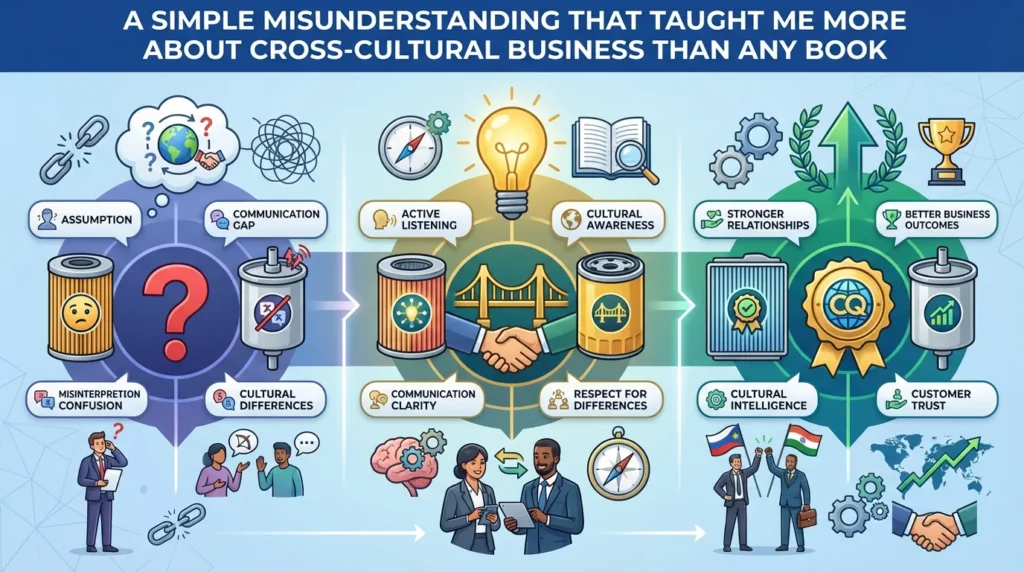
Some lessons you never forget.
Not because they came from a book, course, or seminar – but because one small misunderstanding almost cost you a valuable partnership.
A few years ago, an Italian procurement manager taught me one of the most important lessons in my B2B export career.
Everything was going smoothly…
Our prices were aligned.
Our quality matched his expectations.
Our coverage fit his market.
Then one sentence changed his tone completely.
The Misunderstanding: “We Will Try Our Best”
1.1 A Simple Delivery Question
During one of our calls, the Italian procurement manager asked me a direct question:
“Can you deliver by [a specific date]?”
For us, this was a serious inquiry.
The lead time was tight, but possible with careful planning.
I answered the way many Chinese suppliers politely do:
“We will try our best.”
From my side, this answer meant:
- ✅ We are committed
- ✅ We will put in 100% effort
- ✅ We will organize production to support your schedule
In Chinese business culture, “try our best” is a strong, positive promise.
It means, “We will do everything we can to make this happen.”
1.2 How He Heard It
But for him, as a European procurement manager, it sounded very different.
In his mind, “we will try our best” meant:
- ❌ They are not confident
- ❌ The date is risky
- ❌ This supplier may not be reliable
Suddenly, his tone changed:
- His replies became short and cautious
- He stopped talking about long‑term cooperation
- His questions shifted to risk, backup plans, and exact timing
On my side, I was confused.
I thought I had just expressed dedication.
He heard uncertainty.
A single phrase almost broke a potential partnership.
What I Realized About Cross‑Cultural Communication
2.1 “Try Our Best” in Chinese vs European Business Culture
In many Chinese companies, phrases like:
- “We will try our best.”
- “We will do everything we can.”
- “We will work very hard to support you.”
…are meant to show:
- Respect
- Seriousness
- Strong effort and commitment
But in many European business cultures (including Italy, Germany, the Netherlands, Scandinavia, etc.), the same phrase sounds like:
- ⚠️ Uncertainty
- ⚠️ Lack of commitment
- ⚠️ Avoiding a clear yes or no
What they prefer is explicit clarity:
- ✔ “Yes, we can deliver by Oct 20. Confirmed.”
- ✔ “No, Oct 20 is not realistic. The earliest is Oct 28. If you need goods urgently, we can ship part of the order earlier.”
Direct. Clear. No gray zone.
For them:
- “Yes” means yes.
- “No” means no.
- “We will try” means “Probably not.”
2.2 Being Polite Is Not the Same as Being Precise
That day, I understood something important:
- My intention was to be respectful and positive.
- His need was to receive precise and reliable information.
In international trade:
- Being polite is good.
- Being precise is essential.
Politeness without precision creates confusion.
Precision builds trust.
2.3 Communication Matters More Than Perfect Pricing
We often think buyers will choose suppliers based on:
All of those matter.
But what this experience showed me is that:
Cross‑cultural communication can be more important than a perfect price sheet.
If the buyer:
- Misunderstands your commitment
- Doubts your reliability
- Feels your language is vague
…he will see you as high risk, no matter how competitive your numbers are.
The Turning Point: From Ambiguity to Clarity
3.1 Realising Where Things Went Wrong
After that call, I didn’t just move on.
I took time to think:
- Why did his tone change so suddenly?
- What exact moment triggered the shift?
- What did my words mean to him, not just to me?
The more I reflected, the clearer it became:
- The problem wasn’t our lead time.
- The problem wasn’t our capability.
- The problem was how I expressed our commitment.
My “we will try our best” sounded to him like, “I cannot promise this date.”
3.2 Asking Directly and Learning From the Buyer
Later, I asked him honestly:
“When I said ‘we will try our best’, how did that sound to you?”
He was very open:
- “It sounded like you weren’t sure.”
- “When I plan our promotions and stock, I need a clear message.”
- “I prefer you tell me directly ‘we can’ or ‘we cannot’.”
This simple feedback taught me more than any book on cross‑cultural management.
How I Changed My Communication Style
After that experience, I decided to completely change the way I communicate with overseas buyers, especially in Europe.
4.1 From “We Will Try” to Clear Yes or No
I shifted from:
- “We will try our best.”
- “We will do everything possible.”
- “We should be able to.”
To:
- “Yes, we can ship by Oct 20. Confirmed.”
- “No, Oct 20 is not realistic. The earliest loading date we can commit is Oct 28.”
- “We cannot do 25 days, but we can do 30 days. If this works for you, we will confirm it in the PI.”
That means:
- If we can meet a date → we say yes clearly.
- If we cannot → we clearly say no, and propose a realistic alternative.
No gray zone. No “maybe.” No polite uncertainty.
4.2 Clear Commitments, Timelines, and Expectations
I also made it a habit to communicate with:
- Clear commitments
- “We confirm 30–35 days production time after deposit and artwork approval.”
- Clear timelines
- “We will share packing photos and loading plan by Day 25.”
- Clear expectations
- “To keep this lead time, we need your label confirmation within 48 hours.”
- Clear risks
- “Before the national holiday, we must book space at least two weeks in advance. Otherwise, there is a real risk of vessel delay.”
4.3 The Result: Fewer Follow‑Ups, Fewer Misunderstandings
Once I changed to this style, I noticed:
- Fewer emails like “Please confirm again the delivery date?”
- Fewer misunderstandings about timing and responsibilities
- Fewer unnecessary back‑and‑forth discussions
And most importantly:
Much stronger trust with European and other Western buyers.
Today, many European partners tell me:
“Bruce, what we value most is your clarity.”
Not just price.
Not just speed.
But clarity — because clarity reduces risk.
Why Clarity is a Competitive Advantage in International Trade
5.1 In International Trade, There Are Only Two Types of Communication
I eventually simplified this into one rule:
In international trade, there are only two types of communication:
1️⃣ Clear
2️⃣ Risky
Anything that is not clear — is risky.
Risky for:
- The buyer’s planning
- The supplier’s reputation
- The long‑term relationship
Ambiguous phrases like:
- “We will try.”
- “Should be okay.”
- “No big problem.”
- “Maybe possible.”
…may feel comfortable in some cultures, but in cross‑border B2B, they are dangerous.
5.2 Buyers Use Clarity to Measure Reliability
For professional buyers, especially in Europe:
- Clear answers signal seriousness and control.
- Precise dates signal process and planning.
- Clear “yes” or “no” signals maturity and responsibility.
They are not just buying filters, auto parts, or industrial goods.
They are buying:
- Predictability
- Risk reduction
- Long‑term reliability
Clarity is not just “good communication.”
It is part of your value proposition as a supplier.
Practical Tips for Suppliers: How to Communicate Clearly With European Buyers
If you are a Chinese (or Asian) exporter working with European customers, here are practical ways to avoid the “we will try our best” trap.
6.1 Replace Vague Phrases With Concrete Alternatives
Instead of saying:
- “We will try our best.”
- “Should be no problem.”
- “We will do our best to control.”
Say:
- “Yes, we can ship by [date]. Confirmed.”
- “No, [date] is too tight. The earliest we can commit is [new date].”
- “We can commit to [range] days production after deposit.”
If you are not sure yet, be transparent:
- “At this moment, I need 24 hours to check materials and capacity. I will confirm a realistic date for you tomorrow.”
6.2 Use Numbers, Not Just Adjectives
Avoid:
- “Fast lead time.”
- “Very stable quality.”
- “Strong packaging.”
Use specifics:
- “Regular production time: 30–35 days after deposit and artwork approval.”
- “Our complaint ratio last year was under 0.3% across all export markets.”
- “We use 5‑layer export cartons, 230–250 gsm, with drop tests performed on new designs.”
Numbers build confidence. Vague words create doubt.
6.3 Confirm Agreements in Writing
After calls or video meetings:
- Send a short written summary
- Include key points: prices, lead times, payment terms, responsibilities, next steps
- Ask them to confirm everything is understood correctly
This reduces the risk of:
- Different interpretations
- Memory mistakes
- Internal miscommunication on their side
Practical Tips for Buyers: How to Get Clear Commitments From Suppliers
If you are an importer, distributor, or procurement manager, you can also help avoid misunderstandings.
7.1 Ask for Clear Yes/No and Dates
If a supplier says:
Ask directly:
- “Can you commit to shipping by Oct 20, yes or no?”
If they say:
- “Lead time is about one month.”
Clarify:
- “Is that 30 days or 45 days? Please confirm a realistic range you can stand behind.”
7.2 Share Why Clarity Matters to You
Sometimes suppliers don’t realize how their words affect your planning.
Explain:
- “We have to plan promotions and warehouse capacity.”
- “If shipment is late, we lose sales or face penalties.”
- “I prefer you say ‘no’ to an unrealistic date than say ‘we will try’ and later delay.”
Good suppliers will appreciate this transparency and adapt their communication.
Why This Lesson Matters More Than Any Book
That one Italian procurement manager taught me more about real‑world cross‑cultural business than many books on “international etiquette.”
Because:
- It was practical, not theoretical.
- It affected real orders, real risk, real trust.
- It changed how I speak, write, and negotiate every day.
Since then, we have applied the same principle with buyers in:
- Italy, Spain, Portugal
- Germany, Poland, Czech Republic
- France, the Netherlands, Scandinavia
- And beyond Europe — also in the Middle East, Latin America, and Africa
Different cultures, different styles.
But one universal truth:
Clarity reduces risk.
Reduced risk builds trust.
Trust builds long‑term business.
Beling – Save Your Time & Cost
At Beling, we don’t only focus on:
- Competitive prices
- Reliable filter quality
- Stable lead times
We focus on clear communication:
- Clear “yes” or “no”
- Clear delivery commitments
- Clear documentation and packaging expectations
- Clear feedback when something changes
Because our goal is not just to ship products.
Our goal is to help you plan, reduce risk, and grow your business with confidence.
If you also value clarity in your supply chain, we are happy to:
- Share more insights
- Review your requirements
- Explore long‑term cooperation
📩 bruce.gong@belingparts.com
🌐 www.belingparts.com
Your valuable automotive filter partner since 2008.